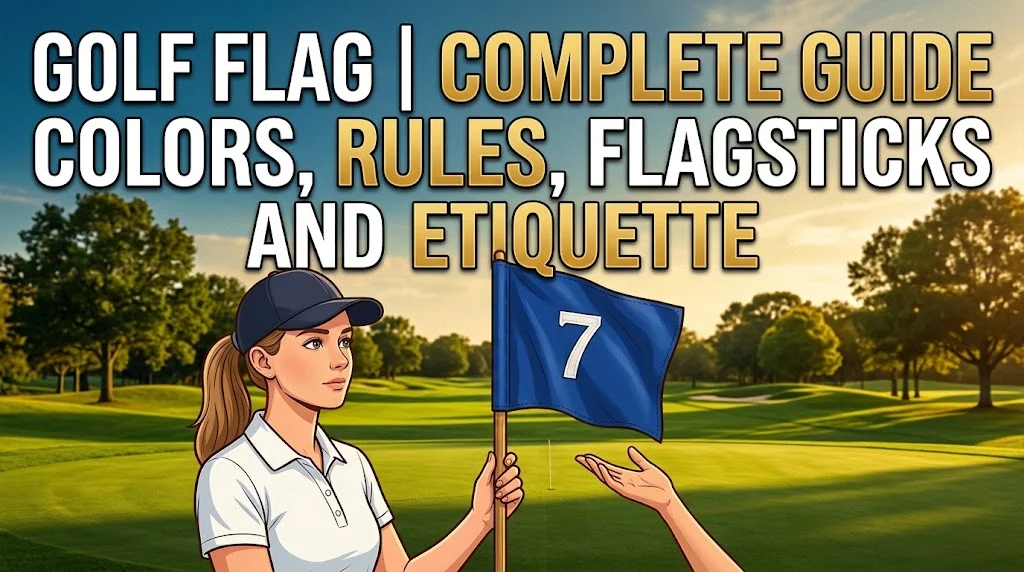
A golf flag may look like a small detail on a golf course, but it plays an important role in the game. From helping golfers locate the hole from a distance to providing a clear target on the green, the golf flag is one of the most recognizable features of golf.
But what do the different golf flag colors mean? Can you putt with the flagstick in the hole? How tall is a golf flagstick? And are there official rules about the size, shape, and placement of a golf flag?
Whether you’re a beginner learning golf terminology or an experienced golfer looking to understand the rules better, this complete guide explains everything you need to know about golf flags and flagsticks.
What Is a Golf Flag?
A golf flag is a colored or marked piece of fabric attached to the top of a flagstick positioned inside a golf hole. It helps golfers identify the location of the hole from across the fairway or green.
The flag is usually attached to a thin pole called the flagstick. The flagstick stands vertically in the hole and acts as a visual target.
In simple terms:
Golf flag = the visible fabric marker.
Flagstick = the pole holding the flag.
Hole = the target on the putting green.
Together, they make it easier for golfers to locate and approach the hole.
Why Is a Golf Flag Important?
A golf course can cover hundreds of acres, and many holes contain hills, trees, bunkers, and other obstacles. Without a visible marker, finding the exact location of the hole could be difficult.
A golf flag serves several purposes:
- Helps golfers locate the hole
- Provides a visible target for approach shots
- Helps players judge distance and direction
- Identifies the hole location on the putting green
- Makes the course easier to navigate
- Supports efficient play and course management
For beginners especially, spotting the golf flag is often the first step toward understanding where the next shot should go.
What Is a Golf Flagstick?
The flagstick is the pole inserted into the hole on the putting green. The flag is attached near its upper section.
Modern flagsticks are commonly made from lightweight materials such as fiberglass, although other materials can also be used.
A flagstick generally consists of:
- A pole
- A flag or banner
- A ferrule or attachment system
- A lower section that fits into the golf hole
The flagstick provides stability while allowing the flag to remain visible from a distance.
Golf Flag vs. Flagstick What’s the Difference?
These terms are often used interchangeably, but they technically describe different things.
| Feature | Golf Flag | Flagstick |
|---|---|---|
| What it is | Fabric marker | Vertical pole |
| Main purpose | Visibility | Supports the flag |
| Location | At the top of the pole | Inside the hole |
| Material | Fabric or synthetic textile | Fiberglass, metal, or similar material |
| Visibility | Highly visible | Visible but thinner |
So, when someone says “the golf flag,” they may be referring to the entire setup, but technically the flag and flagstick are separate components.
What Do Golf Flag Colors Mean?
One of the most common questions beginners ask is whether golf flag colors have a universal meaning.
The answer is no not necessarily.
Golf courses can use different flag colors to communicate information such as hole location, pin position, or other course-specific details. However, there is no universal rule requiring every golf course to use the same color system.
A common system is:
- Red: Front hole location
- White: Middle hole location
- Blue: Back hole location
But this is only a common convention, not a universal standard.
Some courses may use completely different colors or use different combinations to indicate specific information. Always check the course’s local rules or scorecard if you’re unsure.
What Does a Red Golf Flag Mean?
At many courses, a red flag indicates that the hole is positioned toward the front portion of the green.
For an approach shot, knowing that the pin is toward the front can affect club selection. A golfer may choose a different club or target area compared with a back pin position.
However, because color systems vary, don’t assume red always means front at every course.
What Does a Blue Golf Flag Mean?
At courses that use the common three-color system, blue may indicate a back pin position.
A back pin generally means the hole is located toward the rear portion of the putting green.
Again, local course rules take priority.
What Does a White Golf Flag Mean?
White is often used to indicate a middle pin position.
If the flag is white, golfers may assume the hole is located around the central portion of the green but this should only be treated as a convention rather than a universal rule.
Can You Leave the Golf Flagstick in While Putting?
Yes.
Under the modern Rules of Golf, a player can generally make a stroke with the flagstick left in the hole.
This is an important change for golfers who remember the older rule requiring the flagstick to be attended or removed in certain putting situations.
Leaving the flagstick in can be useful for golfers who want a visible target, particularly on long putts.
However, players should still follow the applicable Rules of Golf and local course procedures.
Should You Leave the Flagstick in When Putting?
There is no single answer for every golfer.
Some players prefer the flagstick because it provides a clear visual target. Others prefer putting to an open cup because they feel more comfortable seeing the hole without the pole.
Your decision can depend on:
- Distance of the putt
- Wind conditions
- Slope of the green
- Personal preference
- Playing conditions
For long putts, the flagstick can provide a useful reference point.
For short putts, some golfers prefer removing it because they like a completely unobstructed view of the hole.
Golf Flagstick Rules You Should Know
The Rules of Golf govern how flagsticks are used during play. Modern rules provide more flexibility than many recreational golfers realize.
Important points include:
The Flagstick Can Remain in the Hole
A player may generally make a stroke with the flagstick in the hole.
The Flagstick Can Be Attended
Another player can hold or attend the flagstick when permitted under the rules.
The Flagstick Can Be Removed
A golfer may also remove the flagstick when appropriate.
Players Must Follow the Rules Regarding the Ball and Flagstick
Certain situations involving a ball striking a flagstick can have specific consequences, so golfers should understand the current Rules of Golf rather than relying on older traditions.
For competitive play, always consult the current official rules and any applicable local rules.
How Tall Is a Golf Flagstick?
A flagstick is typically around 7 feet tall, although exact dimensions and construction can vary depending on the course and equipment.
The height is designed to make the hole visible from a reasonable distance while maintaining a practical size for the green.
The flag itself does not need to be enormous. Its movement and contrasting color make it visible against the surrounding landscape.
What Are Golf Flags Made Of?
Golf flags are commonly made from lightweight, weather-resistant fabric.
Common materials can include:
- Polyester
- Nylon
- Synthetic blends
The material needs to withstand outdoor conditions such as:
- Wind
- Rain
- Sunlight
- Humidity
- Frequent handling
High-quality golf flags are often designed to maintain their color and shape despite repeated outdoor exposure.
Why Do Golf Flags Have Different Designs?
Golf clubs often customize flags with their own colors, logos, symbols, or numbers.
A golf flag may display:
- Club branding
- Tournament branding
- Hole numbers
- Country or regional symbols
- Corporate sponsorship
- Special event designs
This makes golf flags useful not only as course markers but also as branding tools.
Golf Flag Numbers: What Do They Mean?
Some golf flags include a number corresponding to the hole.
For example, a flag displaying 7 may indicate that golfers are playing the seventh hole.
This can be especially useful on courses where several greens are visible from one location.
Hole numbers help prevent confusion and make course navigation easier.
Golf Flag Placement and Hole Location
The position of the flag on the green can dramatically change how a hole plays.
A pin placed near the front of the green may encourage an aggressive approach, while a back pin may require more distance.
Course designers and greenkeepers can change hole locations to:
- Adjust difficulty
- Create strategic challenges
- Protect certain areas of the green
- Change tournament conditions
- Provide variety for regular players
This is why the same golf hole can feel completely different from one round to another.
What Is a Pin Sheet?
A pin sheet provides information about hole locations on the greens.
It can help golfers determine where the flag is positioned rather than simply knowing that the hole exists somewhere on the green.
Pin sheets are particularly useful during:
- Tournaments
- Competitive rounds
- Club events
- Practice rounds
- Courses with large or undulating greens
Knowing the exact pin location can improve club selection and strategy.
Golf Flag Etiquette
Golf etiquette is about more than simply hitting good shots. Players should also respect the course and other golfers.
When handling a golf flag:
Be Careful With the Green
Avoid dragging or dropping the flagstick onto the putting surface.
Replace the Flag Properly
After completing a hole, return the flagstick to the hole according to the course’s normal procedure.
Avoid Unnecessary Delays
If your group is playing efficiently, handle the flag quickly and safely.
Respect Other Players
Don’t stand in another player’s line or distract them while they are preparing to putt.
Follow Local Rules
Some courses may have specific procedures for flagsticks, carts, practice areas, or tournament play.
Golf Flagstick in the Hole: Does It Help Your Putt?
The effect of a flagstick on putting performance is a subject golfers often debate.
Some players like having the stick in because it provides a larger visual target. Others prefer the clean appearance of the hole without it.
Rather than assuming one method is always better, golfers should consider what helps them consistently judge:
- Speed
- Line
- Distance
- Break
- Target
Confidence can be just as important as equipment when putting.
How to Choose a Golf Flag for a Home Practice Green
If you’re building a backyard putting green, choosing the right golf flag can make the setup feel more realistic.
Look for:
- Durable fabric
- UV resistance
- Weather-resistant construction
- Strong stitching
- Appropriate flagstick length
- Stable base or cup compatibility
- Easy installation
For practice, a bright, highly visible flag is usually preferable because it makes the target easy to identify.
Golf Flags for Tournaments and Events
Golf flags are also an important part of tournament presentation.
Tournament organizers may create custom flags featuring:
- Event names
- Sponsor logos
- Tournament dates
- Club branding
- Special graphics
A professional tournament flag can improve the visual appearance of the course while creating a memorable keepsake for participants.
Can You Buy Custom Golf Flags?
Yes. Custom golf flags are widely available for golf clubs, events, practice greens, and personal use.
When ordering custom flags, consider:
- Flag dimensions
- Fabric quality
- Printing method
- Color durability
- Flagstick compatibility
- Hole-number requirements
- Outdoor weather resistance
For a golf club, matching the flag design to the club’s branding can create a more professional appearance.
Golf Flag Maintenance Tips
Even a high-quality golf flag eventually needs maintenance.
To keep golf flags looking their best:
- Store spare flags in a dry place
- Avoid folding them while wet
- Clean dirt gently
- Inspect stitching regularly
- Replace badly faded flags
- Check the flagstick for damage
- Keep attachment points secure
Regular maintenance is especially important for courses exposed to strong sunlight and frequent wind.
Why Golfers Should Pay Attention to the Flag
The flag isn’t just decoration.
It can provide valuable information before a golfer hits an approach shot.
Before choosing a club, consider:
Where is the flag?
Front, middle, or back?
Where is the safest landing area?
You don’t always need to attack the flag.
What hazards surround it?
Bunkers, water, slopes, and rough can influence your decision.
How firm is the green?
A ball may release differently depending on course conditions.
Good golfers don’t simply aim at the flag they use the flag location as part of a larger strategy.
Golf Flag Strategy for Beginners
If you’re new to golf, don’t worry about making every shot directly at the flag.
Instead, focus on getting the ball onto a safe part of the green.
For example, if the flag is positioned close to a bunker, aiming toward the center of the green may be smarter than attacking the pin.
A simple beginner strategy is:
See the flag → identify hazards → choose a safe target → select your club → make the shot.
This approach can help reduce unnecessary mistakes and improve scoring.
Frequently Asked Questions
What is a golf flag called?
The fabric marker is commonly called the flag, while the pole holding it is called the flagstick.
What do golf flag colors mean?
Flag colors can indicate hole locations, but there is no universal color system used by every golf course. Always check local course instructions.
Can you leave the flagstick in while putting?
Yes. Under the modern Rules of Golf, a player can generally putt with the flagstick left in the hole.
How tall is a golf flagstick?
A golf flagstick is commonly around 7 feet tall, although exact dimensions can vary.
What is a golf flag made of?
Golf flags are generally made from lightweight, weather-resistant materials such as polyester or nylon.
Does every golf course use the same flag colors?
No. Golf courses can use different color systems, so golfers should check the course’s local conventions.
Why are golf flags different colors?
Different colors can help communicate hole or pin positions, improve visibility, or identify a club or tournament.
Can you buy golf flags for a backyard putting green?
Yes. Golf flags and flagsticks are available for home practice greens in different sizes and designs.
What is a pin sheet?
A pin sheet provides information about the location of the hole on the putting green.
Can golf flags have logos?
Yes. Clubs, tournaments, and organizations often use custom golf flags featuring logos or event branding.
Should I remove the flagstick when putting?
It’s largely a matter of preference and circumstances. Golfers can generally putt with the flagstick in or have it removed under the current rules.
Why is the flag important in golf?
It helps golfers locate the hole, provides a visual target, and can communicate information about the hole location.
Final Thoughts
The golf flag may be one of the smallest features on a golf course, but it has a big role in the game. It helps golfers locate the hole, understand the target, plan approach shots, and navigate the course more confidently.
Understanding the difference between a golf flag and a flagstick, knowing that color meanings can vary by course, and learning the modern rules surrounding the flagstick can make your next round easier and more enjoyable.
Most importantly, don’t think of the flag as simply something to aim at. Use it as information. Look at its position, consider the hazards, judge the green, and choose the smartest target.

Theo Bennett is a passionate sports writer and storyteller at SportNestify.com covering cricket, football, hockey, tennis, basketball and more. With a focus on clear insights, engaging analysis, player stories, and the latest sporting trends, Leo turns every game into a story worth following. His goal is simple