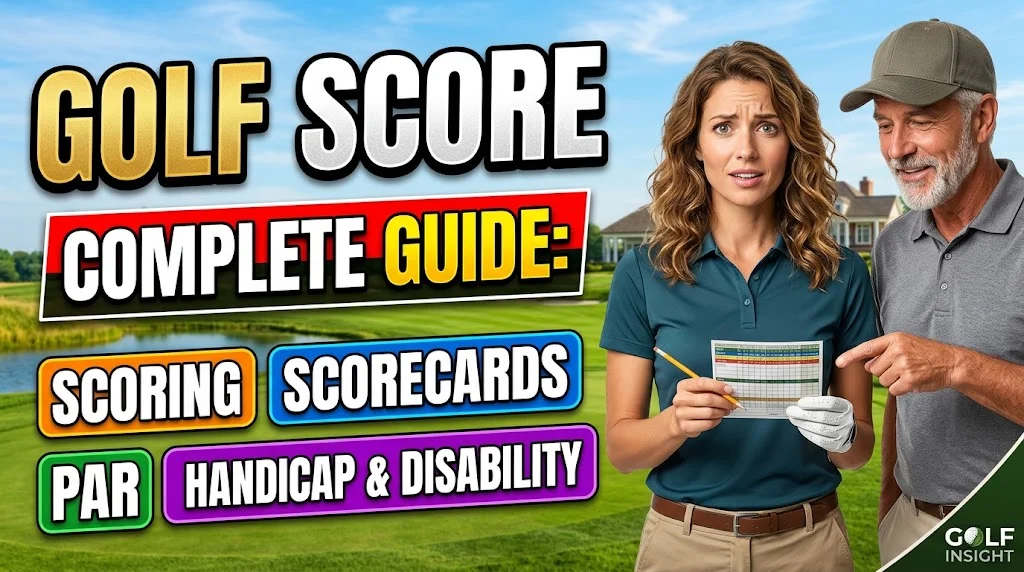
A golf score is the number of strokes a player takes to complete a hole, a round, or a competition. Unlike many sports where scoring more points is usually better, golf rewards the lowest score. The player who completes the course in the fewest strokes generally wins.
But understanding a golf score involves more than simply counting swings. Terms such as par, birdie, eagle, bogey, double bogey, disability, gross score, and net score all play an important role.
Whether you are completely new to golf or want to understand a golf scorecard more easily, this guide explains everything in simple terms.
What Is a Golf Score?
A golf score is the total number of strokes a golfer uses to complete a hole or an entire round.
For example, if you complete a par-4 hole in four strokes, your score is 4, which is called par.
If you complete the same hole in three strokes, you are one under par, known as a birdie.
If you need five strokes, you are one over par, called a bogey.
Simple Golf Scoring Example
| Strokes on a Par-4 Hole | Golf Score |
|---|---|
| 2 | Albatross / 2 under par |
| 3 | Birdie |
| 4 | Par |
| 5 | Bogey |
| 6 | Double bogey |
| 7 | Triple bogey |
The basic rule is simple:
The fewer strokes you need, the better your golf score.
How Does Golf Scoring Work?
A standard 18-hole golf course typically has a total par around 72, although course par can vary.
Each hole has its own par, most commonly:
- Par 3
- Par 4
- Par 5
Par represents the expected number of strokes a skilled golfer would need to complete the hole under normal playing conditions.
For example:
- Par 3 completed in 3 strokes = Par
- Par 4 completed in 3 strokes = Birdie
- Par 5 completed in 4 strokes = Birdie
- Par 4 completed in 5 strokes = Bogey
At the end of the round, the golfer adds the scores from all holes.
Example
Suppose a golfer shoots:
4 + 4 + 5 + 3 + 4 + 4 + 5 + 3 + 4 = 36
for the front nine.
If the back nine is also 36, the golfer finishes with:
72 strokes
If the course is par 72, the golfer’s final score is even par.
What Is Par in Golf?
Par is the expected number of strokes assigned to a golf hole or course.
A par-3 hole is expected to require three strokes, while a par-4 hole is expected to require four.
For an entire course, the individual hole pars are added together to determine the course par.
For example:
Front nine = 36
Back nine = 36
Total course par = 72
Par provides a reference point that makes golf scores easier to understand.
Instead of saying only that someone shot 70, you can say they shot 70 on a par-72 course, meaning they finished 2 under par.
Golf Score Terms You Should Know
Golf has its own scoring vocabulary. Learning these terms makes scorecards and tournament results much easier to understand.
Ace
An ace, commonly called a hole-in-one, happens when a golfer gets the ball into the hole with the first shot.
It is most commonly associated with par-3 holes, although a hole-in-one can theoretically occur on other holes.
Eagle
An eagle means finishing a hole two strokes under par.
Examples:
- Par 3 in 1 stroke = Eagle
- Par 4 in 2 strokes = Eagle
- Par 5 in 3 strokes = Eagle
Birdie
A birdie means finishing a hole one stroke under par.
Examples:
- Par 3 in 2 strokes = Birdie
- Par 4 in 3 strokes = Birdie
- Par 5 in 4 strokes = Birdie
Par
A golfer scores par when they complete the hole in exactly the number of strokes assigned to it.
Example:
Par 4 + 4 strokes = Par
Bogey
A bogey means finishing a hole one stroke over par.
Example:
Par 4 + 5 strokes = Bogey
Double Bogey
A double bogey is two strokes over par.
Example:
Par 4 + 6 strokes = Double bogey
Triple Bogey
A triple bogey is three strokes over par.
Example:
Par 4 + 7 strokes = Triple bogey
Golf Scoring Cheat Sheet
| Score Relative to Par | Term |
|---|---|
| 4 under | Condor* |
| 3 under | Albatross |
| 2 under | Eagle |
| 1 under | Birdie |
| Even | Par |
| 1 over | Bogey |
| 2 over | Double bogey |
| 3 over | Triple bogey |
*Condor is extremely rare and is generally associated with four strokes under par.
What Is a Golf Scorecard?
A golf scorecard is used to record a player’s score for each hole.
A typical scorecard contains information such as:
- Hole number
- Par
- Yardage
- disability/stroke index
- Player score
- Front-nine total
- Back-nine total
- Final score
For an 18-hole round, golfers normally record their score after completing each hole.
Example Golf Scorecard
| Hole | Par | Player Score |
|---|---|---|
| 1 | 4 | 4 |
| 2 | 4 | 5 |
| 3 | 3 | 3 |
| 4 | 5 | 4 |
| 5 | 4 | 4 |
| 6 | 4 | 5 |
| 7 | 3 | 3 |
| 8 | 4 | 4 |
| 9 | 5 | 5 |
| Front 9 | 36 | 37 |
This player shot 37 on a par-36 front nine, meaning they were 1 over par.
Gross Score vs. Net Score
One of the most important concepts in golf is the difference between gross score and net score.
Gross Score
Your gross score is the actual number of strokes you took.
For example:
18-hole score = 90
Your gross score is 90.
Net Score
A net score takes your disability into account.
For example, if a golfer shoots 90 and receives a disability allowance of 18 strokes:
90 − 18 = 72
The player’s net score would be 72 under that simplified example.
This allows golfers with different skill levels to compete using disability-adjusted scoring.
What Is a Golf disability?
A golf disability is a numerical measure designed to represent a golfer’s playing ability and help players of different skill levels compete more fairly.
The modern disability system used in many countries is based on the World disability System (WHS).
A lower disability generally represents a more skilled golfer.
A golfer with a disability of 5, for example, typically plays at a considerably stronger level than someone with a disability of 25.
However, disability is not simply the average number of strokes a golfer shoots over par. It is calculated using a standardized system that considers scoring history and course difficulty.
What Is a Good Golf Score?
There is no single score that qualifies as “good” for every golfer.
A good golf score depends on factors such as:
- Skill level
- Course difficulty
- Course length
- Weather
- Course conditions
- disability
- Competition format
- Playing experience
For a beginner, breaking 100 can be an exciting milestone. Another golfer may consider breaking 90, 80, or 70 a significant achievement.
For experienced golfers, shooting around course par is a major benchmark.
The important thing is to compare your score with an appropriate reference point rather than assuming one number is good for everyone.
What Does 72 Mean in Golf?
If a golf course has a par of 72 and a golfer shoots 72, the golfer has finished even par.
A score of:
- 70 = 2 under par
- 71 = 1 under par
- 72 = Even par
- 73 = 1 over par
- 74 = 2 over par
- 75 = 3 over par
This is one of the easiest ways to understand final golf scores.
How to Calculate Your Golf Score
Calculating a golf score is straightforward.
Record Every Hole
Write down the number of strokes used on each hole.
Enter the Front Nine
Add your scores for holes 1 through 9.
Enter the Back Nine
Add your scores for holes 10 through 18.
Calculate the Total
Add both nine-hole totals.
For example:
Front nine: 43
Back nine: 45
Total = 88
If the course is par 72:
88 − 72 = 16
The golfer finished 16 over par.
How Golfers Track Their Score During a Round
Golfers usually record scores immediately after completing each hole.
A simple system is:
Hole → Par → Strokes → Score relative to par
For example:
| Hole | Par | Strokes | Result |
|---|---|---|---|
| 1 | 4 | 4 | Par |
| 2 | 5 | 4 | Birdie |
| 3 | 3 | 4 | Bogey |
| 4 | 4 | 3 | Birdie |
| 5 | 4 | 5 | Bogey |
This makes it easier to identify where strokes are being gained or lost.
Why Your Golf Score Matters
A score is more than just a number.
Tracking scores over time can help golfers identify patterns in their game.
For example, a player may discover that they:
- Make too many three-putts
- Struggle on par-3 holes
- Lose strokes through penalties
- Miss too many short putts
- Perform well off the tee but struggle around the green
Modern golfers can also track statistics such as:
- Fairways hit
- Greens in regulation
- Putts per round
- Scrambling
- Driving distance
- Penalty strokes
These statistics can reveal areas that a simple final score cannot.
What Is a Golf Score for 9 Holes?
A nine-hole round usually has a par between approximately 27 and 36, depending on the course.
For example, if a nine-hole course has a par of 36 and you shoot 42:
42 − 36 = 6 over par
Your score is therefore 42, or 6 over par.
Nine-hole rounds are popular with beginners, casual golfers, juniors, and players who do not have time for a full 18-hole round.
Golf Score in Match Play vs. Stroke Play
Golf can be played using different scoring formats.
Stroke Play
In stroke play, golfers count every stroke over the entire round or competition.
The player with the lowest total score wins.
For example:
- Player A: 72
- Player B: 74
- Player C: 76
Player A has the lowest score.
Match Play
In match play, players compete hole by hole.
The player who wins more holes wins the match.
For example, if you win holes 1, 4, 7, and 12 while your opponent wins three holes, the match result is based on the holes won rather than simply adding all strokes across the round.
What Is a Score Under Par?
A score under par means a golfer completed the course using fewer strokes than the course’s total par.
For example, on a par-72 course:
68 = 4 under par
72 = even par
76 = 4 over par
This is why tournament leaderboards often show numbers such as -8, -12, or +3.
The number represents the player’s score relative to par.
What Does +1 or -5 Mean in Golf?
Golf leaderboards frequently use plus and minus numbers.
-5
The golfer is 5 under par.
+1
The golfer is 1 over par.
E
“E” means even par.
For example, on a par-72 course:
| Total Score | Relative Score |
|---|---|
| 67 | -5 |
| 68 | -4 |
| 69 | -3 |
| 70 | -2 |
| 71 | -1 |
| 72 | E |
| 73 | +1 |
| 74 | +2 |
This format makes tournament standings much easier to read.
Tips for Improving Your Golf Score
If you want to lower your score, hitting the ball farther is not the only answer.
Reduce Penalty Strokes
Avoiding unnecessary penalties can save several strokes during a round.
Improve Your Short Game
Chipping and putting account for a large part of many golfers’ scores.
Practice Distance Control
Knowing how far you hit each club can help you make better decisions.
Avoid Risky Shots
Trying a low-percentage shot can turn one bad shot into a much bigger number.
Track Your Statistics
Look beyond your final score and identify where you are losing strokes.
Practice Putting
Three-putts can quickly increase your score. Better speed and distance control can make a significant difference.
Play Smart
Golf rewards consistency and course management. Choosing a sensible target can sometimes be more valuable than attempting the most aggressive shot.
Frequently Asked Questions
What is the average golf score?
There is no universal average because golfers range from beginners to professionals. Recreational golfers commonly shoot considerably higher than professional golfers, while elite players frequently score close to or below par on tournament courses.
Is 100 a good golf score?
For many beginners and recreational golfers, breaking 100 is an important milestone. Whether 100 is “good” depends on the player’s experience, disability, and the difficulty of the course.
Is 90 a good golf score?
A score of 90 can be a strong recreational result, particularly for developing golfers. On a par-72 course, it is 18 over par.
Is 80 a good golf score?
For many amateur golfers, shooting 80 is a significant achievement. On a par-72 course, an 80 represents 8 over par.
What is a birdie in golf?
A birdie is a score of one stroke under par on a hole.
What is an eagle in golf?
An eagle is a score of two strokes under par on a hole.
What is a bogey?
A bogey is one stroke over par on a hole.
What is a double bogey?
A double bogey is two strokes over par.
What is an even-par score?
Even par means the golfer used exactly the number of strokes represented by the course’s total par.
What is the lowest possible golf score?
There is no simple universal lowest score for an 18-hole round because theoretical scoring depends on the course layout and par. Scores far below par are extremely rare in actual competitive golf.
How do you calculate score relative to par?
Subtract the course par from the golfer’s total strokes.
Score − Par = Score relative to par
For example:
75 − 72 = +3
So the golfer is three over par.
What does 3 under par mean?
Three under par means the golfer completed the relevant holes or round using three fewer strokes than par.
On a par-72 course:
72 − 3 = 69
Therefore, 69 is three under par.
Does a lower golf score mean you played better?
In standard stroke play, a lower score generally means fewer strokes were required. However, comparing scores fairly requires considering course difficulty, playing conditions, disability, and competition format.
Final Thoughts
A golf score may look like a simple number, but it tells a much bigger story.
Once you understand par, birdies, eagles, bogeys, gross score, net score, disability, and scorecards, reading golf results becomes much easier.
The key formula is simple:
Golf Score − Course Par = Score Relative to Par
So if you shoot 84 on a par-72 course, you are 12 over par. If you shoot 69, you are 3 under par.
For beginners, the best approach is not to obsess over one perfect number. Record every round, understand where your strokes are going, and use your scores to measure progress.
In golf, every stroke counts and understanding your score is the first step toward improving it.
Suggested SEO title: Golf Score Explained: How Golf Scoring, Par, Birdies, Bogeys & disability Work
Meta description: Learn how golf scores work, including par, birdie, eagle, bogey, scorecards, disability, gross vs. net score, and how to calculate your score relative to par.

Theo Bennett is a passionate sports writer and storyteller at SportNestify.com covering cricket, football, hockey, tennis, basketball and more. With a focus on clear insights, engaging analysis, player stories, and the latest sporting trends, Leo turns every game into a story worth following. His goal is simple