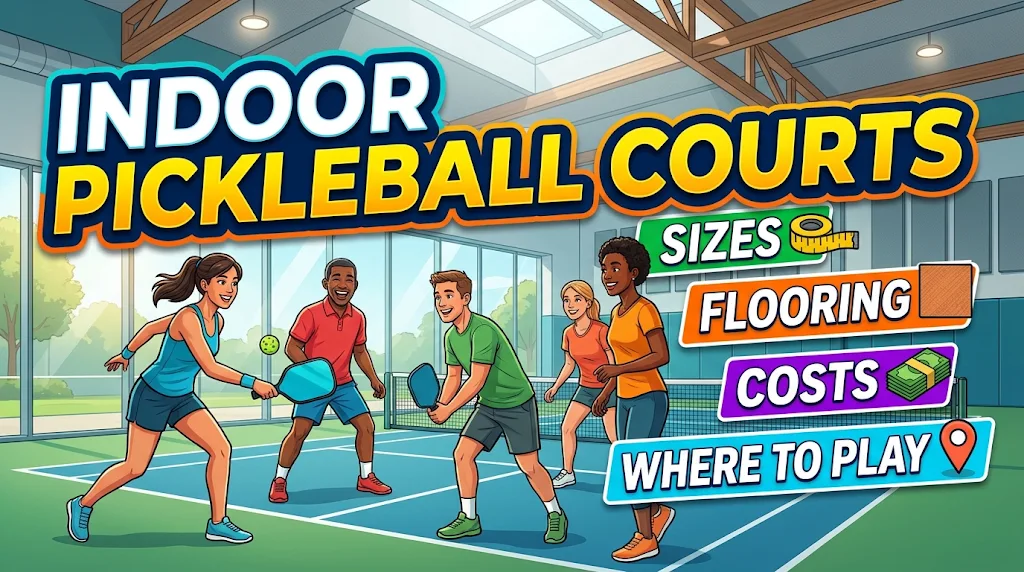
Pickleball is growing fast, and it’s easy to see why. It combines the fun of tennis, badminton, and table tennis into one exciting game that people of almost every age can enjoy. But what happens when it’s raining, too hot outside, or simply too windy to play? That’s where indoor pickleball courts make all the difference.
Indoor courts give players a comfortable, controlled environment to enjoy the game throughout the year. Whether you’re a beginner picking up a paddle for the first time, a regular player looking for a reliable place to practice, or someone planning to build a pickleball facility, understanding indoor courts can help you make better decisions.
From court dimensions and flooring to lighting, equipment, costs, and booking tips, here’s everything you need to know about indoor pickleball courts.
What Are Indoor Pickleball Courts?
Indoor pickleball courts are specially marked playing areas located inside gyms, sports centers, recreation facilities, schools, and dedicated pickleball clubs. They follow the same basic playing dimensions and rules as outdoor courts but provide protection from weather and outdoor conditions.
Unlike outdoor courts, indoor facilities offer a more controlled playing environment. Players don’t have to worry about rain, direct sunlight, strong winds, or extreme temperatures interrupting their games.
Indoor pickleball is generally played with a lightweight paddle and a perforated plastic ball designed for indoor use. Indoor balls typically have larger holes and are softer than outdoor balls, helping create a different playing experience.
In simple terms: Indoor pickleball courts provide a weather-protected space where players can enjoy pickleball, practice their skills, and compete throughout the year.
Indoor Pickleball Court Dimensions
One of the most important things to understand is that indoor and outdoor pickleball courts use the same standard playing dimensions.
A regulation pickleball court measures:
- Court length: 44 feet
- Court width: 20 feet
- Total playing area: 880 square feet
- Non-volley zone (kitchen): 7 feet on each side of the net
- Net height: 36 inches at the sidelines and 34 inches at the center
These measurements apply to both singles and doubles games.
However, the actual space required is larger than the playing area. Players need additional room around the sidelines and baselines to move safely, chase shots, and return difficult balls.
For a more comfortable playing experience, a total space of approximately 30 by 60 feet is a useful planning target. Larger facilities may provide even more clearance.
Indoor vs. Outdoor Pickleball Courts: What’s the Difference?
Both indoor and outdoor pickleball offer exciting gameplay, but the playing conditions can feel quite different.
| Feature | Indoor Courts | Outdoor Courts |
|---|---|---|
| Weather | Protected from weather | Affected by weather |
| Wind | Minimal wind interference | Wind can affect shots |
| Sunlight | No direct sunlight | Sunlight and glare |
| Flooring | Wood, vinyl, or sports surfaces | Concrete or asphalt |
| Ball | Indoor-specific ball | Outdoor-specific ball |
| Playing schedule | Usually year-round | Weather dependent |
| Environment | Controlled setting | Natural environment |
Which one is better?
Indoor courts are often the better choice for players who want consistent playing conditions, predictable ball movement, and protection from the weather. Outdoor courts may appeal more to players who enjoy fresh air, natural light, and a more open environment.
Ultimately, the best option depends on your playing style and personal preference.
Best Flooring for Indoor Pickleball Courts
Flooring plays a major role in comfort, safety, and performance. A good indoor court surface should provide reliable traction, consistent ball bounce, and enough cushioning to support players during quick movements.
Here are some common flooring options:
Wooden Sports Flooring
Wooden floors are commonly found in school gyms and indoor sports halls. They provide a smooth playing surface and can offer good shock absorption when properly designed and maintained.
However, the finish must provide suitable traction. An overly slippery surface can increase the risk of falls.
Vinyl Sports Flooring
Vinyl sports flooring is another popular option for indoor recreation facilities. It offers a consistent surface, is relatively easy to clean, and can provide good grip when designed for sports use.
Rubber Flooring
Rubber flooring can offer cushioning and traction, making it useful in certain recreational environments. However, the surface must be suitable for pickleball because excessive softness or an inconsistent texture may affect ball bounce.
Modular Sports Tiles
Interlocking sports tiles can be installed over suitable indoor surfaces. They are available in different designs and may offer practical installation and maintenance benefits.
Best choice: Choose a purpose-built sports surface that provides consistent ball response, suitable grip, and player comfort. Always test the surface before opening a facility to regular play.
What Equipment Do You Need for Indoor Pickleball?
You don’t need a lot of expensive equipment to start playing pickleball indoors. A few basic items are enough to get you on the court.
- Pickleball paddle: Choose a comfortable paddle that suits your experience and playing style.
- Indoor pickleball: Use a ball designed specifically for indoor play.
- Sports shoes: Wear non-marking court shoes with good lateral support and grip.
- Net: A regulation net should be 36 inches high at the sidelines and 34 inches at the center.
- Comfortable clothing: Wear lightweight clothing that allows you to move freely.
- Water bottle: Keep yourself hydrated, especially during longer sessions.
Beginners should focus on comfort and control rather than buying the most expensive equipment.
Lighting and Ceiling Height Requirements
Good lighting is essential for indoor pickleball. Players need to follow fast-moving balls, judge their distance, and react quickly without struggling with shadows or glare.
A well-designed facility should include:
- Even lighting across the entire playing area.
- Minimal glare when players look upward.
- Limited shadows around the court.
- Properly positioned fixtures outside the main playing space where possible.
Ceiling height is equally important. Since pickleball involves lobs and overhead shots, a low ceiling can interrupt gameplay.
A ceiling clearance of around 18–20 feet or more is a useful planning target for recreational facilities, although the ideal height depends on the level of play and facility design.
How Much Does It Cost to Build an Indoor Pickleball Court?
The cost of building an indoor pickleball court depends on several factors, including location, available space, flooring, lighting, construction materials, and facility size.
A court installed inside an existing gym may cost considerably less than a completely new indoor sports facility.
Here are the main expenses to consider:
- Space or building: Purchasing, renting, or renovating a suitable indoor location.
- Flooring: Installing or upgrading a sports surface.
- Court markings: Adding accurate boundary lines and the non-volley zone.
- Net and equipment: Purchasing nets, paddles, balls, and other essentials.
- Lighting: Installing suitable sports lighting.
- Ventilation and climate control: Keeping the facility comfortable.
- Maintenance: Cleaning, repairs, and regular surface inspections.
There isn’t one universal construction price. Before starting a project, request local contractor estimates and compare the cost of converting an existing space with building a dedicated facility.
Where Can You Find Indoor Pickleball Courts?
Finding an indoor pickleball court is often easier than you think. Many existing sports and recreation facilities have started offering pickleball sessions.
Here are some places worth checking:
- Community recreation centers: Often provide affordable access and beginner-friendly sessions.
- Local gyms: Some fitness centers offer indoor courts or shared gym space.
- Dedicated pickleball clubs: These facilities focus on pickleball and may offer leagues, tournaments, and coaching.
- Schools and universities: Some open their indoor sports facilities for community activities.
- Sports complexes: Larger facilities may offer multiple courts and organized events.
When searching online, try phrases such as “indoor pickleball courts near me,” “pickleball open play near me,” or “indoor pickleball clubs in [your city].”
Before visiting, check opening hours, booking requirements, equipment availability, and whether the facility offers beginner sessions.
Tips for Choosing the Right Indoor Pickleball Facility
Not every indoor pickleball facility offers the same experience. A little research can help you avoid uncomfortable courts and disappointing visits.
Consider these factors before booking:
Check the court surface: Look for a clean, even floor with suitable grip and consistent ball bounce.
Look at the available space: Make sure there is enough room around the court for safe movement.
Ask about court availability: Some facilities require advance reservations, while others offer walk-in or open-play sessions.
Check the lighting: Good lighting makes a noticeable difference, especially during fast rallies.
Find out about beginner programs: Coaching and introductory sessions can make learning easier.
Compare membership and booking fees: Look for pricing that fits your playing frequency and budget.
Read player reviews: Feedback from regular visitors can reveal useful details about court conditions, staff, cleanliness, and overall experience.
Indoor Pickleball Rules Every Beginner Should Know
Indoor pickleball follows the same fundamental rules as outdoor pickleball.
Here are a few basics to remember:
- Games are commonly played to 11 points, and a team must win by at least 2 points.
- Only the serving team can score under traditional side-out scoring.
- The serve must be hit diagonally into the opponent’s service court.
- Each team must let the ball bounce once after the serve before playing volleys. This is known as the two-bounce rule.
- Players cannot volley the ball while standing in the non-volley zone, commonly called the kitchen.
- The kitchen extends 7 feet from the net on both sides.
These rules make pickleball easy to learn while still allowing plenty of room for strategy and competitive play.
Benefits of Playing Pickleball Indoors
Indoor pickleball isn’t just convenient. It also offers several advantages that make it attractive to beginners and experienced players.
Play throughout the year: Weather doesn’t have to decide when you can enjoy your favorite sport.
More consistent conditions: Without wind and direct sunlight, players can focus more on technique and positioning.
Great for beginners: Controlled surroundings can make it easier to learn basic shots and understand ball movement.
Social opportunities: Indoor clubs and recreation centers often organize group sessions, leagues, and friendly matches.
Convenient scheduling: Many facilities provide scheduled sessions, making it easier to build a regular playing routine.
Like any physical activity, pickleball should be approached at a comfortable pace. Warm up before playing, wear appropriate shoes, and take breaks when needed.
Frequently Asked Questions
What size is an indoor pickleball court?
A standard indoor pickleball court measures 20 feet wide and 44 feet long. Additional space around the court is recommended for safe movement and comfortable play.
Are indoor and outdoor pickleball courts the same size?
Yes. Both use the same standard playing dimensions of 20 by 44 feet. The main differences are the playing environment, flooring, and ball type.
Can you play pickleball on an indoor basketball court?
Yes. Many gyms convert basketball courts into pickleball courts using temporary nets and boundary markings. Players should ensure that the surface provides appropriate traction and enough space.
What type of ball is used for indoor pickleball?
Indoor pickleball generally uses a ball designed for indoor play. These balls usually have larger holes and are softer than outdoor balls, creating different bounce and flight characteristics.
How much space do you need for an indoor pickleball court?
The playing area itself is 20 by 44 feet. A space of approximately 30 by 60 feet is a useful target for a more comfortable court layout, although larger spaces are preferable when available.
Is indoor pickleball easier than outdoor pickleball?
Not necessarily. Indoor conditions eliminate wind and direct sunlight, which some players find easier to manage. However, indoor balls and different floor surfaces can change the speed and feel of the game.
Can beginners play at indoor pickleball facilities?
Absolutely. Many indoor facilities offer beginner sessions, introductory lessons, equipment rentals, and social games. Check with your local facility to find a suitable session.
Do indoor pickleball courts require reservations?
It depends on the facility. Some allow walk-in play, while others require advance booking or membership. Checking the schedule before visiting is always a good idea.
Final Thoughts
Indoor pickleball courts make it easier to enjoy one of the world’s fastest-growing recreational sports without worrying about changing weather conditions. Whether you want to learn the game, improve your skills, meet new players, or create a dedicated sports facility, indoor courts offer a practical and enjoyable option.
Before choosing a court, pay attention to its dimensions, flooring, lighting, ceiling clearance, available space, and booking policies. The right facility can make every game more comfortable, enjoyable, and rewarding.
Grab your paddle, find a nearby indoor court, and get ready to enjoy your next rally!

Theo Bennett is a passionate sports writer and storyteller at SportNestify.com covering cricket, football, hockey, tennis, basketball and more. With a focus on clear insights, engaging analysis, player stories, and the latest sporting trends, Leo turns every game into a story worth following. His goal is simple