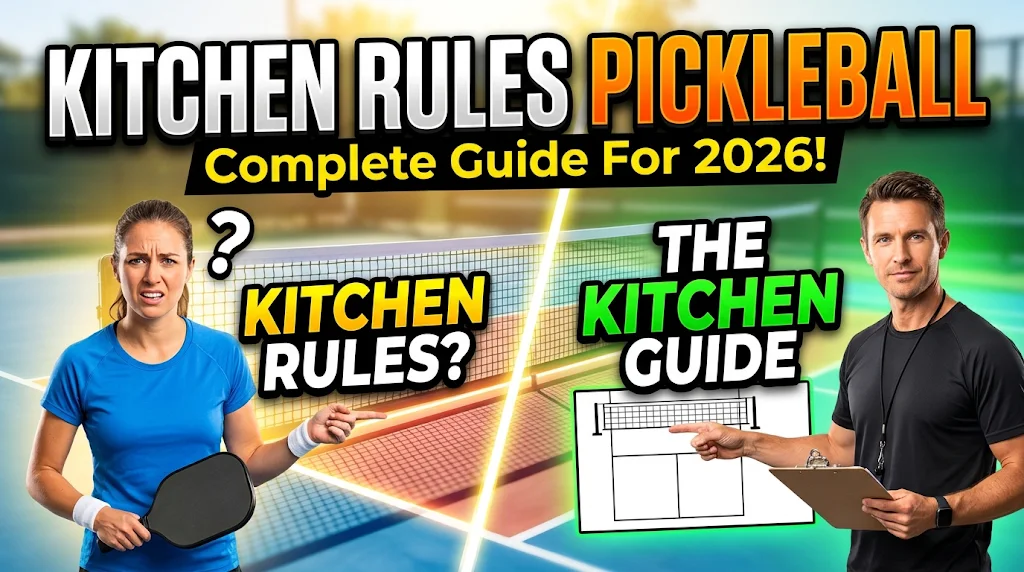
If you’re new to pickleball, there’s one court rule you need to understand before stepping into a competitive match: the kitchen rule. It might sound like a funny name, but this small area near the net can decide who wins or loses a rally.
In pickleball, the kitchen is officially called the Non-Volley Zone (NVZ). It extends 7 feet from the net on both sides of the court. Players can enter this area, stand in it, and hit balls after they bounce. However, they cannot hit the ball out of the air (volley) while standing in the kitchen or touching its boundary line.
The rule is simple once you understand it, but mistakes involving foot placement, momentum, and volleys can cost you important points. This guide explains all the pickleball kitchen rules, including what is legal, what counts as a fault, common mistakes, and smart strategies for playing around the kitchen line.
What Is the Kitchen in Pickleball?
The kitchen is the 7-foot area directly in front of the net on each side of a pickleball court. Its official name is the Non-Volley Zone because players cannot volley the ball while touching this area.
A standard pickleball court measures 20 feet wide and 44 feet long. The kitchen covers the first 7 feet from the net on each side, creating a space where players must let the ball bounce before hitting it.
The kitchen has a major impact on how pickleball is played. It prevents players from standing right next to the net and smashing every incoming shot. Instead, it encourages controlled shots, patience, positioning, and strategy.
Remember: The kitchen is not a restricted area where players are never allowed to step. The restriction applies specifically to volleying.
The Essential Pickleball Kitchen Rules
Understanding these rules will help you avoid unnecessary faults and play with more confidence.
You Cannot Volley While Standing in the Kitchen
This is the most important kitchen rule in pickleball.
A volley happens when you hit the ball before it touches the ground. If any part of your body touches the kitchen or its boundary line while volleying, you commit a fault.
For example:
- Standing inside the kitchen and hitting the ball out of the air is illegal.
- Touching the kitchen line while volleying is illegal.
- Standing outside the kitchen and hitting a volley without touching the zone is legal.
Even a tiny foot movement onto the line can cost you the rally.
You Can Enter the Kitchen After the Ball Bounces
Here’s something many beginners misunderstand: You are allowed to enter the kitchen!
You can step inside whenever necessary to return a ball that has bounced in the non-volley zone.
For example, your opponent hits a soft shot that lands just over the net. You can move into the kitchen, let the ball bounce, and hit it back.
You can also stay inside the kitchen after returning the bounced ball. There is no rule requiring you to immediately leave.
However, before hitting another volley, you must completely re-establish yourself outside the kitchen.
The Kitchen Line Is Part of the Kitchen
This is one of the easiest rules to forget.
The kitchen boundary line is considered part of the non-volley zone. That means touching the line while volleying is treated exactly like stepping inside the kitchen.
Imagine standing just outside the kitchen and reaching forward to hit a fast-moving ball. If your foot touches the line before, during, or as part of the volleying action, it’s a fault.
Keep your feet behind the line when preparing for a volley.
Momentum Can Cause a Kitchen Fault
This is probably the most misunderstood kitchen rule.
You might hit a perfectly legal volley while standing outside the kitchen, but your forward momentum can carry you into the zone afterward.
If that happens, it’s still a fault.
For example:
- You stand outside the kitchen line.
- Your opponent hits a high ball.
- You move forward and hit a volley.
- Your momentum carries you across the line.
- Your foot lands inside the kitchen.
That’s a kitchen fault, even though your paddle contacted the ball while you were outside.
The important detail is that the volleying action includes the momentum from your shot. You must regain balance and control before entering the kitchen.
Your Partner Can Cause a Kitchen Fault
In doubles pickleball, you must pay attention to your partner’s position too.
If you hit a volley and your momentum causes you to collide with your partner, who is touching the kitchen, you commit a fault.
The same principle applies if you touch anything else that is in contact with the kitchen while your volleying momentum is still carrying you forward.
Both players should maintain enough space to avoid accidental contact.
You Must Reset Before Hitting Another Volley
Suppose you enter the kitchen to return a bounced ball. You then move backward and prepare to attack your opponent’s next shot.
Can you immediately volley?
Not until both feet have completely contacted the playing surface outside the kitchen.
Simply jumping out of the kitchen and hitting a volley before establishing both feet outside is not legal.
A good habit is to step back, regain your balance, and then prepare for your next volley.
You Can Reach Over the Kitchen Without Entering It
You don’t have to stay far away from the net when attacking.
You can reach your paddle over the kitchen line to hit a ball in the air, provided you do not touch the kitchen or its boundary line with your body, clothing, or anything you’re carrying.
This means you can make an aggressive volley close to the net without committing a fault.
Just remember: reaching over the line is legal; touching the kitchen while volleying is not.
What Is Legal and Illegal in the Pickleball Kitchen?
Not sure whether a particular move is allowed? Here’s a quick comparison.
| Situation | Legal or Illegal? |
|---|---|
| Standing in the kitchen | Legal |
| Hitting a bounced ball inside the kitchen | Legal |
| Remaining in the kitchen after a shot | Legal |
| Volleying while standing in the kitchen | Illegal |
| Touching the kitchen line during a volley | Illegal |
| Momentum carrying you into the kitchen after a volley | Illegal |
| Reaching over the kitchen to hit a volley without touching it | Legal |
| Jumping from outside, volleying, and landing outside | Legal |
| Jumping from outside, volleying, and landing inside | Illegal |
| Volleying after entering the kitchen without first resetting outside | Illegal |
The easiest way to remember everything is this: You can play inside the kitchen, but you cannot volley from inside it.
What Happens If You Break a Kitchen Rule?
Breaking a kitchen rule results in a fault.
A fault ends the rally, and your opponents receive the result of that rally under the applicable scoring rules.
For example, if you’re serving and commit a kitchen fault, your team loses the rally and service according to the standard scoring system.
In recreational games, players are generally expected to call their own faults and their partner’s faults. Under the official rules, players may also call non-volley-zone faults on opponents. A claimed fault should be called before the next serve begins.
The best approach is to make honest calls and avoid turning friendly matches into arguments.
Common Pickleball Kitchen Mistakes Beginners Make
Even players who understand the basic rule can make mistakes during fast rallies. Here are some common problems to watch for.
Stepping on the Kitchen Line
Players sometimes focus so much on the ball that they forget where their feet are. A foot touching the kitchen line during a volley is a fault.
How to avoid it: Practice maintaining a comfortable distance behind the line and watch your foot placement during aggressive shots.
Forgetting About Momentum
Hitting the ball outside the kitchen doesn’t automatically make the shot legal. Your movement after contact matters too.
How to avoid it: Practice controlled volleys with balanced footwork instead of rushing toward the net.
Thinking the Kitchen Is Completely Off-Limits
Some beginners avoid entering the kitchen altogether because they believe stepping inside is against the rules.
That’s incorrect. You can enter freely to play bounced balls.
How to avoid it: Practice returning dink shots from inside the kitchen so you become comfortable moving forward and backward.
Volleying Before Both Feet Are Outside
After playing a ball inside the kitchen, players sometimes jump backward and immediately hit a volley.
This is illegal if both feet haven’t completely re-established contact outside the kitchen.
How to avoid it: Take a moment to reset your position before attacking another ball.
Best Strategies for Playing Around the Kitchen Line
Knowing the rules is important, but using them to your advantage is what makes you a better player.
Here are a few practical strategies.
Master the Dink Shot
A dink is a soft shot that lands in your opponent’s kitchen. It forces them to let the ball bounce and makes it harder to attack aggressively.
Practice hitting soft, controlled shots that land close to the net without going too high.
Maintain a Balanced Ready Position
Stand just behind the kitchen line with your knees slightly bent and your paddle in front of you.
This position helps you react quickly while keeping your feet outside the non-volley zone.
Avoid Rushing Forward
Many players lose points because they move too aggressively after hitting a volley.
Use short, controlled steps and maintain your balance. Remember, a powerful shot isn’t worth a fault.
Watch Your Opponent’s Paddle
Your opponent’s paddle position can give you clues about where the ball is going.
Stay alert, keep your paddle ready, and avoid leaning too far into the kitchen.
Practice Reset Shots
A reset shot is a soft shot that slows down an aggressive rally. It can help you regain control when your opponent is attacking.
Instead of trying to hit every ball hard, focus on placing the ball in a difficult position and forcing your opponent to make another shot.
Frequently Asked Questions
Can You Stand in the Kitchen in Pickleball?
Yes. You can stand inside the kitchen at any time. The only restriction is that you cannot volley the ball while touching the non-volley zone or its boundary line.
Can You Step Into the Kitchen to Hit a Ball?
Yes. You can enter the kitchen to hit a ball after it bounces. You can even remain inside the zone after returning it.
Can You Jump Over the Kitchen Line to Hit a Volley?
Yes, provided you jump from outside the kitchen, hit the volley, and land outside without your momentum carrying you into the zone. Touching the kitchen or its line during the volleying action results in a fault.
Is the Kitchen Line Considered In or Out?
The kitchen line is considered part of the kitchen. If you touch it while volleying, you commit a fault.
Can You Reach Over the Kitchen Line?
Yes. Reaching over the kitchen line is legal if you don’t touch the non-volley zone or its line while volleying.
Can You Hit the Ball After It Bounces in the Kitchen?
Absolutely. You can enter the kitchen and hit a ball after it bounces. This is one of the most important differences between entering the kitchen and volleying inside it.
Can Your Paddle Touch the Kitchen?
Your paddle can touch the kitchen when you’re not volleying. However, if you’re volleying and your paddle or anything else you’re carrying touches the non-volley zone, it’s a fault.
Does the Kitchen Rule Apply in Singles and Doubles?
Yes. The same non-volley-zone rules apply to both singles and doubles pickleball.
Why Is It Called the Kitchen in Pickleball?
The official rulebook calls this area the non-volley zone. “Kitchen” is the popular nickname players use. Its exact historical origin isn’t firmly established, but the name has become part of pickleball culture.
Final Thoughts
The kitchen rule might seem confusing when you first start playing pickleball, but it becomes much easier with practice.
Remember the three most important points: you can enter the kitchen whenever you need to, you cannot volley while touching the kitchen or its line, and your momentum after a volley must not carry you into the zone.
Once you understand these basics, you’ll make fewer mistakes, improve your positioning, and become more confident during fast rallies.
So, the next time someone hits a soft dink just over the net, don’t panic or avoid the kitchen. Step in, let the ball bounce, and make your return. That’s how smart pickleball is played!

Theo Bennett is a passionate sports writer and storyteller at SportNestify.com covering cricket, football, hockey, tennis, basketball and more. With a focus on clear insights, engaging analysis, player stories, and the latest sporting trends, Leo turns every game into a story worth following. His goal is simple