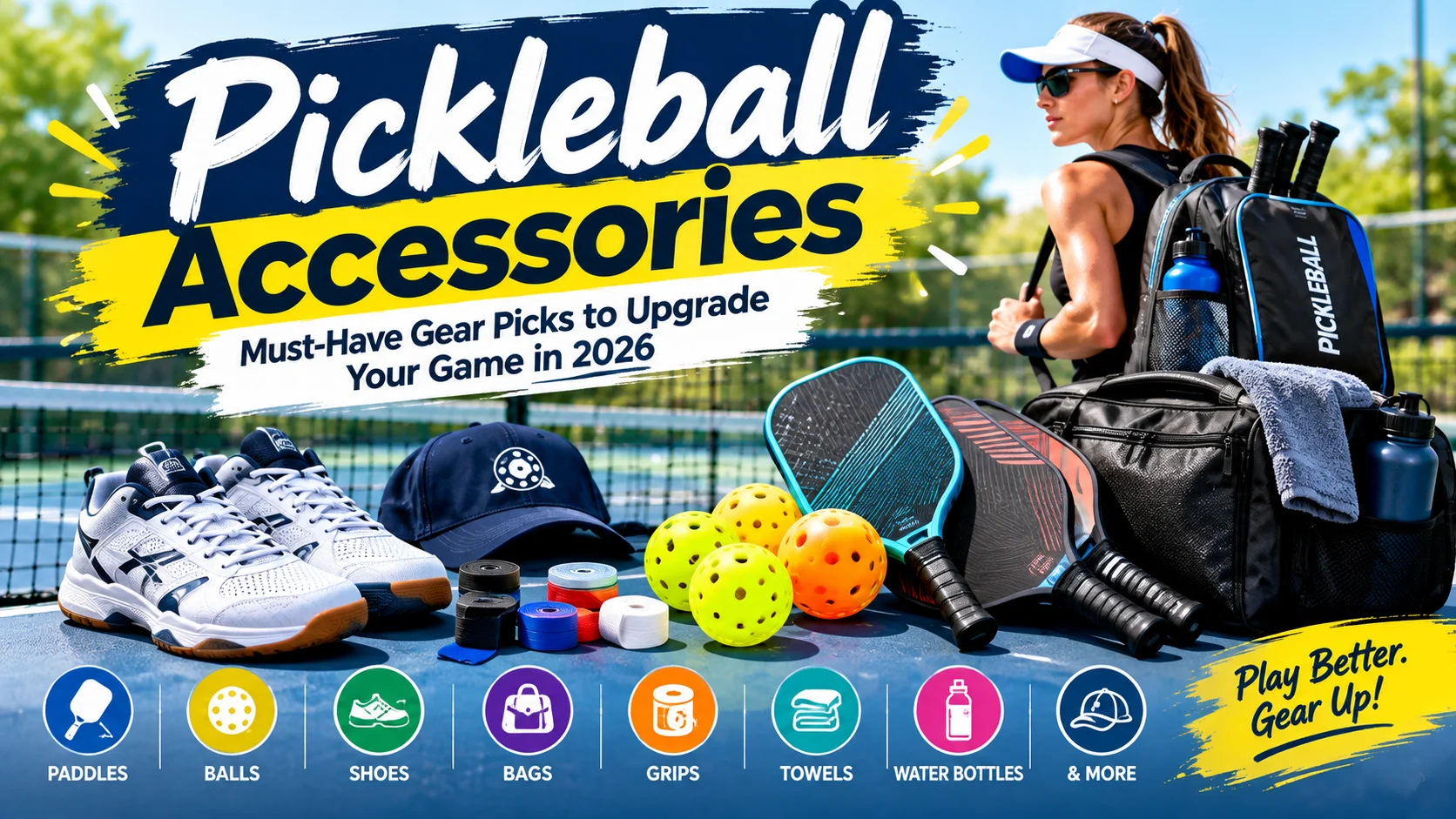
Pickleball may look simple grab a paddle, a few balls, and step onto the court but the right pickleball accessories can make every session more comfortable, organized, and enjoyable.
From a fresh overgrip that keeps your paddle secure to court shoes that support quick lateral movement, small upgrades can solve surprisingly big problems. And with the sport continuing to attract players of every age and skill level, the accessory market now includes everything from practical essentials to advanced training equipment.
But which accessories are actually worth buying?
This complete guide breaks down the best pickleball accessories in 2026, what each one does, who needs it, and how to build a smart pickleball gear kit without wasting money.
What Are Pickleball Accessories?
Pickleball accessories are the equipment and extras used alongside a paddle and pickleballs to improve performance, safety, comfort, organization, or training.
Popular accessories include:
- Pickleball bags and backpacks
- Paddle covers
- Overgrips
- Pickleball shoes
- Protective eyewear
- Towels
- Water bottles
- Hats and visors
- Ball hoppers
- Training targets
- Portable nets
- Ball machines
- Wristbands
- Replacement edge guards
- Court markers
- Ball tubes and retrievers
You don’t need all of them. The smartest approach is to buy accessories based on how, where, and how often you play.
Best Pickleball Accessories You Should Consider
Pickleball Overgrips
An overgrip is one of the simplest and most useful accessories you can add to your setup.
It gives your paddle handle a fresh, comfortable surface and can help absorb sweat during long matches. A worn or slippery grip can make you squeeze the paddle harder than necessary.
Best for: Every player.
Why it matters: It’s inexpensive, easy to replace, and directly affects how the paddle feels in your hand.
Pickleball Paddle Cover
Your paddle can take plenty of abuse while being transported from your home to the court.
A pickleball paddle cover protects the paddle face and edge from scratches, impacts, and general wear.
If you’ve invested in a premium paddle, a protective cover is an inexpensive way to help keep it looking and performing better.
Pro tip: Choose a cover with padding and a secure closure rather than a very thin sleeve.
Pickleball Bag or Backpack
A dedicated pickleball bag makes carrying your equipment considerably easier.
A good bag can hold:
- Paddles
- Pickleballs
- Shoes
- Water bottle
- Towel
- Extra grips
- Phone and keys
- Small accessories
For regular players, look for multiple compartments and, ideally, a separate shoe section. Current gear guides increasingly emphasize organization and shoe ventilation as practical features rather than simply buying the largest bag available.
Backpack vs. Sling Bag
A pickleball backpack is better if you carry several paddles and accessories.
A sling bag is usually better for casual players who want something lightweight and compact.
Pickleball Shoes
One accessory deserves special attention: pickleball shoes.
Pickleball requires frequent lateral movement, sudden stops, quick starts, and changes of direction. That’s very different from simply walking or running forward.
Court shoes are designed to provide the traction and stability needed for these movements.
What to Look For
Choose shoes with:
- Strong lateral support
- Good court traction
- Comfortable cushioning
- A secure heel
- Breathable construction
- Durable outsole
If you’re playing frequently, shoes should generally receive a higher priority than purely cosmetic accessories.
Protective Eyewear
A fast-moving pickleball can travel toward the face unexpectedly, particularly during close net exchanges.
Sports-rated protective eyewear can provide an additional layer of protection and is especially worth considering for competitive or frequent players. Pickleball safety has received increasing attention as participation has grown.
Look for eyewear designed specifically for sports rather than ordinary sunglasses.
Pickleball Balls
Technically, balls are core equipment rather than an accessory but having the right spare balls is essential.
Indoor and outdoor pickleballs are designed differently.
Outdoor Pickleballs
They generally need to handle harder surfaces, wind, and faster play.
Indoor Pickleballs
They tend to have characteristics suited to smoother indoor courts and controlled conditions.
Always check the ball type before buying a large quantity.
Pickleball Towel
It sounds basic, but a towel can become one of the most-used accessories in your bag.
Sweat can affect your hands and grip, especially during hot outdoor sessions.
A compact microfiber towel is:
- Lightweight
- Fast-drying
- Easy to pack
- Useful between games
For players in hot or humid climates, it’s practically a court-day essential.
Water Bottle
Hydration is easy to overlook when you’re focused on competition.
A reusable insulated water bottle keeps your drink available throughout a long session and can help you avoid constantly leaving the court to find water.
For regular players, choose a bottle that:
- Doesn’t leak
- Fits inside your bag
- Is easy to open
- Holds enough water for your typical session
Pickleball Hat or Visor
Outdoor players know how distracting bright sunlight can be.
A hat or visor can help reduce glare while keeping sweat away from your face.
A lightweight, breathable design is usually the best choice.
Best for: Outdoor pickleball players.
Pickleball Wristbands
Wristbands can help manage sweat during intense sessions.
They’re inexpensive and easy to keep in your bag, making them a useful backup even if you don’t wear one every game.
They’re particularly handy during summer play.
Ball Hopper
If you practice regularly, constantly bending down to collect balls gets old quickly.
A pickleball ball hopper lets you collect and store multiple balls more efficiently.
It’s especially useful for:
- Coaches
- Instructors
- Drilling sessions
- Ball machines
- Solo practice
Casual players may not need one, but serious practice sessions can become much more convenient with a hopper.
Pickleball Ball Retriever
A ball retriever is another simple convenience accessory.
Instead of repeatedly bending down, you can collect balls more efficiently.
This becomes particularly useful when practicing hundreds of shots.
Some adaptive players may also benefit from specialized retrieval solutions; USA Pickleball’s rule-change database includes proposals concerning ball retrievers for players with physical limitations.
Lead or Tungsten Tape
Players looking to customize their paddle’s feel sometimes use lead or tungsten tape.
Adding weight can alter characteristics such as:
- Swing weight
- Stability
- Balance
- Feel on impact
However, this isn’t something beginners necessarily need.
If you compete under official rules, make sure any paddle modification remains compliant with applicable equipment regulations. USA Pickleball maintains equipment approval and rule information for sanctioned play.
Pickleball Edge Guard Tape
Edge guard tape protects the paddle’s perimeter from scratches and impacts.
It’s particularly useful for players who frequently hit the ground while reaching for low shots.
It’s inexpensive compared with replacing an entire paddle.
Paddle Eraser or Cleaner
Over time, dirt and ball residue can accumulate on a paddle surface.
A paddle-specific cleaning or erasing product can help maintain the paddle’s surface.
Always follow the paddle manufacturer’s care instructions rather than using aggressive household cleaners.
Pickleball Ball Machine
A ball machine is one of the more advanced accessories available.
It can repeatedly feed balls so you can practice without requiring another player.
You can use one for drills involving:
- Dinks
- Drives
- Third-shot drops
- Volleys
- Serves
- Reaction speed
- Footwork
It’s expensive compared with ordinary accessories, but serious players and coaches may find it valuable.
Portable Pickleball Net
A portable net can turn a suitable outdoor space into a practice area.
When shopping, pay attention to:
- Stability
- Frame quality
- Setup time
- Portability
- Net tension
- Storage bag
This is especially useful for clubs, coaches, schools, and players who regularly practice outside dedicated facilities.
Pickleball Court Markers
Court markers can help players create temporary practice areas.
They’re useful for drills focused on:
- Footwork
- Positioning
- Target accuracy
- Movement patterns
They also work well for coaches training groups of players.
Pickleball Training Targets
Want to improve accuracy rather than simply hit harder?
Training targets give you a specific landing zone to aim for.
You can use targets to practice:
- Cross-court dinks
- Deep serves
- Third-shot drops
- Passing shots
- Volleys
The best training accessory is often the one that turns random hitting into purposeful practice.
Pickleball Scorekeeper
A portable scorekeeper can be surprisingly useful during recreational games.
It eliminates arguments over the score and makes it easier for new players to follow the game.
Some players simply use a phone, but a physical scorekeeper is faster and more convenient courtside.
Pickleball Socks
Don’t underestimate socks.
Good athletic socks can improve comfort by helping manage moisture and reducing friction.
Look for:
- Breathable fabric
- Cushioning
- Secure fit
- Moisture management
- Seamless or low-friction construction
Comfort matters more when you’re playing multiple games in one session.
Pickleball Backpack Hooks and Accessories
Small organizational accessories can make your setup much easier.
Examples include:
- Fence hooks
- Key clips
- Ball tubes
- Small gear pouches
- Shoe bags
- Accessory organizers
They’re not glamorous, but they can prevent your bag from becoming a chaotic pile of equipment.
Pickleball Sunglasses
Outdoor players may also benefit from sports sunglasses designed to stay secure during movement.
Look for lightweight frames and lenses that don’t easily slip when you sweat.
Avoid choosing sunglasses purely because they look stylish the fit and stability matter more on court.
Cooling Towel
For hot-weather pickleball, a cooling towel can be a useful comfort upgrade.
Wet it according to the manufacturer’s instructions, shake or activate it as directed, and place it around your neck during breaks.
It’s especially useful for outdoor summer sessions.
Small First-Aid Kit
A tiny first-aid kit takes up very little space but can be useful when you’re playing regularly.
Consider carrying:
- Bandages
- Athletic tape
- Blister protection
- Antiseptic wipes
- Small cold pack
It’s one of those accessories you hope you never need but you’ll appreciate having it when you do.
How to Choose the Right Pickleball Accessories
Don’t buy accessories simply because they’re popular.
Use this simple priority system.
If You’re a Beginner
Start with:
- Spare pickleballs
- Overgrip
- Water bottle
- Towel
- Comfortable court shoes
- Paddle cover
- Small pickleball bag
You don’t need an expensive training machine or giant equipment bag on day one.
If You’re an Intermediate Player
Consider adding:
- Better overgrips
- Dedicated pickleball shoes
- Protective eyewear
- Quality backpack
- Ball hopper
- Training targets
- Paddle customization tape
If You’re a Competitive Player
Your kit may include:
- Multiple paddles
- Tournament-approved equipment
- Several ball types
- Extra grips
- Protective eyewear
- Performance shoes
- Large gear bag
- Towels
- Hydration system
- Training equipment
For sanctioned competition, verify that your paddle is listed as approved rather than assuming a manufacturer’s marketing claim is enough.
What Pickleball Accessories Are Actually Worth It?
Not every accessory deserves your money.
A smart priority list looks like this:
| Accessory | Priority |
|---|---|
| Court shoes | ⭐⭐⭐⭐⭐ |
| Overgrip | ⭐⭐⭐⭐⭐ |
| Pickleballs | ⭐⭐⭐⭐⭐ |
| Protective eyewear | ⭐⭐⭐⭐⭐ |
| Water bottle | ⭐⭐⭐⭐ |
| Pickleball bag | ⭐⭐⭐⭐ |
| Paddle cover | ⭐⭐⭐⭐ |
| Towel | ⭐⭐⭐⭐ |
| Hat/visor | ⭐⭐⭐ |
| Ball hopper | ⭐⭐⭐ |
| Training targets | ⭐⭐⭐ |
| Portable net | ⭐⭐⭐ |
| Ball machine | ⭐⭐ |
| Decorative accessories | ⭐ |
The key lesson is simple: buy accessories that solve a problem you actually have.
A $15 overgrip can be more useful than a $150 bag if your current grip is worn out.
How Much Should You Spend on Pickleball Accessories?
You don’t need to spend hundreds of dollars to build a useful setup.
Budget Setup
A beginner can focus on:
- Overgrip
- Balls
- Water bottle
- Towel
- Basic bag
Mid-Range Setup
Add:
- Better court shoes
- Protective eyewear
- Quality backpack
- Paddle cover
- Extra grips
- Training accessories
Advanced Setup
Serious players may eventually invest in:
- Multiple paddles
- Premium bags
- Specialized footwear
- Ball machines
- Portable nets
- Coaching equipment
Spend according to your playing frequency not someone else’s equipment list.
Pickleball Accessories Checklist
Before heading to the court, run through this quick checklist:
☐ Paddle
☐ Spare pickleballs
☐ Overgrip
☐ Pickleball bag
☐ Court shoes
☐ Water bottle
☐ Towel
☐ Protective eyewear
☐ Hat or visor
☐ Phone/keys
☐ Extra socks
☐ Paddle cover
For serious practice:
☐ Ball hopper
☐ Training targets
☐ Extra paddle
☐ Ball machine
☐ Court markers
This simple checklist can prevent the classic mistake of arriving at the court and realizing you forgot something important.
FAQs
What pickleball accessories do beginners need?
Beginners should prioritize court shoes, pickleballs, an overgrip, water bottle, towel, and a simple bag. A paddle cover and protective eyewear are also worthwhile additions.
What is the most useful pickleball accessory?
For many players, an overgrip is one of the most useful low-cost accessories because it directly affects paddle comfort and handling. Court shoes are another high-priority investment because pickleball involves frequent lateral movement.
Do I need a pickleball bag?
Not necessarily. Casual players can use a normal sports bag, but a dedicated pickleball backpack or bag becomes much more convenient when you carry multiple paddles, balls, shoes, towels, and accessories.
Are pickleball shoes really necessary?
They are strongly recommended for frequent players. Pickleball involves movements that differ from normal running, so shoes designed for court movement can provide more appropriate traction and lateral stability.
What should I keep in my pickleball bag?
A good basic setup includes your paddle, spare balls, overgrip, water bottle, towel, shoes, and protective eyewear. Add sunscreen, extra socks, athletic tape, and training equipment if you regularly spend several hours on the court.
Are pickleball accessories worth buying?
Yes but only when they solve a genuine problem. Accessories such as grips, shoes, balls, eyewear, bags, and towels can improve comfort, safety, or convenience. Expensive gadgets aren’t automatically better.
What accessories help improve pickleball skills?
Training targets, ball hoppers, portable nets, and ball machines can make practice more structured. However, accessories don’t replace good technique, repetition, movement, and coaching.
Final Verdict
The best pickleball accessories aren’t necessarily the most expensive ones. They’re the products that make your time on the court safer, easier, more comfortable, and more productive.
Start with the essentials: good court shoes, quality balls, a fresh grip, hydration, a towel, and basic protection. Then build from there based on your playing style.
If you practice frequently, add training targets, a ball hopper, or a portable net. If you’re constantly traveling to different courts, invest in a quality pickleball backpack. And if you’re serious about competition, pay attention to equipment approval and current rules before modifying your gear. USA Pickleball’s official rules process is updated as new rulebook changes are considered.

Leo Carter is a passionate sports writer and storyteller at SportNestify.com covering cricket, football, hockey, tennis, basketball and more. With a focus on clear insights, engaging analysis, player stories, and the latest sporting trends, Leo turns every game into a story worth following. His goal is simple