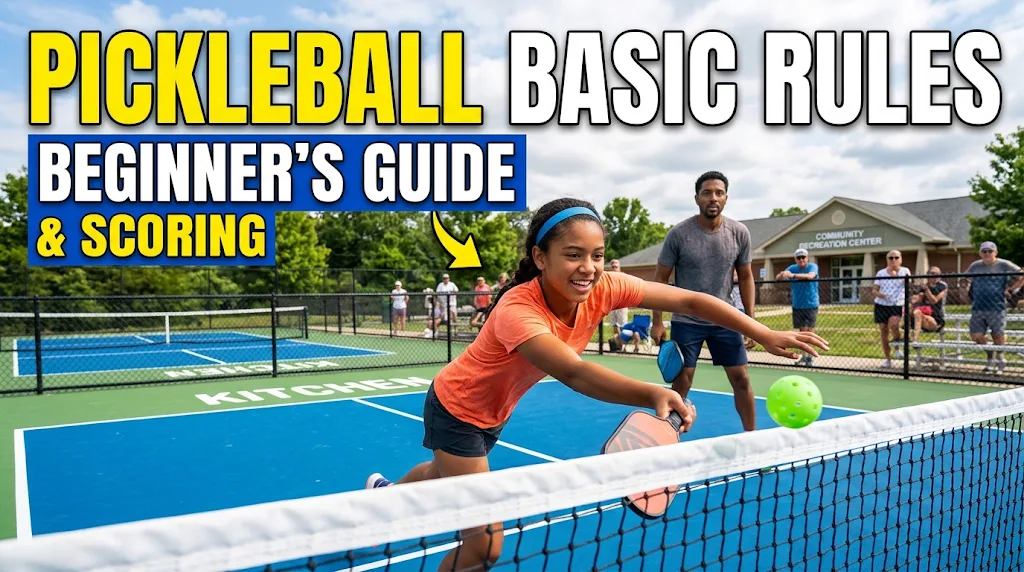
Want to play pickleball but don’t know where to start? You’re not alone! Pickleball is one of the easiest and most enjoyable paddle sports to learn. It combines elements of tennis, badminton, and table tennis, making it exciting for beginners and experienced players alike.
However, before stepping onto the court, you need to understand a few important rules. From serving and scoring to the famous kitchen rule, knowing the basics will help you enjoy the game, avoid unnecessary mistakes, and compete with confidence.
The good news? You don’t need hours of practice to understand how pickleball works.
In this guide, we’ll explain the basic rules of pickleball in simple language, including court boundaries, serving rules, scoring, common faults, and helpful tips for first-time players.
What Are the Basic Rules of Pickleball?
Pickleball is played between two players (singles) or two teams of two players (doubles). Players use solid paddles to hit a lightweight plastic ball with holes over a net.
The main objective is to hit the ball into your opponent’s court in a way that prevents them from returning it legally.
Here are the essential pickleball rules every beginner should know:
- Games are generally played to 11 points, and you must win by at least 2 points.
- Only the serving team scores points under traditional scoring.
- Serves must travel diagonally into the opposite service court.
- Players must follow the two-bounce rule at the beginning of every rally.
- Players cannot volley the ball while standing in the kitchen.
- A ball landing on a boundary line is generally considered in, except when a serve touches the kitchen line.
- A rally ends when a player commits a fault.
Understand these seven rules, and you’re already familiar with the foundation of pickleball!
Understand the Pickleball Court
Before learning how to play, take a moment to understand the court. Knowing where to stand and where the ball should land makes the game much easier.
A standard pickleball court measures:
- Length: 44 feet
- Width: 20 feet
- Net height: 36 inches at the sidelines and 34 inches at the center.
The court has several important areas:
Baseline: The back boundary line where players stand when serving.
Sidelines: The lines running along the sides of the court.
Centerline: Divides each service area into right and left sections.
Non-Volley Zone (Kitchen): The seven-foot area on each side of the net where players cannot hit a volley.
Both singles and doubles use the same court dimensions.
Singles vs. Doubles Rules
Pickleball can be played in two main formats: singles and doubles.
Singles Pickleball
Singles is a one-on-one game. Each player covers the entire court on their side, so movement, positioning, and accurate shots are especially important.
The basic rules remain the same, but serving positions depend on the server’s score:
- Even score: Serve from the right side.
- Odd score: Serve from the left side.
Doubles Pickleball
Doubles involves two players on each team. It is the most common format and is particularly beginner-friendly because teammates can share court coverage.
Each player gets an opportunity to serve during their team’s service turn, except for the first service sequence of the game.
Both formats follow the same basic rules, including the kitchen rule and two-bounce rule.
Pickleball Serving Rules
Every pickleball rally begins with a serve. The server must hit the ball diagonally across the net into the opponent’s opposite service court.
Unlike tennis, pickleball has specific serving requirements.
Here are the main serving rules:
- The serve must be made diagonally across the court.
- At least one foot must remain behind the baseline when the ball is struck.
- Neither foot can touch the baseline or court surface at the moment of contact.
- A volley serve must use an upward arm motion.
- Paddle contact must be below waist level.
- The paddle head must not be above the highest part of the wrist at contact.
- Only one serve attempt is allowed per server.
There are two legal serving methods:
Volley Serve: The player strikes the ball before it touches the ground, following the required underhand serving motion.
Drop Serve: The player releases the ball naturally, lets it bounce, and then hits it. The restrictions on upward arm motion and paddle position do not apply to a drop serve.
Important: The serve must land in the correct diagonal service court. If it lands in the kitchen, including on the kitchen line, it is a fault.
The Two-Bounce Rule
The two-bounce rule is one of the most important pickleball rules, and every beginner should understand it.
Here’s how it works:
- The serving team hits the ball diagonally into the opponent’s court.
- The receiving team must let the ball bounce once before returning it.
- The serving team must also let the returned ball bounce once before hitting it.
After these two required bounces, both teams can either hit the ball before it touches the ground (volley) or let it bounce first.
Why does this rule matter?
It prevents players from rushing toward the net immediately after serving and creates longer, more competitive rallies.
Remember: The ball must bounce once on each team’s side before either team can legally volley.
Understanding the Kitchen Rule
If there’s one pickleball rule that confuses beginners, it’s the kitchen rule!
The kitchen, officially called the Non-Volley Zone (NVZ), is a seven-foot area extending from the net on each side of the court.
Here’s the most important thing to remember:
You cannot hit the ball out of the air while standing in the kitchen or touching its boundary line.
However, you can legally enter the kitchen and hit a ball after it bounces.
For example, imagine your opponent hits a soft shot that lands inside the kitchen. You can step into the area and return the ball after it bounces.
There is another important detail: If you hit a volley outside the kitchen but your momentum carries you into the kitchen afterward, you commit a fault.
This rule also applies if your clothing or paddle touches the kitchen during that movement.
Beginner Tip: Don’t be afraid of the kitchen! You can stand inside it whenever you’re not volleying. Just make sure you don’t hit the ball out of the air while touching the zone.
Pickleball Scoring Rules
Scoring is another area that beginners sometimes find confusing.
Under traditional pickleball scoring, only the serving team can earn points. If the receiving team wins a rally, it doesn’t receive a point; instead, it gains the opportunity to serve.
Most recreational games are played to 11 points, and a team must win by at least two points.
For example:
- 11–9: The game is over.
- 11–10: The game continues.
- 12–10: The game is over.
How Does Doubles Scoring Work?
In doubles, players use a three-number score announcement.
For example, a score of 5–3–2 means:
- First number (5): Serving team’s score.
- Second number (3): Receiving team’s score.
- Third number (2): Second server.
Each team generally gets two serving opportunities per service turn, one for each partner.
When the first server commits a fault, their partner gets the opportunity to serve. When the second server commits a fault, the serve passes to the opposing team. This is called a side-out.
Special exception: At the beginning of a game, the first serving team gets only one serving opportunity before the serve passes to the other team.
How Does Singles Scoring Work?
Singles scoring is simpler because there’s only one server per team.
The server’s position depends on their score:
- Even score: Serve from the right side.
- Odd score: Serve from the left side.
The game still follows the standard 11-point, win-by-two format.
What Is a Fault in Pickleball?
A fault is a rule violation that ends the rally.
Depending on which team commits the fault, the result is either a point for the serving team or a loss of serve.
Common pickleball faults include:
- Hitting the ball outside the court boundaries.
- Hitting the ball into the net.
- Failing to return the ball before it bounces twice.
- Violating the two-bounce rule.
- Volleying while standing in the kitchen.
- Touching the kitchen after a volley because of momentum.
- Serving into the wrong service area.
- Serving into the kitchen or onto its boundary line.
- Touching the net or net post while the ball is in play.
- Allowing the ball to hit your body or clothing while it is in play.
Avoiding these mistakes will help you keep rallies alive and improve your overall performance.
Pickleball Line Rules: Is the Ball In or Out?
Line calls can make a big difference during a close game.
Fortunately, the basic rule is easy to remember:
If the ball touches any boundary line, it is considered in.
However, there’s one important exception.
When serving, the ball must completely clear the kitchen and its boundary line. If the serve touches the kitchen line, it’s a fault.
For other shots, a ball touching the sideline or baseline is considered in.
If you’re playing recreationally, always make fair and honest line calls. Good sportsmanship is an important part of pickleball.
How to Win a Pickleball Game
Winning isn’t just about hitting the ball harder. Good positioning, patience, and smart shot selection can make a huge difference.
Here are some beginner-friendly strategies:
Keep Your Serves Consistent
You don’t need a powerful serve to win. Focus on getting the ball into the correct service area.
Learn the Dink Shot
A dink is a soft shot that lands in your opponent’s kitchen. It forces opponents to move forward and can create opportunities to win the rally.
Move Toward the Kitchen Line
After completing the two-bounce sequence, moving toward the kitchen line can give you better control of the rally.
Communicate With Your Partner
In doubles, talk to your teammate. Simple calls like “mine,” “yours,” and “out” can prevent unnecessary mistakes.
Avoid Unnecessary Power Shots
Beginners often try to hit every ball as hard as possible. Instead, focus on placement, consistency, and patience.
Remember, smart pickleball is often more effective than aggressive pickleball.
Beginner Mistakes to Avoid
Learning pickleball becomes much easier when you know which mistakes to watch out for.
Here are five common mistakes beginners should avoid:
- Forgetting the two-bounce rule: Never volley before the serve and return have both bounced.
- Stepping into the kitchen during a volley: Keep your feet and momentum under control.
- Serving into the wrong area: Always aim for the diagonally opposite service court.
- Misunderstanding scoring: Remember that traditional scoring awards points only to the serving team.
- Hitting every shot too hard: Controlled shots and good positioning often work better.
Practice these basics, and you’ll quickly become more comfortable on the court.
Frequently Asked Questions
What are the 5 basic rules of pickleball?
The five essential rules are:
- Serve diagonally into the opposite service court.
- Follow the two-bounce rule.
- Do not volley inside the kitchen.
- Keep the ball within the court boundaries.
- Under traditional scoring, only the serving team earns points.
What score do you play to in pickleball?
Most standard pickleball games are played to 11 points. However, you must win by at least two points. Some tournaments use games to 15 or 21 points.
Can you step into the kitchen in pickleball?
Yes! You can step into the kitchen whenever you want, provided you don’t volley the ball while touching the kitchen or its boundary line. You can legally hit a ball after it bounces inside this area.
Can you serve overhand in pickleball?
Standard volley serves must follow the underhand serving requirements. However, players can use a legal drop serve, where the ball bounces before being hit.
Do you get a second serve in pickleball?
No. Each server gets one serve attempt. If the serve is faulty, the serving sequence moves forward according to the service rotation.
Can the ball hit the line in pickleball?
Yes. A ball touching a boundary line is generally considered in. The exception is the kitchen line on a serve, which makes the serve a fault.
Is pickleball easier than tennis?
Many beginners find pickleball easier to learn because it uses a smaller court, a lightweight ball, and a paddle with a solid hitting surface. However, both sports require practice, coordination, and strategy.
Can you play pickleball with two players?
Absolutely! Pickleball can be played as singles, with one player on each side, or doubles, with two players on each side.
Final Thoughts
Pickleball is easy to learn, fun to play, and a fantastic way to stay active while spending time with friends and family.
Once you understand the serving rules, two-bounce rule, kitchen restrictions, and scoring system, you’re ready to enjoy your first game.
Don’t worry about mastering every technique immediately. Start with the basics, practice your serves, learn to control your shots, and gradually develop your strategy.

Leo Carter is a passionate sports writer and storyteller at SportNestify.com covering cricket, football, hockey, tennis, basketball and more. With a focus on clear insights, engaging analysis, player stories, and the latest sporting trends, Leo turns every game into a story worth following. His goal is simple