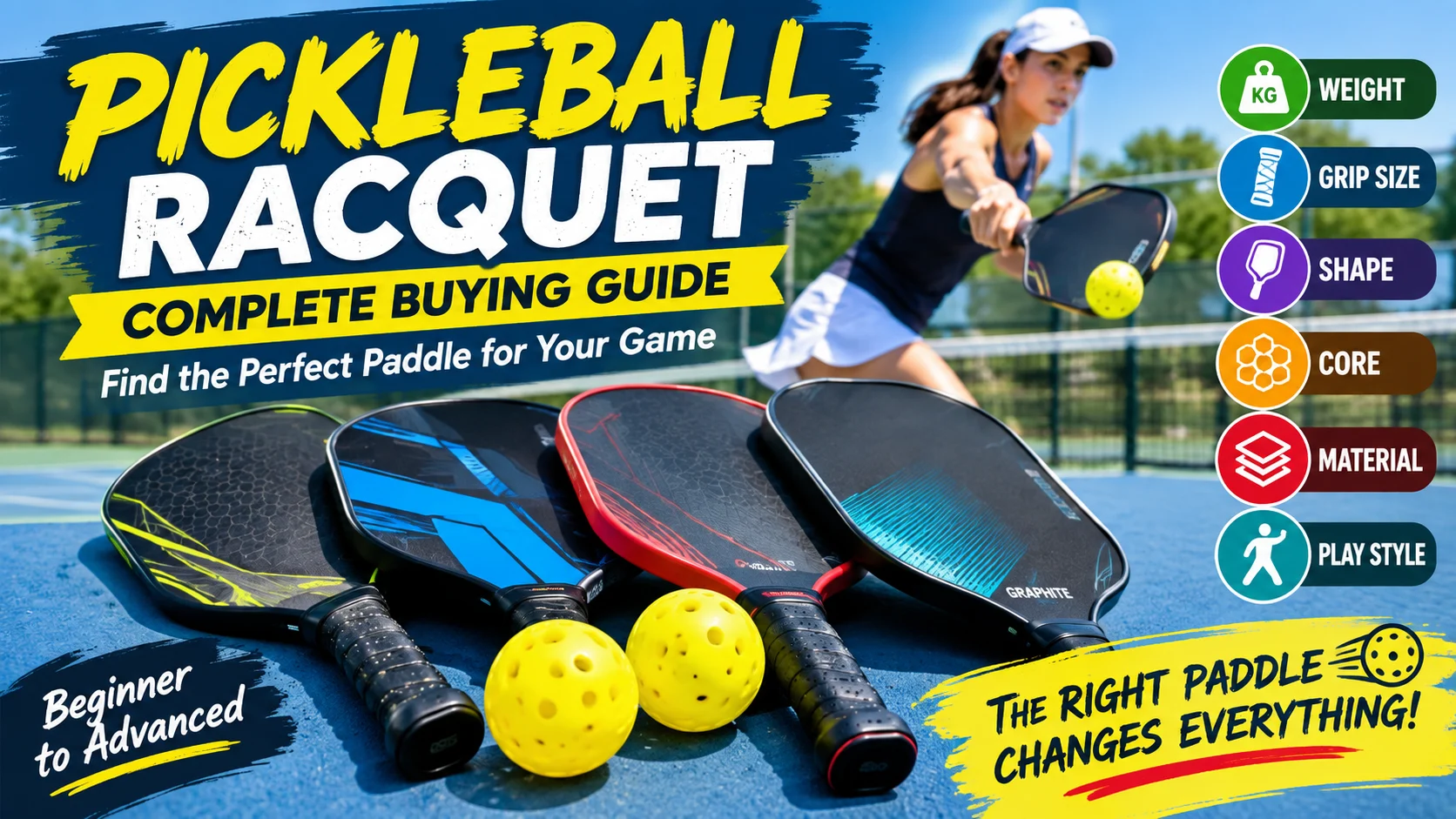
If you’re getting serious about pickleball, one piece of equipment can make a surprisingly big difference: your pickleball racquet.
Whether you’re a complete beginner, a recreational player, or someone trying to improve their control and power, choosing the right paddle can change how the game feels in your hands. The right one can help with accuracy, spin, reaction speed, and comfort while the wrong one can make every shot feel harder than it should.
But there’s one important detail to know first: in pickleball, the equipment is officially called a paddle, not a racquet. People commonly search for “pickleball racquet,” though, so this guide uses both terms to help you find exactly what you need.
So, what makes a good pickleball racquet, and how do you choose one? Let’s break it down.
What Is a Pickleball Racquet?
A pickleball racquet, more accurately called a pickleball paddle, is the solid hitting surface players use to strike the perforated plastic pickleball over the net.
Unlike a tennis racquet, a pickleball paddle normally has:
- A solid face
- A shorter handle
- No strings
- A compact hitting surface
- A lightweight or moderately weighted construction
Modern paddles can be made from materials such as carbon fiber, fiberglass, graphite, composite materials, and various polymer or honeycomb cores.
The combination of weight, shape, core, surface material, and handle design determines how a paddle performs.
Pickleball Racquet vs. Tennis Racquet: What’s the Difference?
If you’re coming from tennis, don’t assume your tennis racquet will work for pickleball.
| Feature | Pickleball Paddle | Tennis Racquet |
|---|---|---|
| Face | Solid | Stringed |
| Length | Shorter | Longer |
| Weight | Generally lighter | Generally heavier |
| Head design | Compact/solid | Larger/stringed |
| Handle | Shorter | Longer |
| Main focus | Control, quick reactions, spin | Power, reach, topspin |
The smaller court and fast exchanges around the kitchen line make a pickleball paddle much more suitable for quick reactions and precise placement.
How to Choose the Best Pickleball Racquet
There isn’t one paddle that’s perfect for everyone. The best choice depends on your playing style, experience, physical comfort, and priorities.
Here are the most important factors to consider.
Paddle Weight
Weight is one of the first specifications you should check.
Pickleball paddles generally fall into three broad categories:
Lightweight Paddles
Light paddles are typically easier to maneuver and can feel excellent during rapid exchanges.
Best for:
- Beginners
- Players who prioritize speed
- Quick hands at the kitchen
- Players concerned about arm fatigue
The trade-off is that lightweight paddles may provide less natural power.
Midweight Paddles
Midweight paddles offer a balanced combination of control, maneuverability, and power.
They’re often a great choice for recreational and intermediate players who don’t want an extreme setup.
Heavy Paddles
Heavier paddles can generate more power with less effort, but they may feel slower during quick exchanges.
Best for:
- Power-oriented players
- Experienced players
- Players who like solid contact
However, heavier doesn’t automatically mean better.
Quick rule: If you’re unsure, a midweight paddle is often the safest starting point.
Paddle Shape
The shape of a pickleball racquet affects reach, sweet spot, maneuverability, and overall feel.
Widebody Paddle
Widebody paddles generally provide a larger hitting area and a forgiving sweet spot.
They’re particularly attractive to beginners because slight mishits are less punishing.
Elongated Paddle
Elongated paddles provide additional reach and can help with leverage.
They’re popular with players looking for:
- More reach
- Greater leverage
- Extra spin potential
- Aggressive shot-making
The downside is that an elongated paddle can feel less forgiving than a widebody design.
Standard Shape
Standard paddles sit between the two approaches and can offer a balanced combination of maneuverability and coverage.
Paddle Core
The internal core plays a major role in how your paddle feels.
Many modern pickleball paddles use a polymer honeycomb core, although other materials and constructions are available.
The core influences:
- Power
- Control
- Feel
- Sound
- Vibration
- Responsiveness
For players who prioritize soft shots, resets, and precise placement, control-oriented core construction can be especially appealing.
For players who want aggressive drives, a more power-focused design may be preferable.
Surface Material
The paddle face interacts directly with the ball, so its material matters.
Carbon Fiber
Carbon-fiber paddles are popular among players looking for excellent control and spin.
They can provide a responsive feel and are often found on performance-oriented paddles.
Fiberglass
Fiberglass surfaces can produce a lively response and are often associated with power-oriented paddle designs.
Graphite
Graphite has traditionally been popular because of its lightweight feel and responsive characteristics.
However, don’t judge a paddle solely by the face material. The entire construction matters.
Grip Size
A pickleball racquet should feel secure without forcing you to squeeze the handle.
An improperly sized grip can affect:
- Comfort
- Wrist movement
- Control
- Reaction speed
- Fatigue
A grip that’s too large may feel awkward and restrict comfortable hand movement.
A grip that’s too small may require excessive squeezing.
When possible, test the handle before buying.
Pro tip: If you’re between sizes, many players prefer starting slightly smaller because an overgrip can increase the handle size.
Handle Length
Handle length is another specification that doesn’t get enough attention.
A longer handle can provide additional leverage and may appeal to players transitioning from tennis.
A shorter handle can feel easier to maneuver, especially during quick exchanges.
If you use a two-handed backhand, handle length becomes even more important.
What Is the Best Pickleball Racquet for Beginners?
For beginners, simplicity usually wins.
You don’t necessarily need the most expensive carbon-fiber paddle available. Instead, look for a paddle that offers:
- Comfortable grip
- Moderate weight
- Forgiving hitting area
- Good control
- Durable construction
- Approved tournament specifications if competition is your goal
A balanced paddle allows beginners to develop technique before deciding whether they need more power, spin, or reach.
Best beginner strategy: Start with a forgiving, midweight paddle rather than buying an ultra-specialized paddle immediately.
What Is the Best Pickleball Racquet for Advanced Players?
Advanced players usually have a much clearer idea of what they want.
A competitive player might prioritize:
- High spin potential
- Carbon-fiber construction
- Large sweet spot
- Fast hand speed
- Greater reach
- Maximum control
- Extra power
At this level, paddle selection becomes highly personal.
One player may prefer a soft control paddle for resets and dinks, while another may want an aggressive paddle designed for drives and put-away shots.
The “best” paddle is therefore the one that complements your game rather than the one with the longest list of specifications.
Control vs. Power: Which Pickleball Racquet Should You Choose?
This is one of the biggest decisions you’ll make.
Choose Control If You:
- Prefer dinking
- Play patiently
- Like soft resets
- Focus on placement
- Spend a lot of time at the kitchen
- Want predictable shots
Choose Power If You:
- Hit aggressive drives
- Like attacking high balls
- Play from the baseline frequently
- Want deeper shots
- Prefer offensive play
Want Both?
Look for a balanced paddle.
Modern paddle technology has made it possible to achieve impressive combinations of power, control, and spin, although every paddle still involves trade-offs.
How Much Does a Pickleball Racquet Cost?
Pickleball paddles are available across a wide price range.
Budget Paddles
Good for casual players and beginners who aren’t sure how frequently they’ll play.
Mid-Range Paddles
Often provide an excellent balance of durability, technology, performance, and price.
Premium Paddles
Designed for players who want advanced materials, specialized construction, greater spin potential, or tournament-level performance.
But here’s the important part:
Price doesn’t automatically equal better performance for every player.
A $200 paddle isn’t necessarily better for a beginner than a well-designed $70–$100 paddle.
How Long Does a Pickleball Paddle Last?
The lifespan of a pickleball racquet depends on:
- Frequency of play
- Paddle construction
- Playing conditions
- Impact damage
- Storage
- Surface wear
A recreational player may use the same paddle for a long time, while a competitive player who plays several times per week may notice performance changes sooner.
Watch for:
- Cracks
- Edge-guard damage
- Loose components
- Significant surface wear
- Changes in sound
- Reduced responsiveness
- A noticeable loss of performance
If the paddle no longer feels the way it originally did, it may be time for a replacement.
How to Take Care of Your Pickleball Racquet
Good maintenance can help protect your investment.
Keep It Dry
Avoid leaving your paddle exposed to rain or excessive moisture.
Don’t Leave It in Extreme Heat
High temperatures inside vehicles can damage paddle materials and adhesives.
Use a Paddle Cover
A protective cover can reduce scratches and accidental damage.
Avoid Unnecessary Impacts
Don’t use the paddle to hit objects other than the ball.
Inspect It Regularly
Check the edge guard, face, and handle for signs of damage.
Can You Use a Cheap Pickleball Racquet?
Absolutely.
If you’re a beginner or casual player, an inexpensive paddle can be perfectly adequate.
The key is making sure it has:
- Comfortable weight
- Suitable grip
- Adequate durability
- A forgiving face
- Legal dimensions if you plan to compete
You don’t need professional-level equipment to enjoy pickleball.
In fact, learning proper technique is more important than owning the most expensive paddle.
Pickleball Paddle Buying Mistakes to Avoid
Before buying, watch out for these common mistakes.
Buying Only Because It’s Expensive
A higher price doesn’t guarantee that the paddle matches your style.
Ignoring Weight
A paddle can look perfect online but feel completely different in your hand.
Choosing the Wrong Grip
Comfort matters more than many beginners realize.
Focusing Only on Spin
Spin is useful, but control and consistency are equally important.
Copying a Professional Player
A professional’s paddle may be optimized for their technique, strength, and playing style not yours.
Forgetting Tournament Rules
If you’re buying for competitive play, verify that the paddle meets the applicable rules and approval requirements.
Frequently Asked Questions
Is a pickleball racquet the same as a pickleball paddle?
Yes, in everyday conversation people sometimes say “pickleball racquet,” but the standard term in pickleball is paddle.
What is the best pickleball racquet for beginners?
A lightweight-to-midweight, forgiving paddle with a comfortable grip is generally a good starting point. Beginners should prioritize control and comfort rather than maximum power.
What weight pickleball paddle is best?
There is no universal ideal weight. Lightweight paddles emphasize maneuverability, while heavier paddles can provide more stability and power. A midweight paddle is a good compromise for many recreational players.
Are carbon-fiber pickleball paddles better?
Carbon fiber can offer excellent control, feel, and spin potential, but “better” depends on your playing style and preferences.
How much should I spend on a pickleball paddle?
Casual beginners can start with an affordable model, while frequent and competitive players may benefit from investing in a more advanced paddle.
Does paddle shape really matter?
Yes. Widebody paddles generally emphasize forgiveness, while elongated paddles can provide additional reach and leverage.
What paddle is best for spin?
Paddles with textured, high-friction surfaces are generally designed to enhance spin. However, your technique remains a major factor.
Can I use a tennis racquet for pickleball?
A traditional tennis racquet isn’t designed for pickleball. Pickleball is played with a solid paddle specifically designed for the sport.
How often should I replace my pickleball paddle?
Replace it when its performance noticeably declines or when you see structural damage. Competitive players may replace paddles more frequently than casual players.
Should beginners choose power or control?
Most beginners benefit from prioritizing control and forgiveness. Once you develop consistent technique, you can move toward a more specialized power or spin paddle.
Final Verdict
The best pickleball racquet isn’t necessarily the most expensive, lightest, heaviest, or most technologically advanced option.
It’s the paddle that fits your hand, your game, and your goals.
For beginners, choose forgiveness and comfort. For intermediate players, look for a balance of power and control. Advanced players can fine-tune their choice basezd on spin, reach, hand speed, core construction, and playing style.
Before buying, pay particular attention to weight, grip size, shape, handle length, core, surface material, and your preferred style of play.
And remember: the paddle can help your game, but it can’t replace good technique.
The right pickleball paddle doesn’t just sit in your hand it becomes part of your game.

Theo Bennett is a passionate sports writer and storyteller at SportNestify.com covering cricket, football, hockey, tennis, basketball and more. With a focus on clear insights, engaging analysis, player stories, and the latest sporting trends, Leo turns every game into a story worth following. His goal is simple