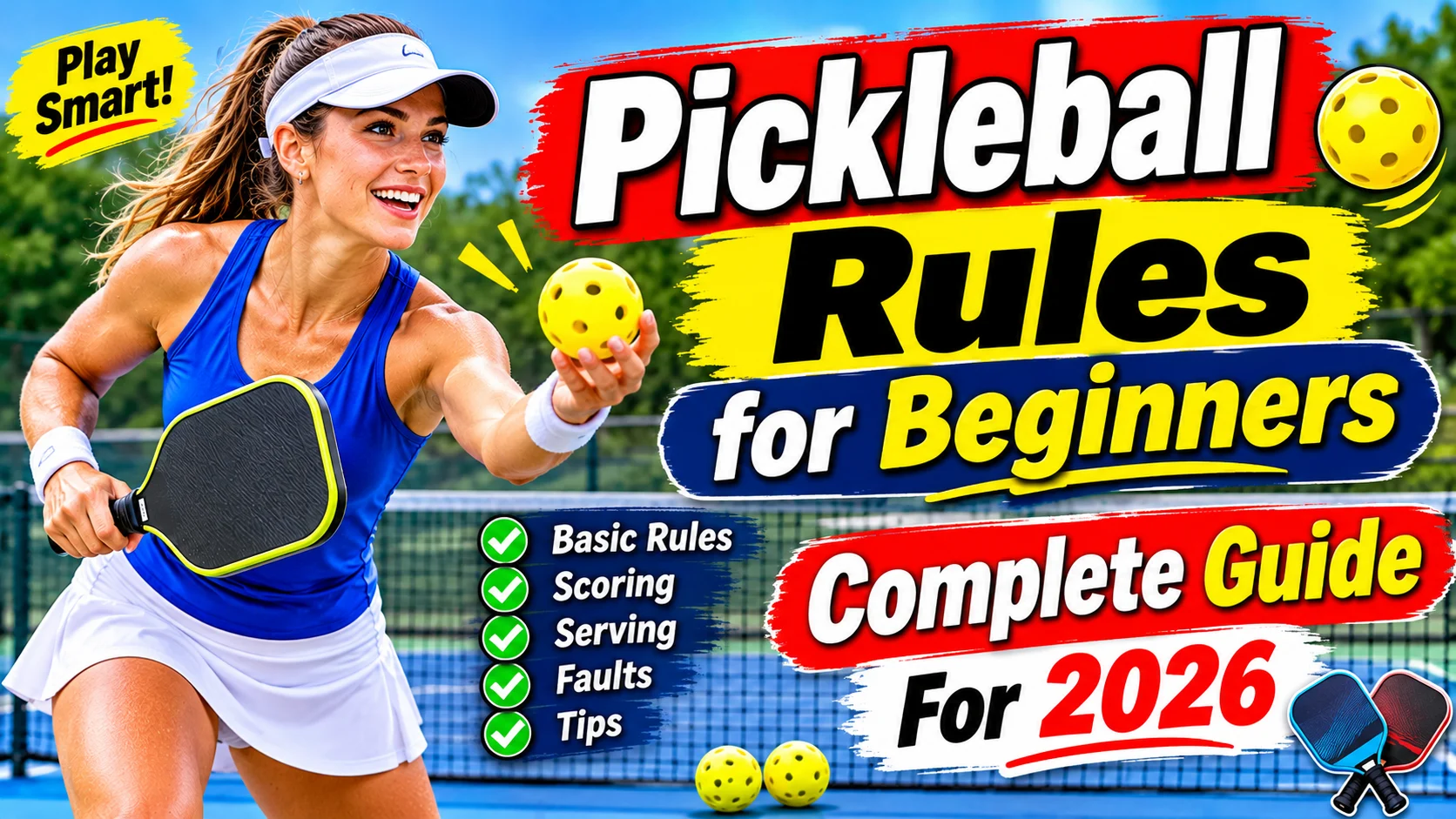
Have you ever watched a pickleball game and wondered why players suddenly stop at the kitchen line, why the ball must bounce twice, or why everyone seems so serious about a tiny plastic ball?
You’re not alone!
Pickleball is one of the easiest sports to start playing, but its rules can feel a little confusing when you’re new. The good news? You don’t need years of experience, expensive equipment, or incredible athletic skills to enjoy the game.
Whether you’re stepping onto a pickleball court for the first time, learning with friends, or preparing for your first local tournament, understanding the basic rules will help you play confidently and avoid unnecessary mistakes.
This beginner-friendly guide explains pickleball rules for beginners, including court boundaries, serving rules, scoring, the kitchen rule, the double-bounce rule, faults, singles, and doubles. By the end, you’ll know exactly how to play your first game.
Let’s get started!
What Is Pickleball?
Pickleball is a paddle sport that combines elements of tennis, badminton, and table tennis. Players use solid paddles to hit a lightweight, perforated plastic ball over a net.
The game can be played in two formats:
- Singles: One player competes against one opponent.
- Doubles: Two players compete against two opponents.
Doubles is especially popular among recreational players because it encourages teamwork, communication, and strategic positioning.
The objective is simple: hit the ball over the net, keep it inside the opponent’s court, and make your opponent commit a mistake or fail to return it.
A standard pickleball game is generally played to 11 points, and a team must win by at least two points.
Understand the Pickleball Court
Before learning how to serve or score, you need to understand the court.
A standard pickleball court measures:
- Length: 44 feet
- Width: 20 feet
- Net height: 36 inches at the sidelines
- Net height at center: 34 inches
The court is divided into two halves by a net. Each side contains two service courts and a seven-foot non-volley zone, commonly called the kitchen.
Here are the main court areas you should know:
Baseline: The back boundary line of the court.
Sidelines: The lines marking the left and right boundaries.
Centerline: Divides each side’s service area into left and right sections.
Non-Volley Zone (Kitchen): The seven-foot area on both sides of the net where volleying is prohibited.
Service Courts: The areas where a legal serve must land.
Understanding these markings makes it much easier to know where to stand and where the ball must land.
Pickleball Serving Rules for Beginners
Serving is how every rally begins. Although the serving rules may seem complicated initially, they’re quite easy once you understand the basics.
Here are the important rules:
- The server must serve diagonally into the opponent’s service court.
- The serve must clear the net and land beyond the kitchen line.
- The server must stand behind the baseline when making contact.
- The serve must land inside the correct diagonal service area.
- Only one serve attempt is allowed, except when a let serve occurs under the applicable rules.
How Can You Serve the Ball?
There are two common legal serving techniques:
Traditional Volley Serve: The paddle contacts the ball without allowing it to bounce first. The paddle must move in an upward arc, and contact must be below the waist under the traditional volley-serve requirements.
Drop Serve: The server drops the ball and hits it after it bounces. Unlike the volley serve, the drop serve does not have the same upward-arc or below-the-waist contact requirements.
Where Should You Stand?
Your feet must remain behind the baseline and within the imaginary extensions of the sidelines and centerline when contacting the serve.
Beginner tip: Don’t focus on hitting the ball as hard as possible. A controlled serve that lands deep and accurately is usually more useful than a powerful serve that goes out.
The Double-Bounce Rule (Two-Bounce Rule)
The double-bounce rule is one of the most important pickleball rules for beginners.
It means that after the serve:
- The receiving team must let the ball bounce once before returning it.
- The serving team must let the return bounce once before hitting it.
After these two required bounces, either team can volley the ball or play it after a bounce, provided they follow the kitchen rules.
Simple Example
Imagine you’re playing doubles:
- Player A serves diagonally.
- Player B lets the serve bounce and returns it.
- Player A’s team lets the return bounce.
- Both teams can now volley or hit groundstrokes.
Why does this rule exist?
It prevents the serving team from rushing directly to the net and attacking immediately. It also creates longer rallies and gives both teams a fair opportunity to establish their positions.
What Is the Kitchen Rule in Pickleball?
The kitchen is probably the most talked-about part of pickleball.
Its official name is the Non-Volley Zone (NVZ). It extends seven feet from the net on both sides of the court.
The main rule is simple:
You cannot hit the ball out of the air while standing in the kitchen or touching its boundary line.
This is called a volley.
However, you can enter the kitchen to play a ball that has bounced.
Important Kitchen Rules
- You may stand inside the kitchen whenever you want.
- You may hit a ball after it bounces inside the kitchen.
- You cannot volley while touching the kitchen or its line.
- You cannot volley and then fall into the kitchen because of your momentum.
- You must regain your balance outside the kitchen before making another volley.
Can You Step Into the Kitchen?
Yes! This is a common misunderstanding.
The kitchen is not a restricted area where players can never step. You can enter it to return a bounced ball, retrieve a short shot, or position yourself.
The restriction applies to volleying, not simply standing there.
Beginner tip: When you’re near the net, stay balanced and avoid stepping onto the kitchen line while attempting a volley.
Pickleball Scoring Rules Explained
Scoring is often the most confusing part of pickleball for beginners. Unlike tennis, traditional pickleball uses a simple point system.
How Does Pickleball Scoring Work?
The basic scoring rules are:
- Only the serving team can score points.
- A team earns a point when it wins a rally while serving.
- If the serving team loses a rally, it loses its serve.
- Most recreational games are played to 11 points.
- You must win by at least two points.
For example, if the score reaches 10–10, the game doesn’t end at 11. One team must reach 12–10, 13–11, or another score with a two-point advantage.
What Do the Three Numbers Mean?
In doubles, players announce three numbers before serving.
For example:
7 – 5 – 2
7: Serving team’s score
Serving
5: Receiving team’s score
2: Second serverExample of a traditional doubles score announcement.
The third number tells you which player is serving during the team’s service turn.
How Does Scoring Work in Singles?
Singles scoring is simpler because there is only one player on each side.
Players announce two numbers:
- First number: Server’s score.
- Second number: Receiver’s score.
There is no server number in singles.
Remember: In singles, an even score means you serve from the right side, while an odd score means you serve from the left side.
Doubles Pickleball Rules
Doubles is the most common way to enjoy pickleball. Each team has two players, and teamwork is just as important as individual skill.
Here are the basic doubles rules:
Both players get a serving turn: Normally, each player on a serving team gets an opportunity to serve before the team loses its service turn.
Start on the right: At the beginning of a team’s service turn, the first server serves from the right-hand court.
Switch sides after scoring: When the serving team scores, its players switch positions, and the same server serves again from the opposite side.
Second server takes over: When the first server commits a fault, the partner becomes the second server.
Side-out: When the second server also loses the rally, the serve passes to the opposing team.
What Is the First-Serve Exception?
At the beginning of a new game, the first serving team gets only one server before the serve passes to the opponents.
That’s why the first score is traditionally announced as:
0-0-2
It helps avoid giving the opening team an unfair advantage.
Singles Pickleball Rules
Singles pickleball is played one-on-one. The court dimensions remain the same as doubles, but each player must cover the entire court on their side.
The basic rules are almost identical:
- Serve diagonally into the opposite service court.
- Follow the two-bounce rule.
- Stay out of kitchen volleys.
- Score points when serving.
- Win by two points.
How Does Serving Work in Singles?
The server’s position depends on their score:
| Server’s score | Serving position |
|---|---|
| 0 | Right side |
| 1 | Left side |
| 2 | Right side |
| 3 | Left side |
| 4 | Right side |
| 5 | Left side |
This pattern continues throughout the game.
Unlike doubles, there is only one server per side. When that player loses a rally while serving, the opponent gets the serve.
Common Pickleball Faults Beginners Should Avoid
A fault is a rule violation that ends a rally. Understanding common faults can save you from losing easy points.
Here are some mistakes new players frequently make:
Hitting the Ball Out of Bounds
If the ball lands completely outside the court boundaries, the shot is out and the player who hit it commits a fault.
Serving Into the Kitchen
A serve must land beyond the kitchen line in the correct diagonal service court. Landing on the kitchen line is a fault.
Volleying Inside the Kitchen
Hitting the ball before it bounces while touching the kitchen or its line is illegal.
Hitting the Ball Into the Net
If the ball fails to cross the net and lands on your side, you commit a fault.
Letting the Ball Bounce Twice
You must return the ball before it bounces twice on your side.
touching the Net During Play
Touching the net or net-support system while the ball is live is a fault.
Other faults include volleying before the required two bounces, making an illegal serve, or having the ball hit your body or clothing while it is live.
Pickleball Line Rules: Is the Ball In or Out?
Line calls are another important part of learning pickleball.
The general rule is straightforward:
If the ball touches a boundary line, it is considered in.
However, there is one important exception: the kitchen line on a serve.
- A serve touching the kitchen line is a fault.
- A serve landing on the baseline, centerline, or sideline of the correct service court is in.
- During regular rallies, a ball touching a boundary line is in.
- A ball landing completely outside the court is out.
When you’re unsure about a line call, give your opponent the benefit of the doubt. Good sportsmanship makes the game more enjoyable for everyone.
What Equipment Do Beginners Need?
You don’t need a lot of equipment to start playing pickleball. A few basic items are enough.
| Equipment | Why you need it |
|---|---|
| Pickleball paddle | Used to hit the ball |
| Pickleball balls | Special perforated plastic balls |
| Court shoes | Provide grip and stability |
| Comfortable clothing | Helps you move freely |
| Water bottle | Keeps you hydrated |
How to Choose Your First Paddle
Beginners should look for a comfortable, lightweight paddle with a balanced feel and a grip that fits their hand.
You don’t need the most expensive paddle to learn the game. Focus on control, comfort, and ease of handling.
Indoor vs. Outdoor Pickleballs
Indoor and outdoor pickleballs are slightly different.
- Indoor balls: Generally have fewer, larger holes and a softer feel.
- Outdoor balls: Generally have more, smaller holes and are designed for outdoor conditions.
Use the type of ball that matches the court and game you’re playing.
Beginner Pickleball Strategies That Actually Help
Knowing the rules is only half the battle. Learning a few simple strategies can make your first games much easier.
Start With Controlled Shots
Don’t try to hit every ball as hard as possible. Focus on keeping the ball inside the court and developing consistency.
Learn the Dink Shot
A dink is a soft shot that lands in your opponent’s kitchen. It forces opponents to move forward and can create opportunities to win a rally.
Move Toward the Kitchen Line
After completing the required two-bounce sequence, moving toward the kitchen line can help you control the game. Stay balanced and avoid volleying while touching the kitchen.
Communicate With Your Partner
In doubles, call out who will take middle shots. Simple communication prevents confusion and missed opportunities.
Practice Your Serve
A reliable serve puts pressure on your opponent and helps you start rallies confidently.
Be Patient
Pickleball rewards smart decisions and consistent shots. You don’t need to win every rally with a powerful smash.
Pickleball Etiquette: Basic Rules of Good Sportsmanship
Pickleball is not just about winning. Respect and fair play are important parts of the sport.
Follow these simple etiquette guidelines:
- Call the score clearly before serving.
- Avoid distracting opponents during rallies.
- Don’t argue over close line calls.
- Give opponents enough space to play.
- Return stray balls safely.
- Congratulate your opponents after the game.
- Be friendly and patient with new players.
Remember, everyone starts as a beginner. A welcoming attitude makes pickleball enjoyable for players of all skill levels.
Essential Pickleball Rules Cheat Sheet
Want to remember the most important rules without reading the entire guide again? Here’s a quick reference.
| Rule | What beginners should remember |
|---|---|
| Players | Singles or doubles |
| Court size | 20 × 44 feet |
| Game points | Usually 11 |
| Winning margin | 2 points |
| Serving direction | Diagonally |
| Scoring | Traditional scoring awards points to the serving team |
| Two-bounce rule | Serve and return must bounce |
| Kitchen | No volleying inside it |
| Kitchen size | 7 feet from the net on each side |
| Serve position | Behind the baseline |
| Line calls | Lines are generally in |
| Side-out | Serve passes to the opponents |
Frequently Asked Questions
What are the basic rules of pickleball for beginners?
The basic rules include serving diagonally, allowing the ball to bounce once on each side after the serve, avoiding volleys inside the kitchen, and keeping the ball within the court boundaries. Traditional games are generally played to 11 points, with a two-point winning margin.
Can you step into the kitchen in pickleball?
Yes. You can step into the kitchen whenever you want, as long as you don’t volley the ball while touching the kitchen or its boundary line. You can legally enter the kitchen to hit a ball after it bounces.
How many points do you need to win pickleball?
Most standard pickleball games are played to 11 points. However, you must win by at least two points. Some tournament games are played to 15 or 21 points.
Can you score points when you’re not serving?
Under traditional side-out scoring, no. Only the serving team can earn points. The receiving team must win the rally to gain the opportunity to serve.
However, rally scoring is also used in some formats, where the team winning each rally earns a point regardless of who served.
Is the serve allowed to hit the net in pickleball?
Yes. Under the 2026 USA Pickleball rules, a serve that touches the net while crossing and lands in the correct service court remains in play. There is no automatic replay for a net-touching serve.
Can you hit the ball twice in pickleball?
A player generally cannot deliberately hit the ball twice in one continuous attempt. However, certain accidental double contacts in one continuous motion are allowed under the official rules.
What happens if the ball lands on the kitchen line during a serve?
It is a fault. The serve must land beyond the kitchen line inside the correct diagonal service court.
Is pickleball easier than tennis?
Many beginners find pickleball easier to learn because the court is smaller, the paddle is easier to handle, and the basic rules are relatively simple. However, becoming an advanced player still requires practice, strategy, and good footwork.
Can beginners play pickleball without lessons?
Absolutely! Many people learn through recreational games, beginner videos, and practice with friends. Understanding the serving, scoring, kitchen, and two-bounce rules gives you a strong starting point.
What is the most important rule in pickleball?
The two-bounce rule and kitchen rule are two of the most important rules to understand. They make pickleball different from other paddle sports and have a major influence on how rallies develop.
Final Thoughts
Pickleball is easy to start, exciting to play, and rewarding to improve at. You don’t have to memorize every official rule before stepping onto the court.
Start by understanding the basics: how to serve, when to score, how the two-bounce rule works, and why the kitchen matters. Once these rules become familiar, you’ll find it much easier to enjoy rallies, develop your skills, and play confidently with others.
Don’t worry about making mistakes during your first few games. Every experienced pickleball player was once a beginner.
Grab your paddle, find a court, invite a friend, and give it a try. Your first great pickleball rally might be just one game away

Theo Bennett is a passionate sports writer and storyteller at SportNestify.com covering cricket, football, hockey, tennis, basketball and more. With a focus on clear insights, engaging analysis, player stories, and the latest sporting trends, Leo turns every game into a story worth following. His goal is simple