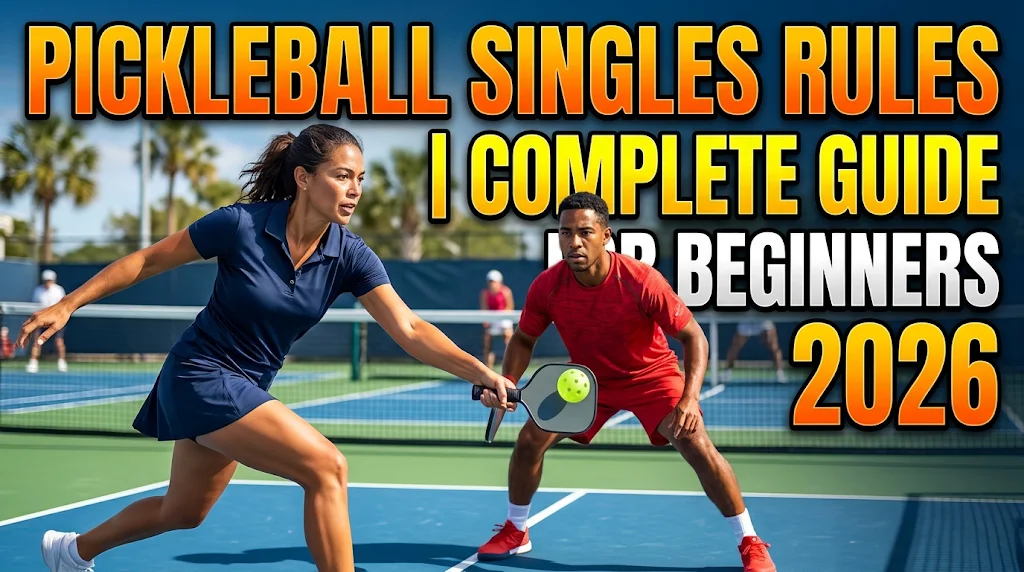
Want to play pickleball but don’t have a partner? No problem! Pickleball singles is one of the most exciting ways to enjoy the sport. It’s just you, your paddle, your opponent, and a court where every shot counts.
Unlike doubles, singles pickleball requires players to cover the entire court alone. That means more running, quicker reactions, smarter shot placement, and plenty of opportunities to outthink your opponent.
But before stepping onto the court, you need to understand the rules. How do you serve? How does scoring work? Can you step into the kitchen? What happens when the ball lands on a line?
This guide explains pickleball singles rules in simple language, covering everything from serving and scoring to faults, court boundaries, and winning strategies.
Whether you’re a complete beginner or an experienced player looking to improve your game, you’ll find everything you need to play singles pickleball confidently.
What Is Singles Pickleball?
Singles pickleball is a one-on-one version of pickleball where one player competes against another.
Both players use paddles to hit a lightweight plastic ball with holes over a net. The objective is to send the ball into your opponent’s court in a way that makes it difficult or impossible to return.
The biggest difference between singles and doubles is court coverage. In singles, you must defend the entire court yourself. There is no partner to cover your weaknesses or chase difficult shots.
The good news? Singles uses the same standard court dimensions and most of the same rules as doubles.
Quick Singles Pickleball Rules
Here are the essential rules to remember before your first match:
- Players: One player on each side.
- Court size: 20 feet wide and 44 feet long.
- Net height: 36 inches at the sidelines and 34 inches at the center.
- Scoring: Traditional side-out scoring.
- Winning score: Usually 11 points, with a two-point lead required.
- Serving: Underhand volley serve or legal drop serve.
- Serve direction: Diagonally into the opposite service court.
- Two-bounce rule: Each player must allow the ball to bounce once after the serve before volleying becomes legal.
- Kitchen rule: Players cannot volley while touching the non-volley zone.
- Winning objective: Score points by serving successfully and forcing your opponent into a fault.
Pickleball Singles Court Rules
The first thing to understand is the court.
A standard pickleball court measures 20 feet wide and 44 feet long. These dimensions remain the same whether you’re playing singles or doubles.
The court is divided into two sides by a net, with each side containing several important areas.
Important court lines and areas include:
- Baseline: The back boundary line of the court.
- Sidelines: The lines running along the left and right edges.
- Centerline: Separates the right and left service courts.
- Non-volley zone: The seven-foot area directly next to the net, commonly called the kitchen.
- Service courts: The two diagonal sections behind the kitchen.
In singles, you use the full width and length of the court. You don’t need to play inside narrower singles sidelines like in traditional tennis.
One important detail: The court lines are generally considered part of the areas they define. A ball landing on a boundary line is normally in, but a serve landing on the non-volley zone line is a fault.
Pickleball Singles Serving Rules
Serving is where every singles rally begins. Getting the serve right is essential because an illegal serve can immediately cost you possession.
In standard pickleball, the server must serve diagonally into the opposite service court.
There are two legal serving methods.
Volley Serve
A volley serve means hitting the ball before it touches the ground.
Under the official rules, the server must:
- Keep the arm moving in an upward arc when striking the ball.
- Make contact below waist level.
- Keep the paddle head below the highest part of the wrist at contact.
- Stand behind the baseline when serving.
- Avoid touching the baseline or court with either foot when striking the ball.
The serve must travel diagonally over the net and land inside the correct service court.
Drop Serve
The drop serve is another legal option, especially useful for beginners.
Instead of hitting the ball directly from the air, you release it and allow it to bounce before striking it.
The ball must be dropped naturally, without throwing or pushing it downward or upward to create an advantage.
Unlike the volley serve, the drop serve does not have the same restrictions on the serving arm’s upward motion or paddle position.
Where Should You Stand When Serving?
This is one of the most important singles rules.
Your position depends on your current score:
- Even score (0, 2, 4, 6, 8, 10): Serve from the right side.
- Odd score (1, 3, 5, 7, 9): Serve from the left side.
For example, if your score is 4, you serve from the right. If you score another point and reach 5, your next serve comes from the left.
Remember: Your opponent receives the serve in the diagonally opposite service court.
How Many Serve Attempts Do You Get?
In traditional singles pickleball, you get one serve attempt.
If your serve lands in the net, goes out of bounds, or lands in the kitchen, it’s a fault.
There is no second serve like in tennis.
Pickleball Singles Scoring Rules
Scoring is one area that confuses new pickleball players, but singles scoring is actually quite simple.
Under traditional side-out scoring, only the serving player can score a point.
Here’s how it works:
- You serve the ball to your opponent.
- If you win the rally, you earn one point.
- You keep serving and switch serving sides.
- If you lose the rally, your opponent gets the serve.
- Your opponent can now score points while serving.
Unlike doubles, singles does not use a third number for the server position.
What Is the Winning Score?
Most recreational singles games are played to 11 points.
However, you must win by at least two points.
For example:
- 11–8: You win.
- 11–10: The game continues.
- 12–10: You win.
- 15–13: You win.
Some tournaments use games to 15 or 21 points, also requiring a two-point advantage.
Always check the tournament format before playing.
Singles Scoring Example
Let’s say you’re playing against an opponent.
| Rally | Your Score | Opponent’s Score | Result |
|---|---|---|---|
| Start | 0 | 0 | You serve from right |
| You win | 1 | 0 | Serve from left |
| You win | 2 | 0 | Serve from right |
| Opponent wins | 2 | 0 | Opponent gets serve |
| Opponent wins | 2 | 1 | Opponent scores |
| You win | 2 | 1 | You regain serve |
Notice something important: When your opponent wins a rally while serving, they earn a point. When you win a rally while receiving, you don’t earn a point under traditional side-out scoring. You simply regain the serve.
The Two-Bounce Rule in Singles
The two-bounce rule is one of the most important rules in pickleball.
It prevents players from rushing directly to the net and smashing the ball immediately after serving.
Here’s how it works:
First bounce: The receiver must let the serve bounce before returning it.
Second bounce: The server must let the return bounce before hitting it back.
After these two required bounces, either player can volley the ball or allow it to bounce before returning it.
Example
Imagine you serve the ball diagonally.
Your opponent allows it to bounce and returns it. You must also let that return bounce before hitting it.
After that, both players can move forward, attack, defend, and volley whenever appropriate.
Remember: The two-bounce rule applies to the beginning of every standard rally, not just the first rally of the game.
The Kitchen Rule in Singles Pickleball
The kitchen, officially called the non-volley zone (NVZ), is the seven-foot area on each side of the net.
It’s one of pickleball’s most recognizable rules.
The main rule is simple:
You cannot hit the ball out of the air while standing in or touching the kitchen.
If you volley the ball while touching the kitchen line, your foot is inside the kitchen, or your momentum carries you into the kitchen after the volley, you commit a fault.
However, you can legally enter the kitchen whenever you want, provided you don’t volley the ball while touching it.
For example, if your opponent hits a short shot into the kitchen, you can step inside, allow the ball to bounce, and return it.
You can also remain inside the kitchen and play bounced shots.
Can You Step Into the Kitchen After Hitting the Ball?
Yes, but there is an important condition.
If you hit a volley outside the kitchen, your momentum must not carry you into the kitchen or onto its line.
You must regain your balance outside the kitchen before entering it legally.
This rule applies even if the rally has already ended before your momentum carries you into the zone.
What Counts as a Fault in Singles Pickleball?
A fault is a rule violation that stops the rally.
Understanding common faults can help you avoid unnecessary mistakes.
Here are the most common singles pickleball faults:
Serving out of bounds: Your serve lands outside the correct diagonal service court.
Kitchen violation: You volley the ball while touching the non-volley zone.
Hitting the ball into the net: Your return fails to clear the net.
Double bounce: You allow the ball to bounce twice on your side before returning it.
Illegal serve: You violate the required serving technique or position.
Hitting the ball out: Your shot lands outside your opponent’s court.
Net contact: You or your paddle touch the net or net support system while the ball is live.
Two-bounce violation: You volley the serve or the first return before the required bounce.
Ball hits your body: A live ball hits you or something you’re wearing or carrying.
In traditional side-out scoring, a fault by the serving player means the serve passes to the opponent. A fault by the receiving player awards a point to the server.
Pickleball Singles Line Rules
Line calls can make a big difference in close matches.
The basic rule is that a ball touching a boundary line is considered in, except when a serve touches the kitchen line.
Here are the important situations:
- Ball touches the baseline: In.
- Ball touches the sideline: In.
- Ball touches the centerline: In.
- Serve touches the kitchen line: Fault.
- Ball lands completely outside the court: Out.
In recreational games, players generally make line calls on their own side of the court.
If you’re unsure whether a ball landed in or out, the benefit of the doubt generally goes to your opponent.
Clear and honest line calls help keep the game competitive and enjoyable.
How Is Singles Different From Doubles Pickleball?
Although singles and doubles share most of the same rules, the playing experience is very different.
| Feature | Singles | Doubles |
|---|---|---|
| Players | 1 vs. 1 | 2 vs. 2 |
| Court dimensions | 20 × 44 feet | 20 × 44 feet |
| Serving | One player serves | Both players usually serve |
| Scoring | Two numbers | Three numbers |
| Court coverage | Entire court alone | Shared with partner |
| Strategy | Speed and placement | Teamwork and positioning |
| Physical demand | Generally higher | More shared movement |
One major difference is serving rotation.
In singles, your serving side is determined by whether your score is even or odd.
In doubles, the serving rotation involves two players on each team, with a different scoring and server sequence.
Best Strategies for Winning Singles Pickleball
Knowing the rules helps you play correctly. Knowing the right strategies helps you win.
Singles pickleball requires a combination of patience, movement, and smart shot selection.
Here are some practical strategies to improve your game.
Move Your Opponent Around
Don’t hit every shot directly toward your opponent.
Try placing the ball toward the corners and making your opponent move from side to side.
This can create open spaces for your next shot.
Use Deep Serves
A deep serve pushes your opponent toward the baseline and makes it harder for them to attack immediately.
Focus on consistency rather than trying to hit the hardest possible serve.
Return the Serve Deep
A deep return gives you more time to move forward and prepare for your opponent’s next shot.
It also makes it harder for your opponent to move toward the kitchen line quickly.
Improve Your Footwork
Singles players cover more ground than doubles players.
Use small adjustment steps, stay balanced, and avoid standing flat-footed.
Good footwork helps you reach difficult shots without losing control.
Learn to Hit Drop Shots
A soft drop shot can force your opponent to move forward and hit the ball upward.
This gives you an opportunity to take control of the rally.
Be Patient
Not every ball needs to be smashed.
Sometimes the smartest move is to return the ball safely, wait for a weak shot, and attack when the opportunity appears.
Common Singles Pickleball Mistakes Beginners Should Avoid
Even players who understand the rules can make simple mistakes that cost them points.
Watch out for these common problems:
- Serving from the wrong side of the court.
- Forgetting to switch sides after scoring.
- Volleying before the two-bounce requirement is complete.
- Stepping into the kitchen while hitting a volley.
- Hitting every shot too hard.
- Standing too close to the baseline after serving.
- Ignoring your opponent’s weak side.
- Trying risky shots instead of keeping the ball in play.
The best way to improve is to focus on consistency first. Once you can keep the ball in play, start developing more aggressive shots.
Frequently Asked Questions
Is singles pickleball played on the same court as doubles?
Yes. Standard singles and doubles pickleball use the same court dimensions: 20 feet wide and 44 feet long.
How do you score in singles pickleball?
Under traditional side-out scoring, only the serving player can score points. If the receiver wins the rally, they gain the serve instead of a point.
Do you switch sides after every point in singles?
Yes. When you score a point while serving, you switch between the right and left serving positions. Your position depends on whether your score is even or odd.
Can you enter the kitchen in singles pickleball?
Yes. You can enter the kitchen whenever you want, but you cannot volley the ball while touching the kitchen or its line.
What score do you play to in singles pickleball?
Most games are played to 11 points, and you must win by two points. Some competitive formats use 15 or 21 points.
Can you hit the ball before it bounces in singles?
Yes. Once the two-bounce rule has been satisfied, you can volley the ball from anywhere outside the kitchen, provided you don’t commit another fault.
Is the serve always diagonal in singles pickleball?
Yes. The server must hit the ball diagonally into the opponent’s opposite service court.
How many serves do you get in singles pickleball?
Under standard traditional singles rules, you get one serve attempt. If you commit a serving fault, you lose the serve.
Can you use the drop serve in singles pickleball?
Yes. The drop serve is legal in singles and doubles, provided it follows the official drop-serve requirements.
What happens if the ball hits the line?
A ball touching a boundary line is generally considered in. The exception is a serve touching the non-volley zone line, which is a fault.
Final Thoughts
Pickleball singles is all about smart decisions, quick movement, and consistent shots. While the rules are similar to doubles, playing one-on-one requires more stamina and individual court awareness.
Start by mastering the basics: serve from the correct side, understand traditional scoring, follow the two-bounce rule, and avoid kitchen violations.
Once these rules become second nature, focus on improving your footwork, shot placement, and overall strategy.
You don’t need professional-level skills to enjoy singles pickleball. You just need a paddle, a ball, an opponent, and a willingness to improve.

Theo Bennett is a passionate sports writer and storyteller at SportNestify.com covering cricket, football, hockey, tennis, basketball and more. With a focus on clear insights, engaging analysis, player stories, and the latest sporting trends, Leo turns every game into a story worth following. His goal is simple