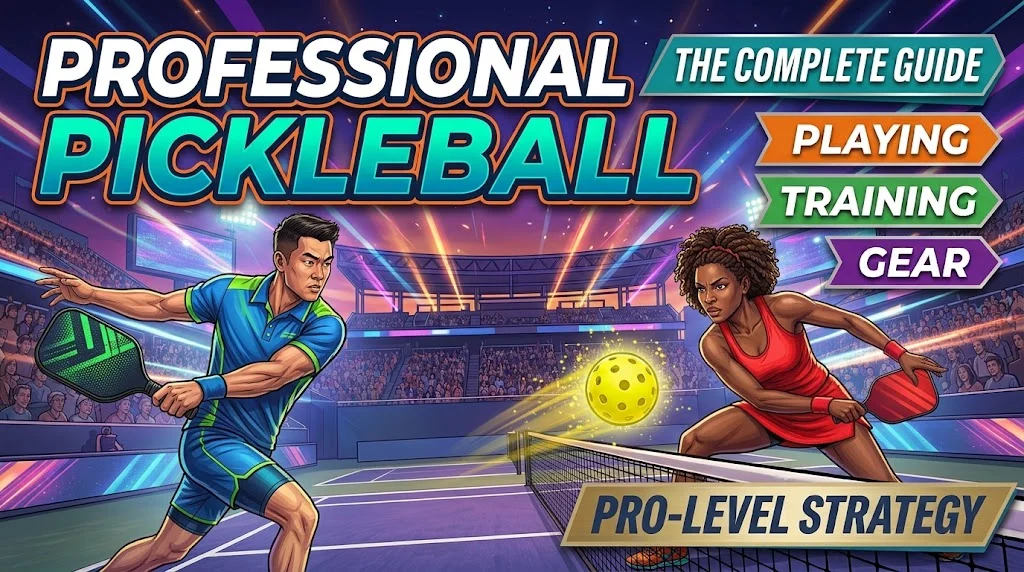
Pickleball has evolved far beyond a casual backyard game. Today, professional pickleball is a serious competitive sport with elite athletes, specialized training, advanced paddles, organized tournaments, and rapidly growing fan interest.
But what does it actually take to play pickleball professionally?
Whether you’re an aspiring pro, an ambitious recreational player, or simply curious about how professional pickleball works, this guide covers the essentials from rules and rankings to training, equipment, strategy, tournaments, and the path to becoming a professional player.
What Is Professional Pickleball?
Professional pickleball is the highest level of competitive pickleball, where skilled players compete in organized tournaments under standardized rules.
Professional players typically specialize in:
- Singles
- Men’s doubles
- Women’s doubles
- Mixed doubles
At the professional level, the game is much faster and more tactical than recreational pickleball. Players need excellent hand speed, precise shot placement, court awareness, consistency, athletic movement, and the ability to make smart decisions under pressure.
The biggest difference isn’t simply hitting the ball harder.
Professional pickleball is about controlling the game.
A pro can slow down a rally, create an opening, force an opponent into an uncomfortable position, and finish the point with a well-timed attack.
How Do You Become a Professional Pickleball Player?
There isn’t one universal route to becoming a professional pickleball player. However, most successful players follow a similar progression:
Learn → Practice → Compete → Improve → Enter Higher-Level Events → Build a Ranking → Go Pro
Master the Fundamentals
Before worrying about professional tournaments, develop reliable fundamentals.
Focus on:
- Forehand and backhand technique
- Serves
- Returns
- Dinks
- Volleys
- Third-shot drops
- Drives
- Resets
- Lob shots
- Footwork
Consistency should come before power.
A player who can hit ten controlled shots is usually more dangerous than someone who can hit one spectacular winner followed by three unforced errors.
Play Competitive Matches
Practice is important, but tournament experience teaches lessons that drills cannot.
Start playing:
- Local tournaments
- Club competitions
- Amateur divisions
- Regional events
- Rating-based competitions
Competitive matches teach you how to manage nerves, momentum, fatigue, pressure, and tactical adjustments.
Improve Your Rating
Competitive pickleball uses player ratings to help measure skill levels and organize competition.
Ratings can help you identify weaknesses and determine which competitive level is appropriate for you.
Instead of asking, “Am I good enough to go pro?” ask:
“What specific skills are keeping me from the next level?”
That question creates a much better improvement plan.
What Skills Do Professional Pickleball Players Need?
Professional pickleball requires a combination of technical skill, physical ability, tactical intelligence, and mental strength.
Soft Game Control
One of the defining skills of high-level pickleball is the ability to control the soft game.
This includes:
- Dinking
- Resets
- Soft drops
- Controlled volleys
At the kitchen line, tiny differences in ball placement can completely change a rally.
Professionals aren’t simply trying to hit the ball over the net. They’re trying to make their opponent hit the next shot from an uncomfortable position.
Third-Shot Drop
The third-shot drop is one of the most important shots in competitive pickleball.
The goal is to hit a soft, controlled shot that lands in the opponent’s kitchen, giving the serving team an opportunity to move forward.
A strong third-shot drop can transform a defensive position into an attacking opportunity.
Speed and Reflexes
Professional rallies can become extremely fast.
Players need:
- Quick hands
- Fast reactions
- Explosive movement
- Balance
- Coordination
At the kitchen line, there may be only fractions of a second to react.
Shot Placement
Power can help but precision wins points.
Pros constantly target areas such as:
- Opponent’s backhand
- Feet
- Sideline gaps
- Middle of the court
- Open spaces
- Player transition zones
The objective is to make the opponent uncomfortable rather than simply hitting hard.
Mental Toughness
Professional pickleball is also a mental game.
Elite players need to stay composed after:
- Losing several points
- Missing an easy shot
- Losing a lead
- Facing match point
- Playing against a stronger opponent
A single mistake doesn’t have to become a five-point collapse.
Professional Pickleball Equipment
The right equipment can improve comfort, consistency, and performance but expensive gear won’t replace good technique.
Pickleball Paddle
A professional paddle needs to provide a balance of:
- Control
- Power
- Spin
- Maneuverability
- Stability
Players often choose paddles based on their playing style.
A power-oriented player may prefer a paddle designed for aggressive shots, while a control-focused player may prioritize touch and precision.
Pickleball Balls
Indoor and outdoor pickleballs are designed differently.
Outdoor balls generally have smaller holes and are built to handle wind and harder surfaces. Indoor balls typically have larger holes and behave differently during rallies.
Competitive players should practice with the type of ball used in their tournaments whenever possible.
Pickleball Shoes
Footwear is often overlooked by beginners.
Professional players need shoes that provide:
- Lateral stability
- Grip
- Cushioning
- Durability
- Quick movement support
Running shoes aren’t always ideal because pickleball involves frequent side-to-side movements, sudden stops, and changes of direction.
Clothing
Professional pickleball clothing should be lightweight, breathable, flexible, and comfortable.
Good apparel allows players to move freely without being distracted by overheating or restrictive materials.
Professional Pickleball Strategy
Professional pickleball strategy is much deeper than simply trying to hit winners.
The Kitchen Is the Battlefield
The non-volley zone, commonly called the kitchen, is central to competitive pickleball.
Players generally want to establish a strong position near the kitchen line because it provides better opportunities to attack and control the rally.
But getting there isn’t enough.
You need to arrive under control.
A rushed approach can leave you vulnerable to an aggressive counterattack
The Importance of the Return
The return of serve is another crucial part of professional pickleball.
A good return can:
- Push the opponent deep.
- Give you time to move forward.
- Establish better court position.
- Create pressure on the serving team.
A deep, controlled return is often more valuable than a risky return aimed at hitting an immediate winner.
Singles vs. Doubles in Professional Pickleball
Professional singles and doubles require noticeably different strategies.
Professional Singles
Singles demands greater individual court coverage.
Players need:
- Strong movement
- Stamina
- Consistent groundstrokes
- Effective serving
- Deep returns
- Ability to create angles
Because there is no partner covering half the court, positioning and endurance become extremely important.
Professional Doubles
Doubles is more about teamwork and positioning.
Partners need to communicate and coordinate:
- Who takes the middle?
- Who covers the lob?
- When should they attack?
- When should they reset?
- When should they switch positions?
The best doubles teams often look synchronized because they anticipate each other’s decisions.
How Much Do Professional Pickleball Players Practice?
There isn’t one universal training schedule for professional players.
However, serious competitors commonly divide training into several areas rather than simply playing matches all day.
A typical training program can include:
Technical Training:
Dinks, drops, drives, volleys, serves and returns.
Tactical Training:
Point construction, positioning, opponent analysis and game strategy.
Physical Training:
Strength, mobility, speed, balance and conditioning.
Mental Training:
Focus, pressure management and match preparation.
Match Play:
Competitive games that test everything under realistic conditions.
The key is quality over mindless repetition.
Professional Pickleball Training Drills
If you want to train like a serious player, start with drills that have a specific purpose.
Dinking Drill
Stand at the kitchen line with a partner and exchange controlled dinks.
Focus on:
- Keeping the ball low
- Moving your opponent
- Avoiding unnecessary errors
- Maintaining consistent contact
Third-Shot Drop Drill
Practice dropping balls from the baseline or transition zone into the kitchen.
Your goal isn’t maximum spin or power.
Your goal is repeatable accuracy.
Reset Drill
Practice slowing down aggressive balls from your opponent.
This teaches you to absorb pace and regain control of the rally.
Volley Reaction Drill
Stand close to the kitchen line and exchange increasingly faster volleys.
This develops hand speed, reaction time and compact paddle movements.
How Much Does It Cost to Play Professional Pickleball?
The cost varies significantly depending on how seriously you compete.
Beginners can start with relatively affordable equipment, while serious competitive players may spend more on:
- High-performance paddles
- Shoes
- Training
- Coaching
- Tournament entry fees
- Travel
- Accommodation
- Fitness programs
For aspiring professionals, travel and tournament expenses can become much more significant than equipment costs.
That’s why players should build a realistic competition budget before pursuing a professional schedule.
Can Anyone Become a Professional Pickleball Player?
Technically, many players can pursue the competitive pathway but reaching the professional level is difficult.
Talent helps, but it isn’t the only factor.
Successful players usually combine:
Skill + Training + Athleticism + Strategy + Consistency + Competition Experience + Mental Strength
You don’t need to start as a child to become a strong pickleball player.
Adults can improve dramatically with structured training and regular competition.
The important thing is to understand where you are now and build toward the next level.
Common Mistakes Aspiring Pickleball Pros Make
Want to improve faster? Avoid these common mistakes.
Trying to Hit Every Ball Hard
Power is exciting, but uncontrolled aggression creates errors.
Learn when to attack and when to reset.
Ignoring the Soft Game
Players who only practice drives often struggle against opponents who can dominate the kitchen.
Practicing Without a Goal
Simply playing games isn’t always effective training.
Identify a weakness and deliberately work on it.
Buying Equipment Instead of Improving Technique
A premium paddle won’t fix poor footwork or inconsistent shot mechanics.
Neglecting Fitness
Pickleball may look relaxed from the sidelines, but competitive matches require repeated explosive movement.
Playing Only Against Easier Opponents
You need challenging competition to discover your weaknesses.
Professional Pickleball Rules You Should Know
Competitive pickleball follows standardized rules covering serving, scoring, the non-volley zone, faults and other aspects of play.
Some fundamentals include:
- Games are commonly played to 11 points, with a team needing to win by 2.
- The serve must follow the applicable serving rules.
- The ball must clear the net and land in the correct service area.
- The non-volley zone restricts players from volleying while standing in the zone.
- Faults can result from several situations, including balls landing out or violating serving or kitchen rules.
Because competitive rules can change and tournament formats can differ, serious players should always check the current rules for the organization and event they are entering.
Where Do Professional Pickleball Players Compete?
Professional players compete in organized tournaments and professional-level events across different regions.
Major competitions attract highly skilled players, large audiences, sponsors and growing media attention.
Professional pickleball has also developed into a more structured sports ecosystem involving:
- Professional tours
- Tournament organizations
- Sponsorships
- Coaching programs
- Training facilities
- Pickleball clubs
- Sports media
- Equipment brands
This growing ecosystem is creating more opportunities for players, coaches, content creators and businesses.
How to Train Like a Professional Pickleball Player
If you’re serious about improving, don’t simply play more.
Train smarter.
A practical weekly structure might look like:
| Training Area | Focus |
|---|---|
| Technique | Dinks, drops, drives, volleys |
| Footwork | Lateral movement and recovery |
| Strength | Legs, core and upper body |
| Conditioning | Match endurance |
| Strategy | Positioning and shot selection |
| Match Play | Competitive decision-making |
| Recovery | Mobility, rest and injury prevention |
Your training plan should also change as your weaknesses change.
For example, if your third-shot drop is reliable but your transition game is weak, spending another hour practicing basic serves may not be the best use of your time.
The Future of Professional Pickleball
Professional pickleball continues to attract attention because it combines accessibility with high-level competition.
One reason for its appeal is simple:
It’s easy to start but incredibly difficult to master.
A beginner can learn the basic rules quickly, while advanced players can spend years developing subtle skills such as spin control, anticipation, soft hands, positioning and tactical awareness.
As participation and professional competition continue to grow, the sport is likely to become even more sophisticated.
Better training systems, improved equipment, stronger athletic preparation and more advanced analytics could push the professional game to another level.
Frequently Asked Questions
What is professional pickleball?
Professional pickleball is the elite competitive level of the sport, featuring highly skilled players competing in organized tournaments and professional-level events.
How do you become a professional pickleball player?
Start by mastering the fundamentals, compete regularly, improve your rating and gradually enter stronger tournaments. Coaching, physical training and match experience can accelerate development.
What skills are most important for professional pickleball?
The most important skills include dinking, third-shot drops, resets, volleys, serves, returns, footwork, positioning, shot selection and mental toughness.
Is professional pickleball difficult?
Yes. Although pickleball is easy to learn at a basic level, professional competition requires exceptional consistency, reaction speed, movement, tactical awareness and mental discipline.
What paddle do professional pickleball players use?
Professional players use a wide range of paddles. The ideal paddle depends on playing style, preferences, specifications and applicable competition regulations.
Can adults become professional pickleball players?
Yes. Adults can develop highly competitive skills with structured practice, coaching, physical preparation and regular tournament experience. However, reaching the professional level requires substantial commitment.
Is pickleball becoming a professional sport?
Yes. Professional pickleball has developed organized competitive circuits, professional athletes, tournaments, sponsorships and a growing audience.
Final Thoughts
Professional pickleball is not just about hitting the ball harder. It’s about making better decisions, controlling the court and executing under pressure.
If you want to move from recreational player to serious competitor, focus on the fundamentals first: dinking, drops, resets, returns, positioning, footwork and consistency.
Then add structured strength training, tactical practice and competitive match experience.
The biggest secret?
Don’t try to play like a professional before you train like one.
Build your skills one layer at a time, compete against better players, study your mistakes and keep improving.
Because in professional pickleball, the difference between a good player and a great player is often not one spectacular shot it’s the ability to make the right shot, at the right time, again and again.

Theo Bennett is a passionate sports writer and storyteller at SportNestify.com covering cricket, football, hockey, tennis, basketball and more. With a focus on clear insights, engaging analysis, player stories, and the latest sporting trends, Leo turns every game into a story worth following. His goal is simple