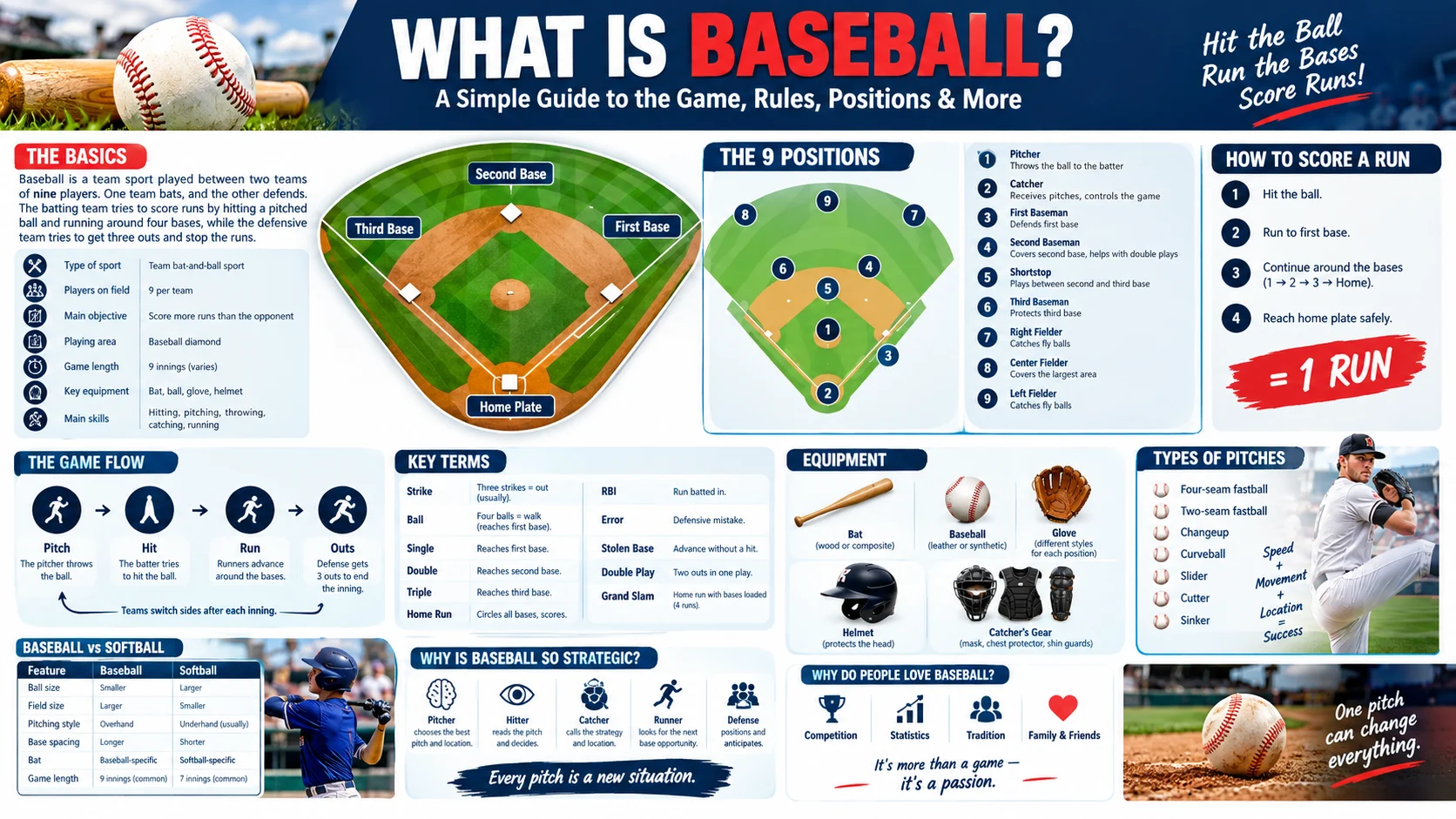
Baseball is a team sport played between two teams of nine players, with one team batting and the other defending at a time. The batting team tries to score runs by hitting a pitched ball and running around four bases, while the defensive team tries to record outs and stop those runs.
At its simplest, baseball is a battle between the hitter, the pitcher, and the defense.
But there is much more to the game.
A single pitch can involve strategy, timing, speed, positioning, and split-second decisions. That’s what makes baseball unique: every pitch can change the game.
What Is Baseball?
Baseball is a bat-and-ball sport in which two teams compete to score the most runs.
A player on offense hits a ball thrown by the opposing team’s pitcher. After making a legal hit, the batter can run around the bases. A complete trip around first, second, third, and home plate scores one run.
The team with the most runs at the end of the game wins.
Baseball at a Glance
| Feature | Baseball |
|---|---|
| Type of sport | Team bat-and-ball sport |
| Players on field | 9 per team |
| Main objective | Score more runs than the opponent |
| Scoring unit | Run |
| Playing area | Baseball diamond |
| Main offensive player | Batter |
| Main defensive player | Pitcher |
| Standard game | 9 innings |
| Key equipment | Bat, baseball, glove, helmet |
| Important skills | Hitting, pitching, throwing, catching, running |
How Does Baseball Work?
Baseball is divided into innings.
During the first half of an inning, one team bats while the other team plays defense.
The teams then switch roles.
The offensive team tries to score runs, while the defensive team attempts to get three outs.
Once three outs are recorded, the teams change sides.
A standard professional baseball game consists of nine innings, although extra innings may be played when the score is tied.
How Do You Score in Baseball?
Scoring a run is the main objective of the offense.
After hitting the ball successfully, a batter can advance around the bases:
Home Plate → First Base → Second Base → Third Base → Home Plate
If the runner reaches home plate safely after touching the required bases, their team scores one run.
Example
Imagine a batter hits a double and reaches second base.
The next batter hits a single, allowing the runner to advance to third.
Another batter hits a sacrifice fly, and the runner reaches home safely.
That’s one run.
Baseball therefore isn’t simply about hitting the ball as far as possible. Teams constantly make decisions about when to run, when to advance, and how to create scoring opportunities.
What Are the Bases in Baseball?
A baseball diamond has four bases:
- Home plate
- First base
- Second base
- Third base
Home plate is where the batter stands and where runs are scored.
The bases form a diamond-shaped path that runners follow.
A player normally advances counterclockwise:
Home → First → Second → Third → Home
What Is an Out in Baseball?
The defensive team needs three outs to end the opponent’s turn at bat.
There are several ways a batter or runner can be recorded as out.
Strikeout
A batter receives three strikes and is called out, subject to the rules governing the particular strikeout situation.
Fly Out
A defensive player catches a batted ball before it touches the ground.
Ground Out
A fielder makes a play that results in the batter-runner being retired before reaching first base.
Force Out
A runner is forced to advance because the batter becomes a runner, and the defense records the out by reaching the required base first.
Tag Out
A defensive player touches a runner with the ball or a glove containing the ball while the runner is not safely on a base.
These different types of outs make baseball strategically complex.
What Is a Strike?
A strike is one of the most important concepts in baseball.
A strike can occur when:
- The batter swings and misses.
- The batter swings and hits a foul ball, subject to the applicable rules.
- A pitched ball passes through the strike zone without being hit.
Three strikes generally result in a strikeout.
However, baseball’s strike rules contain important exceptions, so the simple idea of “three strikes equals an out” doesn’t describe every possible situation.
What Is a Ball?
A ball is generally a pitch that does not enter the strike zone and is not swung at by the batter.
If a batter receives four balls during a plate appearance, the batter is awarded first base, commonly called a walk or base on balls.
This creates an interesting part of baseball strategy.
A pitcher wants to throw effective strikes without giving the hitter a pitch that can be hit hard, while the batter wants to recognize hittable pitches and avoid chasing poor ones.
What Is a Home Run?
A home run occurs when a batter hits a fair ball that allows them to circle all the bases and score.
The most familiar home run is a ball hit over the outfield fence in fair territory.
When a batter hits a home run with no runners on base, they score one run.
If runners are already on base, they can score as well.
A home run with the bases loaded is called a grand slam and scores four runs.
What Are the Positions in Baseball?
Baseball players have specialized defensive positions.
Pitcher
The pitcher throws the ball toward the batter and attempts to prevent the offense from making successful contact.
Catcher
The catcher crouches behind home plate and receives pitches. Catchers also help communicate defensive strategy and control the running game.
First Baseman
The first baseman primarily defends the area around first base.
Second Baseman
The second baseman covers the area between first and second base and often participates in double plays.
Shortstop
The shortstop plays between second and third base and is typically responsible for a large area of the infield.
Third Baseman
The third baseman protects the area around third base and must react quickly to hard-hit balls.
Outfielders
There are three outfield positions:
- Left field
- Center field
- Right field
Outfielders catch fly balls and defend the large area beyond the infield.
What Does the Pitcher Do?
The pitcher is one of the most important defensive players.
Instead of simply throwing the ball as hard as possible, pitchers use different types of pitches and locations to challenge hitters.
Common pitch types include:
- Four-seam fastball
- Two-seam fastball
- Changeup
- Curveball
- Slider
- Cutter
- Sinker
Different pitches move at different speeds and can break in different directions.
A successful pitcher combines velocity, movement, location, and deception.
What Does the Batter Do?
The batter’s job is to help the team score.
That can mean more than hitting home runs.
A batter may try to:
- Get a base hit
- Draw a walk
- Advance a runner
- Hit a sacrifice fly
- Hit for extra bases
- Avoid making an out
Good hitters don’t simply swing at everything.
They must recognize pitches, judge speed and movement, control the strike zone, and decide whether a particular pitch is worth attacking.
What Equipment Is Used in Baseball?
Basic baseball equipment includes:
Baseball Bat
Used to hit the pitched baseball. Bats may be made from wood or other approved materials depending on the league and level of play.
Baseball
A baseball consists of a central core surrounded by material and covered with leather or synthetic material, with distinctive stitching.
Glove
Players use gloves to catch and field the ball. Different positions may use different glove designs.
Batting Helmet
Batters wear helmets to protect their heads from thrown or deflected baseballs.
Catcher’s Equipment
Catchers typically wear specialized protective equipment, including a mask, chest protector, shin guards, and protective accessories required by their level of play.
How Long Is a Baseball Game?
There isn’t a guaranteed fixed length for a baseball game.
A standard game has nine innings, but the amount of time required to complete those innings can vary.
Factors include:
- Number of pitches
- Pitching changes
- Offensive scoring
- Defensive plays
- Coaching decisions
- Game interruptions
- Extra innings
This is different from sports where the clock determines exactly when the game ends.
Baseball vs. Softball: What’s the Difference?
Baseball and softball share many similarities, but they are not the same sport.
| Feature | Baseball | Softball |
|---|---|---|
| Ball | Smaller | Larger |
| Field | Generally larger | Generally smaller |
| Pitching | Overhand | Traditionally underhand |
| Bases | Larger spacing | Generally shorter spacing |
| Bat | Baseball-specific | Softball-specific |
| Game structure | Commonly 9 innings | Commonly 7 innings |
Rules can vary between leagues and competition levels, so these differences are general rather than universal.
Why Is Baseball So Strategic?
Baseball may look slow compared with some sports, but there is constant decision-making underneath the surface.
Every pitch creates a new situation.
The pitcher is thinking:
What pitch should I throw?
The hitter is thinking:
Will this pitch be hittable?
The catcher is thinking:
What location and pitch give us the best chance?
The runner is thinking:
Can I steal the next base?
The defense is thinking:
Where should everyone be positioned?
That combination of individual battles and team strategy is one reason baseball has such a deep statistical and tactical side.
Basic Baseball Terms Every Beginner Should Know
| Term | Meaning |
|---|---|
| At-bat | A batter’s official plate appearance under the scoring rules |
| Strikeout | Batter is retired after a strikeout |
| Walk | Batter reaches first after four balls |
| Single | Hit that allows the batter to reach first |
| Double | Hit that allows the batter to reach second |
| Triple | Hit that allows the batter to reach third |
| Home run | Hit that allows the batter to score |
| RBI | Run batted in |
| Error | Defensive mistake recorded under scoring rules |
| Stolen base | Runner advances to the next base without a hit |
| Double play | Two outs recorded during one continuous defensive sequence |
| Grand slam | Home run with runners on all three bases |
Why Do People Love Baseball?
For some fans, baseball is about competition.
For others, it’s about statistics, strategy, tradition, or spending time with family and friends.
The sport combines individual moments with team responsibility. A pitcher may dominate one at-bat, an outfielder may make a spectacular catch, or a batter may change an entire game with one swing.
That’s the appeal of baseball:
One pitch can change everything.
Frequently Asked Questions
Is baseball easy to learn?
The basic objective is simple: score more runs than the other team. However, the detailed rules and strategy take time to learn.
How many players are on a baseball team?
A team has nine defensive players on the field at one time. A team’s total roster size depends on the league and competition level.
How many innings are in baseball?
A standard professional baseball game consists of nine innings, although some competitions use different formats and tied games can continue into extra innings.
What is the main goal of baseball?
The goal is to score more runs than the opposing team by advancing runners around the bases and reaching home plate safely.
What is a strikeout?
A strikeout occurs when a batter is retired after receiving the required number of strikes under the rules.
What is a grand slam?
A grand slam is a home run hit when there are runners on first, second, and third bases. It produces four runs.
What is a baseball diamond?
The baseball diamond is the infield area formed by home plate, first base, second base, and third base.
What is the difference between a run and an RBI?
A run is scored when a player legally reaches home plate. An RBI, or run batted in, is a statistical credit given to a batter when their action produces a run under the applicable scoring rules.
Final Thoughts
Baseball is a bat-and-ball team sport built around hitting, pitching, defense, base running, and strategy. Two teams alternate between offense and defense, with the offense attempting to score runs and the defense trying to record three outs.
The basic idea is easy to understand, but the deeper you explore baseball, the more fascinating it becomes. Pitch selection, defensive positioning, base running, hitting approach, statistics, and game strategy all contribute to what happens on the field.
Whether you’re completely new to the sport or simply want to understand the basics better, remember the simplest definition:
Hit the ball, run the bases, score runs and prevent the other team from doing the same.

Theo Bennett is a passionate sports writer and storyteller at SportNestify.com covering cricket, football, hockey, tennis, basketball and more. With a focus on clear insights, engaging analysis, player stories, and the latest sporting trends, Leo turns every game into a story worth following. His goal is simple