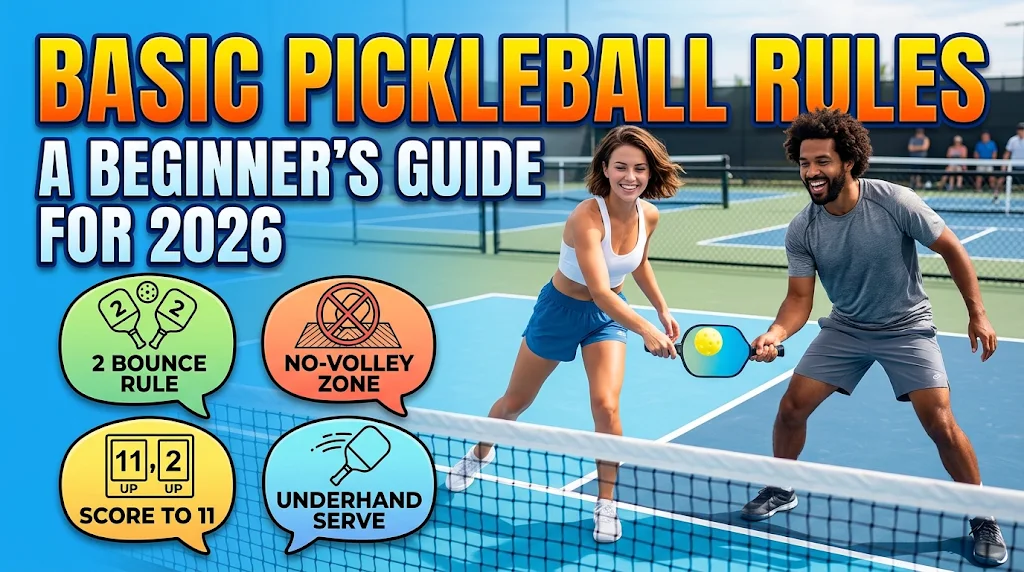
Imagine playing a sport that combines the excitement of tennis, the quick reactions of table tennis, and the easygoing fun of badminton. That’s pickleball! It’s simple to learn, fun for all ages, and surprisingly competitive once you get into it.
But before you grab a paddle and step onto the court, there’s one important thing to understand: the basic pickleball rules.
Whether you’re a complete beginner, planning your first doubles match, or simply trying to understand what everyone is talking about, this guide covers everything you need to know. From serving and scoring to the famous kitchen rule, you’ll learn how pickleball works without getting lost in complicated terminology.
Let’s get started!
What Are the Basic Rules of Pickleball?
Pickleball is played between two players (singles) or two teams of two players (doubles). Players use solid paddles to hit a lightweight, perforated plastic ball over a net.
The main objective is to hit the ball into your opponent’s court while preventing them from returning it legally.
Here are the essential rules every beginner should know:
- Games are normally played to 11 points, and you must win by at least 2 points.
- Traditional scoring awards points only to the serving team.
- Serves must travel diagonally into the opposite service court.
- Both teams must let the ball bounce once after the serve before volleying.
- Players cannot volley while standing in the kitchen (non-volley zone).
- A ball landing on a boundary line is generally considered in, except when a serve lands on the kitchen line.
- A rally ends when a player commits a fault.
Once you understand these rules, you’ll know enough to start playing a friendly game.
Understand the Pickleball Court
Before learning how to play, it helps to understand where everything happens.
A standard pickleball court measures 20 feet wide and 44 feet long. Interestingly, the court uses the same dimensions for both singles and doubles matches.
The court includes:
- Baseline: The back boundary line of each side.
- Sidelines: The outer boundaries along the length of the court.
- Centerline: Divides each service area into right and left sections.
- Non-volley zone (Kitchen): A 7-foot area on both sides of the net.
- Service courts: The areas where diagonal serves must land.
The net measures 36 inches high at the sidelines and 34 inches at the center.
Understanding these areas makes serving, positioning, and calling shots much easier.
How to Serve in Pickleball
Every pickleball rally begins with a serve. Unlike tennis, however, pickleball has specific serving requirements.
Here are the basic rules:
Serve diagonally: You must hit the ball into the diagonally opposite service court.
Keep the serve underhand: For a traditional volley serve, your arm must move in an upward arc. The paddle must contact the ball below waist level, and the paddle head must not be above the highest part of your wrist at contact.
Stay behind the baseline: At least one foot must remain behind the baseline when you hit the serve. Neither foot may touch the court or the imaginary extensions of the sideline and centerline.
Avoid the kitchen: Your serve must land beyond the non-volley zone, including its boundary line.
One serve attempt: Each server gets one serve attempt, although a legal drop serve is also permitted.
What Is a Drop Serve?
A drop serve is an alternative serving method that beginners often find easier.
Instead of hitting the ball directly out of your hand, you release it naturally, allow it to bounce, and then hit it with your paddle.
Unlike a traditional volley serve, a drop serve does not have the same restrictions on the upward swing, waist-level contact, or paddle-head position.
Beginner tip: Practice serving into the opposite service box until you can consistently land the ball in bounds. A reliable serve is more valuable than a powerful one.
Learn the Two-Bounce Rule
If there’s one pickleball rule you absolutely must remember, it’s the two-bounce rule.
Here’s how it works:
- The server hits the ball diagonally into the opponent’s court.
- The receiving team must let the ball bounce once before returning it.
- The serving team must also let the returned ball bounce once before hitting it.
- After these two required bounces, either team can volley the ball or let it bounce.
Example: You serve the ball, and your opponent lets it bounce before returning it. Your team must then let that return bounce before hitting it back.
Afterward, everyone can hit the ball out of the air or after a bounce.
This rule prevents players from rushing straight to the net and attacking immediately after serving. It also creates longer rallies and gives both teams a fair opportunity to get into position.
Understand the Famous Kitchen Rule
The kitchen is probably the most talked-about area in pickleball. And no, you don’t need to bring food onto the court!
The kitchen’s official name is the Non-Volley Zone (NVZ). It extends 7 feet from the net on both sides of the court.
The main rule is simple:
You cannot hit the ball out of the air while standing in the kitchen or touching its boundary line.
This is called volleying.
However, there’s an important difference beginners often miss: You ARE allowed to enter the kitchen and hit a ball after it bounces.
You can also stand inside the kitchen when you’re not volleying.
What Happens If Your Momentum Takes You Into the Kitchen?
Imagine hitting a powerful volley while standing outside the kitchen. Your shot lands perfectly, but your momentum carries you forward, and your foot touches the kitchen line.
That’s a fault!
Even if the ball has already landed, you cannot let your momentum carry you into the non-volley zone after hitting a volley.
The rule also applies if your clothing, paddle, or anything you’re carrying touches the kitchen during that momentum.
Remember: You can step into the kitchen to play a bounced ball. You just cannot volley from there.
How Does Pickleball Scoring Work?
Scoring can seem confusing when you’re playing pickleball for the first time. Fortunately, the traditional system is easy once you understand the basics.
Most recreational games are played to 11 points, and a team must win by 2 points.
For example:
- 11–8: The team with 11 points wins.
- 11–10: The game continues because the winning team needs a two-point advantage.
- 12–10: The game ends.
Who Gets to Score Points?
Under traditional side-out scoring, only the serving team can earn points.
If the serving team wins a rally, it earns one point and continues serving.
If the serving team loses a rally, no point is awarded, and the serve eventually passes to the opposing team.
Some organized competitions also use rally scoring, where a point is awarded after every rally, regardless of which team served.
How to Call the Score in Doubles
Doubles pickleball uses three numbers when announcing the score:
- Serving team’s score.
- Receiving team’s score.
- Server number (1 or 2).
For example, 5-3-2 means:
- Your team has 5 points.
- Your opponents have 3 points.
- The second player on your team is serving.
At the beginning of a traditional game, the starting score is called 0-0-2 because the starting team gets only one server before the serve passes to the other team.
This special starting sequence helps explain why doubles scoring has two serving opportunities for most teams but only one at the beginning.
Pickleball Serving Rotation: Who Serves Next?
In doubles, both players on a team usually get an opportunity to serve before the serve passes to the opposing team.
Here’s the basic sequence:
- The first server begins from the right-hand service court.
- When the serving team scores, the server switches sides and serves again.
- If the first server commits a fault, the partner becomes the second server.
- If the second server commits a fault, the serve goes to the opposing team. This is called a side-out.
When the opposing team gets the serve, its first server starts from the right-hand court.
What About Singles?
Singles pickleball is even simpler.
The serving player serves:
- From the right side when their score is even (0, 2, 4, 6, etc.).
- From the left side when their score is odd (1, 3, 5, 7, etc.).
Unlike doubles, singles does not use a first-server and second-server rotation.
What Is a Fault in Pickleball?
A fault is a rule violation that ends the rally.
Depending on which team commits the fault, the result can be a point for the serving team or a loss of serve.
Here are the most common pickleball faults:
- Hitting the ball out: The ball lands outside the court boundaries.
- Hitting the net: The ball fails to clear the net.
- Kitchen violation: A player volleys while touching the non-volley zone.
- Double bounce: The ball bounces twice before a player returns it.
- Serving incorrectly: The server violates the serving rules or lands the serve outside the correct service court.
- Breaking the two-bounce rule: A player volleys before the required bounces have occurred.
- Touching the net: A player, their paddle, or clothing touches the net or net post while the ball is in play.
- Ball hits a player: A live ball strikes a player or something they’re wearing or carrying.
Avoiding these common mistakes will help you play more confidently and keep rallies going.
Pickleball Line Rules: Is It In or Out?
Knowing how to make correct line calls can save you from unnecessary arguments during a match.
The general rule is straightforward:
If the ball touches a boundary line, it is considered IN.
However, there’s one important exception.
If a serve touches the non-volley zone line, it is considered a fault because the serve must land beyond the kitchen.
For other shots, touching the kitchen line or another boundary line generally means the ball is in, provided it lands within the playable court.
When making line calls, players should be honest and only call a ball out when they are reasonably certain.
Singles vs. Doubles: What’s the Difference?
Pickleball can be played in two main formats. Both use the same court dimensions and basic playing rules, but the strategies are different.
| Feature | Singles | Doubles |
|---|---|---|
| Players | 1 vs. 1 | 2 vs. 2 |
| Court size | 20 × 44 feet | 20 × 44 feet |
| Serving rotation | One server per turn | Two servers per team, usually |
| Score announcement | Two numbers | Three numbers |
| Playing style | More individual movement | More teamwork |
Which is better for beginners?
Doubles is usually the easier starting point because you have a partner to help cover the court. Singles can be more physically demanding because you must cover the entire playing area yourself.
Both formats are fun, so try them and see which one you enjoy most.
Essential Pickleball Etiquette for Beginners
Knowing the rules is important, but good sportsmanship makes the game enjoyable for everyone.
Follow these simple etiquette tips:
- Call the score clearly before serving.
- Avoid arguing over close calls.
- Give your opponents enough space to play.
- Don’t intentionally distract other players during a rally.
- Return stray balls safely instead of hitting them aggressively.
- Congratulate your opponents after a good shot.
- Respect other players waiting for their turn on busy courts.
Remember, pickleball is about competition, exercise, and having fun. A little courtesy goes a long way.
Beginner Tips to Improve Your Pickleball Game
Now that you understand the rules, here are a few practical tips to help you enjoy your first matches.
Focus on control, not power. Beginners often try to hit every ball as hard as possible. Instead, focus on keeping the ball inside the court.
Practice your serve. A consistent serve helps you avoid unnecessary faults and puts you in a better position to start each rally.
Learn the kitchen rule early. Kitchen violations are common among new players. Understanding when you can and cannot volley will save you points.
Communicate with your partner. In doubles, simple calls such as “mine” and “yours” can prevent confusion and missed shots.
Move into position. After serving or returning, don’t just stand and watch. Prepare for the next shot and work with your partner to cover the court.
Stay patient. Pickleball rewards smart placement and consistency. You don’t need to win every rally with a powerful shot.
Frequently Asked Questions
What are the 5 basic rules of pickleball?
The five essential rules are: serve diagonally, follow the two-bounce rule, avoid volleying in the kitchen, keep the ball inside the court, and win by two points. Under traditional scoring, only the serving team can score.
What is the 10-second rule in pickleball?
Under the official rules, the server must serve within 10 seconds after the score has been called. Taking longer results in a fault.
Can you step into the kitchen in pickleball?
Yes. You can enter the kitchen whenever you want, provided you don’t volley while touching it or allow your momentum after a volley to carry you into the zone.
Can the ball bounce twice in pickleball?
No. During a rally, you must return the ball before it bounces twice on your side. However, the two-bounce rule requires one bounce on each team’s side immediately after the serve.
Do you have to win by two points in pickleball?
Yes. Standard games are normally played to 11 points, and you must lead by at least two points to win.
Can you hit the ball before it bounces?
Yes, this is called a volley. However, you must first allow the required two bounces after the serve, and you cannot volley while standing in or touching the kitchen.
Is pickleball easier than tennis?
Many beginners find pickleball easier to learn because it uses a smaller court, a lightweight ball, and relatively simple basic rules. However, competitive pickleball still requires skill, strategy, and practice.
What equipment do you need to play pickleball?
You need a pickleball paddle, a perforated plastic pickleball, and access to a pickleball court with a net. Comfortable athletic shoes are also recommended for safe movement.
Final Thoughts
Pickleball might look complicated when you first see players moving around the court, calling out scores, and talking about something called the kitchen. But once you understand the basic rules, the game becomes surprisingly easy to follow.
Start by learning how to serve, remember the two-bounce rule, understand the kitchen, and practice keeping the ball inside the boundaries.
You don’t have to master every technique before stepping onto the court. Grab a paddle, find a partner, and enjoy a few friendly rallies.
The best way to learn pickleball is to play it. So, what are you waiting for? It’s time to get out there and have some fun!

Theo Bennett is a passionate sports writer and storyteller at SportNestify.com covering cricket, football, hockey, tennis, basketball and more. With a focus on clear insights, engaging analysis, player stories, and the latest sporting trends, Leo turns every game into a story worth following. His goal is simple