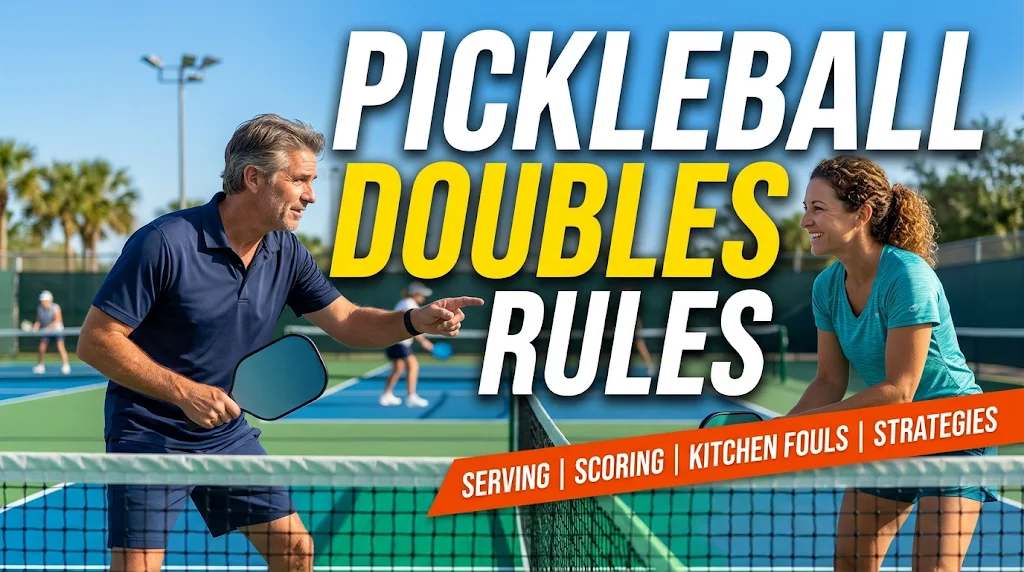
Pickleball doubles is all about teamwork, smart positioning, and knowing when to attack. But if you’re new to the game, even simple things like calling the score, deciding who serves, or understanding the kitchen can get confusing.
The good news? You don’t need to memorize an entire rulebook to enjoy your first doubles match.
In this guide, you’ll learn everything about pickleball doubles rules, from the first serve to the final winning point. We’ll explain how scoring works, when players switch sides, what counts as a fault, and how you and your partner can work together to win more rallies.
Whether you’re a complete beginner, a recreational player, or someone preparing for a competitive match, this guide covers the essential rules in simple language, following the 2026 USA Pickleball Official Rulebook.
What Are the Rules of Pickleball Doubles?
Pickleball doubles is played between two teams of two players on a 20-by-44-foot court. Both teams use the same court dimensions as singles.
The objective is to hit the ball over the net and make it difficult for your opponents to return it legally.
Here are the basic rules every doubles player should know:
- Each team has two players.
- The serve must travel diagonally into the opposite service court.
- Both teams must follow the two-bounce rule at the beginning of each rally.
- Players cannot volley the ball while standing in the kitchen.
- Under traditional scoring, only the serving team can earn points.
- Both partners generally get an opportunity to serve before a side-out.
- Games are usually played to 11 points, with a two-point winning margin.
Quick rule to remember: Win the rally while serving to earn a point. Win the rally while receiving to earn the serve.
Pickleball Doubles Court Dimensions and Player Positions
Before learning the scoring system, it’s important to understand the court and where each player should stand.
A standard pickleball court measures:
| Court feature | Measurement |
|---|---|
| Total length | 44 feet |
| Total width | 20 feet |
| Kitchen depth | 7 feet on each side |
| Net height at sidelines | 36 inches |
| Net height at center | 34 inches |
Each side of the court has two service areas: the right service court and the left service court.
In doubles, both partners share their side of the court. One player serves while the other helps cover the playing area.
Do partners have to stay in specific positions?
No. Players can move around their side of the court during a rally. However, the correct server and receiver must be positioned according to the service rotation rules.
Pickleball Doubles Serving Rules
Serving is one of the most important parts of pickleball doubles. Getting the serve wrong can immediately cost your team the rally.
Follow these rules when serving:
- Stand behind the baseline when making contact with the ball.
- Keep at least one foot on the playing surface behind the baseline or on the ground behind it.
- Do not let either foot touch the court on or inside the baseline when striking the serve.
- Serve diagonally across the net into the opposite service court.
- Make sure the ball clears the non-volley zone and its line.
- Allow the receiving team a fair opportunity to return the serve.
Volley Serve vs. Drop Serve
There are two legal ways to serve:
- Volley serve: Hit the ball before it bounces. The arm must move in an upward arc, paddle contact must be below waist level, and the paddle head must not be above the highest part of the wrist at contact.
- Drop serve: Release the ball and let it bounce naturally before hitting it. The specific volley-serve restrictions do not apply to a drop serve.
A serve landing in the kitchen or outside the correct service court is a fault. A ball that touches the net but still lands legally in the correct service court is generally a valid serve.
How Does Pickleball Doubles Scoring Work?
This is where many beginners get confused.
Unlike tennis, traditional pickleball doubles uses a three-number scoring system. The numbers represent:
- Serving team’s score.
- Receiving team’s score.
- Server number (1 or 2).
For example, a score of 6-4-2 means:
- Your team has 6 points.
- Your opponents have 4 points.
- The second server is serving.
When Does a Team Earn a Point?
Under traditional side-out scoring, only the serving team earns points.
- If the serving team wins the rally, it gets one point.
- If the serving team loses the rally, its serving rotation changes.
- If the receiving team wins the rally, it takes over the serve but does not score a point.
How Many Points Do You Need to Win?
Most recreational games are played to 11 points, and a team must win by at least two points.
For example:
- 11-9: Game over.
- 11-10: Play continues.
- 12-10: Game over.
Some tournaments use games to 15 or 21 points, depending on their competition format.
What Is the First Score in Pickleball Doubles?
A traditional doubles game starts with the score called:
0-0-2
This can sound strange because the starting team has two players. However, at the beginning of a game, only one player gets the first serving opportunity. If that player loses the rally, the serve goes directly to the opposing team.
This prevents the starting team from receiving an extra serving opportunity.
Pickleball Doubles Serving Rotation Explained
In traditional doubles scoring, both partners usually get an opportunity to serve during their team’s service turn.
Here’s how it works:
- The first server begins from the right-hand service court.
- If the serving team wins a point, the same server switches sides and serves again.
- If the first server loses a rally, the second partner becomes the server.
- The second server continues until their team loses a rally.
- The opposing team then receives the serve. This is called a side-out.
Important: Players switch their serving positions after their team scores a point. They do not switch positions simply because they won a rally while receiving.
Example of a Serving Rotation
Imagine Team A consists of Alex and John, while Team B consists of Mike and David.
- Alex starts serving from the right side.
- Alex wins a rally and scores a point.
- Alex switches to the left side and serves again.
- Alex loses the next rally.
- John now gets the second serving opportunity.
- John eventually loses a rally.
- Team B receives the serve.
This rotation continues throughout the game.
The Two-Bounce Rule in Pickleball Doubles
The two-bounce rule is one of the most important rules in pickleball. It prevents either team from rushing to the net and smashing the ball immediately after the serve.
Here’s how it works:
- First bounce: The receiving team must let the serve bounce before returning it.
- Second bounce: The serving team must let the return bounce before hitting it back.
- After these two required bounces, either team can volley the ball or let it bounce before returning it.
Example: Alex serves to Mike. Mike lets the ball bounce and returns it. Alex also lets the ball bounce before hitting it back. From this point onward, all four players can volley the ball.
What happens if someone skips a required bounce?
It’s a fault, and the rally goes to the opposing team.
What Is the Kitchen Rule in Pickleball Doubles?
The kitchen is one of the most talked-about areas of a pickleball court. Its official name is the Non-Volley Zone (NVZ).
It extends 7 feet from the net on both sides of the court.
The main rule is simple: You cannot hit the ball out of the air while standing in the kitchen or touching its boundary line.
However, there’s an important detail that many beginners miss.
What Is Allowed in the Kitchen?
You can legally:
- Stand inside the kitchen.
- Enter the kitchen to return a ball after it bounces.
- Hit a groundstroke while standing inside the kitchen.
- Move out of the kitchen and prepare for another shot.
What Is Not Allowed?
You cannot:
- Volley the ball while standing inside the kitchen.
- Step on the kitchen line while volleying.
- Volley the ball outside the kitchen and then fall into it because of your momentum.
- Let your paddle, clothing, or anything you’re carrying touch the kitchen during the act of volleying.
Can you step into the kitchen after hitting a volley?
No. Your momentum must stop before you touch the kitchen or its boundary line. Even if the ball is already dead, momentum carrying you into the kitchen results in a fault.
What Counts as a Fault in Pickleball Doubles?
A fault is a rule violation that ends the rally. Understanding common faults helps you avoid giving your opponents easy opportunities.
Here are some common examples:
| Fault | What happens? |
|---|---|
| Serve lands out | Serving team loses the rally |
| Serve lands in the kitchen | Serving team loses the rally |
| Ball hits the net and does not cross | Fault |
| Ball bounces twice on your side | Fault |
| Volleying inside the kitchen | Fault |
| Volleying while touching the kitchen line | Fault |
| Missing the ball or failing to return it legally | Fault |
| Violating the two-bounce rule | Fault |
In traditional side-out scoring, a fault by the serving team can cost it the serve. A fault by the receiving team gives the serving team a point.
Pickleball Doubles Out-of-Bounds Rules
Knowing which balls are in or out can make a big difference in doubles.
A ball is considered out if it lands completely outside the court’s boundary lines.
Remember these rules:
- A ball touching a sideline or baseline is considered in.
- A ball landing beyond the boundary lines is out.
- The serve must land in the correct diagonal service court.
- During a rally, the ball can land anywhere inside the opponent’s court, including the sidelines and baseline.
- A ball that hits the net and falls back onto your side is a fault.
Who Makes the Line Calls?
In recreational play without an official, players are generally responsible for making line calls on their own side of the court.
Call a ball out only when you’re sure it landed outside the line. If you’re uncertain, the benefit of the doubt generally goes to your opponent.
Pickleball Doubles Rules for Switching Sides
Players often wonder when they should change sides during a match.
There are two important situations:
During serving: The serving player switches between the right and left service courts each time their team scores a point. Their partner also maintains the correct relative position according to the team’s score and starting positions.
Between games: Teams may switch court ends according to the competition rules. In standard tournament play, players also change ends during a game when a team reaches the designated score threshold.
For a regular 11-point game, players generally switch ends when one team reaches 6 points.
Best Pickleball Doubles Strategies for Beginners
Knowing the rules is only half the battle. If you want to win more games, you and your partner need to play as a team.
Here are six practical strategies to improve your doubles performance.
Communicate Before Every Rally
Decide who takes the middle shots. Simple calls such as “mine,” “yours,” and “switch” prevent confusion and unnecessary collisions.
Move Toward the Kitchen Line
After completing the required two-bounce sequence, work together to move toward the kitchen line. This position gives you more opportunities to attack and control the rally.
Avoid Hitting Every Ball Too Hard
Power isn’t everything in pickleball. Soft shots, especially dinks, can force opponents to move forward and make mistakes.
Target the Middle of the Court
Shots down the middle can create confusion between opponents. They may hesitate over who should return the ball, giving you an opportunity to win the rally.
Cover Your Partner
If your partner moves wide to return a shot, adjust your position to cover the open space. Good doubles teams move together rather than leaving large gaps.
Stay Patient at the Kitchen Line
Don’t rush every opportunity to smash the ball. Sometimes a controlled dink or a well-placed shot is more effective than an aggressive attack.
Common Pickleball Doubles Mistakes to Avoid
Even experienced players make mistakes, especially when they’re under pressure.
Watch out for these common problems:
- Forgetting the server number when calling the score.
- Serving from the wrong side.
- Stepping on the kitchen line while volleying.
- Moving too close to the net before completing the two-bounce sequence.
- Leaving the middle of the court uncovered.
- Hitting every ball too hard instead of using controlled shots.
- Assuming your partner will return every middle shot.
- Failing to communicate before and during rallies.
The easiest way to improve is to practice the serving rotation, kitchen rule, and partner communication until they become automatic.
Frequently Asked Questions
How many players are on a pickleball doubles team?
A doubles team has two players, making four players on the court during a match.
Can both players serve in pickleball doubles?
Yes. Under traditional side-out scoring, both partners generally get a serving opportunity before the team loses its serve. The exception is the first serving sequence of a new game, when only one player serves.
Can you enter the kitchen in pickleball?
Yes. You can enter the kitchen whenever you want, provided you don’t volley the ball while touching the kitchen or its boundary line.
Can you score a point when receiving in doubles?
Under traditional side-out scoring, no. Only the serving team can score. However, rally scoring is another format in which a point is awarded after every rally.
What does 0-0-2 mean in pickleball?
It is the traditional opening score of a doubles game. Both teams start at zero, and the starting team has only one serving opportunity before a side-out.
Do pickleball doubles games always go to 11?
No. Recreational games commonly go to 11, win by 2. Some tournaments use 15 or 21 points, depending on their format.
Can you hit the ball twice in pickleball?
A player generally cannot deliberately hit the ball twice in separate strokes. However, a continuous, single-direction stroke that unintentionally contacts the ball more than once can be legal under the applicable rules.
Is the kitchen line considered part of the kitchen?
Yes. The kitchen line is part of the non-volley zone. Touching it while volleying results in a fault.
Final Thoughts
Pickleball doubles becomes much easier once you understand the serving rotation, three-number scoring system, two-bounce rule, and kitchen restrictions.
But remember, winning isn’t just about knowing the rules. It’s about communicating with your partner, covering open spaces, choosing smart shots, and staying patient during long rallies.
Start by mastering the basic rules, practice your serves, and learn to move together as a team. Before long, you’ll spend less time worrying about mistakes and more time enjoying the game.
Now grab your paddle, find a partner, and get ready to play!

Leo Carter is a passionate sports writer and storyteller at SportNestify.com covering cricket, football, hockey, tennis, basketball and more. With a focus on clear insights, engaging analysis, player stories, and the latest sporting trends, Leo turns every game into a story worth following. His goal is simple