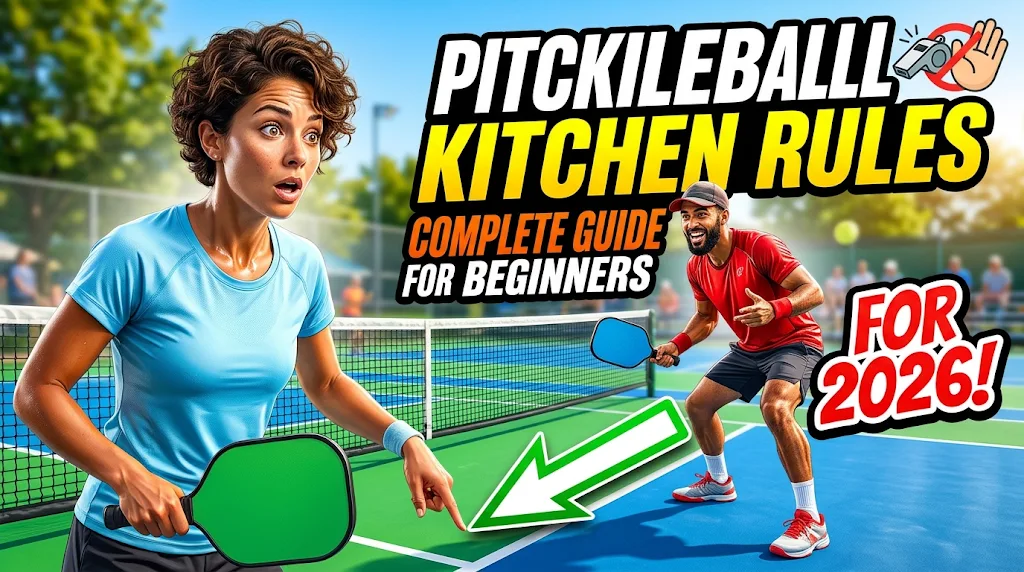
If you’ve ever played pickleball, you’ve probably heard someone shout, “You’re in the kitchen!” And if you’re new to the sport, you might wonder what that actually means. Is there really a kitchen on the court? Can you step inside it? Will you lose a point just by standing there?
Don’t worry. You’re not alone!
The pickleball kitchen rules are among the most important and sometimes most confusing parts of the game. Understanding them can help you avoid unnecessary faults, improve your strategy, and become a more confident player.
The good news? The rules are easier than they sound.
In this guide, we’ll explain what the kitchen is, when you can enter it, what counts as a kitchen violation, and how to use the non-volley zone to your advantage. Whether you’re picking up a paddle for the first time or trying to improve your doubles game, you’ll find everything you need here.
What Is the Kitchen in Pickleball?
The kitchen is the informal name for the non-volley zone (NVZ) in pickleball. It’s the seven-foot area on both sides of the net where players cannot hit the ball out of the air.
Think of it as a special zone that encourages smarter shots instead of powerful smashes right next to the net.
Here are the basic measurements:
- Length: 7 feet from the net on each side.
- Width: 20 feet across the court.
- Total area: 140 square feet on each side.
- Boundary: The non-volley zone line is part of the kitchen.
The kitchen stretches across the entire width of the court, including the line itself.
Here’s the most important thing to remember: You can stand in the kitchen, walk through it, and hit a ball after it bounces there. However, you cannot volley the ball while standing in it.
The Essential Pickleball Kitchen Rules
Let’s break down the rules into simple explanations so you can understand exactly what is allowed and what isn’t.
You Cannot Volley While Standing in the Kitchen
This is the golden rule of pickleball.
A volley happens when you hit the ball before it touches the ground. If any part of your body is touching the kitchen or its boundary line when you volley, it’s a fault.
For example:
- Standing inside the kitchen and hitting the ball out of the air: Fault.
- Standing outside the kitchen and hitting a volley: Legal.
- Touching the kitchen line while volleying: Fault.
Even if your paddle is outside the kitchen, touching the line with your foot is enough to break the rule.
Remember: Your position matters when you hit the volley, not just where your paddle makes contact with the ball.
You Can Enter the Kitchen to Hit a Bounced Ball
Here’s some good news: The kitchen isn’t a forbidden area.
You can enter it whenever you want, provided you’re not volleying the ball.
For example, your opponent hits a soft shot that lands just over the net inside your kitchen. You can step forward, let the ball bounce, and hit it back.
You can even stay inside the kitchen after making that shot.
This is completely legal.
In fact, stepping into the kitchen to return a short shot is an important skill that every pickleball player should learn.
Momentum Can Cause a Kitchen Fault
This is one of the most misunderstood kitchen rules.
Imagine you’re standing outside the kitchen and hit a powerful volley. Your shot is legal, but your body keeps moving forward. A moment later, you step into the kitchen.
Unfortunately, that’s still a fault!
Why? Because your momentum from the volley carried you into the non-volley zone.
The rule applies even if the ball is already dead before you touch the kitchen.
For example:
- You hit a volley outside the kitchen.
- Your forward momentum carries you across the kitchen line.
- Your foot touches the kitchen.
That’s a fault.
The solution? Maintain your balance, control your movement, and avoid leaning too far forward when hitting volleys near the net.
Your Partner Can Also Cause a Kitchen Fault
Here’s something many beginners don’t realize: Your partner’s contact with the kitchen can affect your rally.
If you hit a volley and your momentum causes you to push against your partner, who is standing in the kitchen, you commit a fault.
The rule also applies if something connected to you touches the kitchen.
For instance, if your clothing, paddle, or another item you’re carrying touches the kitchen during the act of volleying, it can result in a fault.
That’s why both players need to maintain good spacing near the net.
You Must Get Both Feet Outside Before Volleying Again
What happens if you enter the kitchen to return a bounced ball and then want to hit a volley?
You must first re-establish your position outside the kitchen.
Under the standard standing-player rule, both feet must make contact with the playing surface completely outside the kitchen before you can legally volley again.
Simply jumping out of the kitchen and hitting the ball before establishing that outside contact isn’t allowed.
A good habit is to step back, regain your balance, and prepare for the next shot.
Jumping Into the Kitchen to Volley Is Not Allowed
Some players think they can jump from outside the kitchen, hit a volley in the air, and land inside the kitchen.
Not so fast!
The kitchen rule considers your momentum and what happens after you hit the ball.
If you jump forward, hit a volley, and land inside the kitchen, it’s a fault.
However, jumping from outside the kitchen, hitting a volley, and landing completely outside the kitchen is legal, provided your momentum doesn’t carry you into the zone afterward.
The Kitchen Line Is Part of the Kitchen
This small detail causes plenty of unnecessary arguments during recreational games.
The kitchen line is not a safe area where you can stand while volleying. It belongs to the non-volley zone.
If your toe touches the line while hitting a volley, you’ve committed a fault.
A helpful tip is to leave a little extra space between your feet and the line instead of standing right on its edge.
Can You Stand in the Kitchen in Pickleball?
Yes! Absolutely.
There is no rule that says you must stay outside the kitchen throughout a rally.
You can legally:
- Stand inside the kitchen.
- Walk through the kitchen.
- Hit groundstrokes inside the kitchen.
- Reach into the kitchen to hit a ball after it bounces.
- Stay inside the kitchen after hitting a bounced ball.
The only major restriction is that you cannot volley while touching the kitchen, including its boundary line.
This is an important distinction. The kitchen is a non-volley zone, not a no-entry zone.
Pickleball Kitchen Rules: Legal vs. Illegal Moves
Still wondering which actions are allowed? Here’s a quick comparison.
| Player Action | Legal or Fault? |
|---|---|
| Standing in the kitchen | Legal |
| Hitting a bounced ball inside the kitchen | Legal |
| Walking through the kitchen | Legal |
| Volleying while standing inside the kitchen | Fault |
| Touching the kitchen line during a volley | Fault |
| Hitting a volley outside and falling into the kitchen | Fault |
| Jumping from outside and landing outside after a volley | Legal |
| Jumping from outside and landing inside after a volley | Fault |
| Hitting a volley while your partner is touching the kitchen because of your momentum | Fault |
Keep this table in mind during your next game. It covers many of the situations that confuse new players.
Does the Kitchen Rule Apply to Serves?
Yes, but there’s an important difference.
A serve must land in the correct diagonal service court, beyond the non-volley zone.
If the serve lands inside the kitchen or touches the kitchen line, it’s a fault.
However, this doesn’t mean you cannot serve toward the kitchen area in general. You can aim for a short serve as long as the ball lands beyond the non-volley zone line in the correct service box.
Also, remember that the kitchen rule is separate from the two-bounce rule. The receiving team must let the serve bounce, and the serving team must let the return bounce before either team can begin volleying.
What Happens If You Break a Kitchen Rule?
Breaking a kitchen rule results in a fault, which ends the rally.
The result depends on which team commits the violation.
- If the serving team commits a fault: It loses the rally and may lose its serve.
- If the receiving team commits a fault: The serving team wins the rally and scores a point under traditional side-out scoring.
For example, if you’re playing doubles and your partner volleys while touching the kitchen line, your team loses the rally.
The best way to avoid these situations is to understand your positioning and stay balanced when approaching the net.
How to Use the Kitchen to Improve Your Pickleball Game
Knowing the rules is one thing. Using them to win more rallies is another!
The kitchen is not just a restricted area. It’s also where some of the most exciting strategic battles happen.
Here are five ways to make it work in your favor.
Master the Dink Shot
A dink is a soft shot that lands in your opponent’s kitchen.
It forces your opponent to move forward and hit the ball after it bounces, making it harder for them to attack aggressively.
Practice hitting gentle, controlled shots rather than trying to overpower every return.
Learn to Move Forward Carefully
Getting close to the kitchen line gives you a strong position during rallies.
However, don’t rush forward after hitting a volley. Your momentum could carry you into the kitchen and cost you the point.
Take small steps, maintain your balance, and stay in control.
Avoid Reaching Too Far
Reaching forward aggressively can make you lose balance.
Instead, bend your knees, lower your body, and use controlled movements when returning low shots.
This helps you maintain a strong position without accidentally stepping into the kitchen during a volley.
Watch Your Opponent’s Position
Pay attention to where your opponent stands.
If they’re positioned too far behind the kitchen line, a well-placed dink can force them forward and create an opportunity for your next shot.
Pickleball isn’t always about hitting harder. Sometimes, placing the ball in the right spot is much more effective.
Practice Kitchen-Line Footwork
Good footwork can make a huge difference.
Practice approaching the kitchen line, stopping under control, and moving sideways without touching the line during a volley.
The more comfortable you become with your positioning, the fewer unnecessary faults you’ll make.
Common Pickleball Kitchen Mistakes Beginners Should Avoid
Even experienced players occasionally make kitchen mistakes. Here are some common problems to watch out for:
Stepping on the kitchen line: Remember, the line is part of the non-volley zone.
Thinking the kitchen is completely off-limits: You can enter it whenever you want, as long as you don’t volley while touching it.
Forgetting about momentum: A legal volley can become a fault if your momentum carries you into the kitchen.
Jumping forward to hit a volley: Landing inside the kitchen after a volley is still a fault.
Volleying too quickly after leaving the kitchen: Both feet must first make contact with the playing surface completely outside the kitchen.
Ignoring your partner’s position: Your momentum can cause a fault if it carries you into something touching the kitchen, including your partner.
Avoiding these mistakes will make your game smoother and help you play with greater confidence.
Frequently Asked Questions
Can you step into the kitchen in pickleball?
Yes. You can step into the kitchen whenever you want. You can even hit a ball after it bounces while standing inside the zone. You just cannot volley while touching the kitchen.
Can your foot touch the kitchen line?
Yes, but not during a volley. The kitchen line is part of the non-volley zone, so touching it while volleying results in a fault.
Can you hit the ball inside the kitchen?
Yes. You can hit the ball inside the kitchen after it bounces. Hitting it before it bounces while touching the kitchen is not allowed.
Can you jump over the kitchen and hit a volley?
Yes, provided you take off from outside the kitchen, hit the volley, and land outside the kitchen without your momentum carrying you into it. You cannot land inside the kitchen after the volley.
Can you stand in the kitchen while your opponent serves?
Yes. There is no general rule preventing you from standing in the kitchen while your opponent serves. However, you must allow the serve to bounce before returning it.
Can you enter the kitchen after hitting a volley?
Not if your momentum from that volley carries you into the kitchen. You must stop your movement and regain control before touching the non-volley zone.
Does the kitchen rule apply to doubles and singles?
Yes. The standard non-volley zone rules apply to both singles and doubles pickleball.
How big is the kitchen in pickleball?
The kitchen extends seven feet from the net on each side and covers the full 20-foot width of the court.
Can your paddle touch the kitchen?
Yes, when you’re not in the act of volleying. If your paddle or anything else connected to you touches the kitchen during a volley, it’s a fault.
Why is it called the kitchen?
The exact origin of the nickname isn’t definitively established. However, the official term is the non-volley zone, while players commonly use “the kitchen” as a casual name.
Final Thoughts
The pickleball kitchen rules might seem confusing at first, but once you understand the basic idea, everything becomes much easier.
You can enter the kitchen, stand inside it, and hit bounced balls without any problem. The key restriction is simple: Never volley while touching the non-volley zone, and don’t let your momentum carry you into it after a volley.
Once you master this rule, you’ll avoid frustrating faults, improve your positioning, and become a smarter player.
So, the next time someone shouts Kitchen! you’ll know exactly what they’re talking about and, more importantly, how to stay out of trouble!
Play smart, stay balanced, and enjoy every rally!

Leo Carter is a passionate sports writer and storyteller at SportNestify.com covering cricket, football, hockey, tennis, basketball and more. With a focus on clear insights, engaging analysis, player stories, and the latest sporting trends, Leo turns every game into a story worth following. His goal is simple