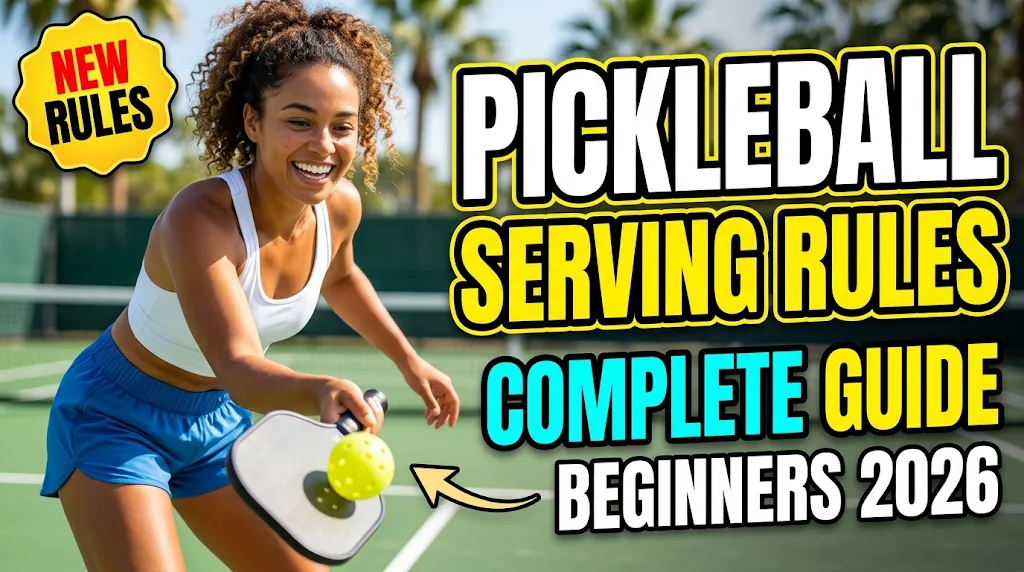
If you’ve ever stepped onto a pickleball court and wondered whether your serve was legal, you’re not alone. Serving looks simple, but a few small mistakes can cost you a point or even your team’s chance to serve.
The good news? Once you understand the pickleball serving rules, getting your serve right becomes much easier.
Whether you’re a complete beginner, a recreational player, or someone preparing for a tournament, this guide explains everything you need to know. We’ll cover legal serving techniques, the two types of serves, foot faults, the kitchen rule, singles and doubles serving order, scoring, and common mistakes.
Let’s get started!
What Are the Basic Pickleball Serving Rules?
Pickleball has specific rules governing how a player must serve. Unlike tennis, you cannot simply throw the ball into the air and hit it with an overhead swing.
Under the 2026 USA Pickleball rules, players can use either a traditional volley serve or a drop serve.
Here are the essential rules:
- Serve underhand: A traditional volley serve must follow specific underhand motion requirements.
- Serve diagonally: The ball must travel crosscourt into the opposite service box.
- Stay behind the baseline: Your feet must follow the legal serving-position requirements when you hit the ball.
- Clear the kitchen: The serve must land beyond the non-volley zone and its boundary line.
- Follow the correct serving order: Singles and doubles have different serving sequences.
- Call the score first: The complete score must be announced before serving.
- One serve attempt: There is no second serve like in tennis.
These rules apply whether you’re playing a casual neighborhood game or a competitive match.
How to Serve in Pickleball
A legal pickleball serve starts with the correct position, ball release, and paddle movement.
Here’s how to do it:
Position Yourself Behind the Baseline
Stand behind the baseline on your side of the court. At least one foot must be in contact with the correct serving area when you hit the serve.
Neither foot can touch the court or the playing surface outside the correct serving area at contact.
Choose Your Serving Style
You can use either:
- Volley serve: Hit the ball before it bounces.
- Drop serve: Release the ball, let it bounce, and then hit it.
Both are legal under USA Pickleball rules.
Aim Diagonally Across the Court
Your serve must travel diagonally into the opposite service box.
For example, if you’re serving from the right side, aim toward your opponent’s right-side service box (diagonally opposite your position).
Clear the Kitchen
Your serve must land beyond the non-volley zone, commonly called the kitchen.
If the ball touches the kitchen line, it’s a fault.
Get Ready for the Return
After serving, prepare for your opponent’s return. Remember that the two-bounce rule requires the serve and the return of serve to bounce before either team can begin volleying.
The Two Types of Legal Pickleball Serves
One of the most useful things to understand is the difference between a volley serve and a drop serve.
Both are legal, but their techniques are different.
Volley Serve
<PRIVATE_PERSON> traditional volley serve is made by releasing the ball and hitting it before it touches the ground.
However, it must meet three important requirements:
- Upward paddle motion: Your paddle must move in a clear upward arc when it contacts the ball.
- Paddle position: The highest point of the paddle head must not be above your wrist joint at contact.
- Ball height: You must contact the ball at or below your waist.
You can use either a forehand or backhand motion.
The volley serve is popular with experienced players because it allows them to control placement, speed, and spin while following the legal serving requirements.
Drop Serve
The drop serve is an excellent option for beginners who struggle with traditional serving techniques.
Here’s how it works:
- Hold the ball in one hand or on your paddle.
- Release it from a natural, unaided height.
- Allow it to bounce on the playing surface.
- Hit it with your paddle after the bounce.
Unlike the volley serve, the drop serve does not require an upward paddle arc, a specific paddle-head position, or contact below the waist.
There is also no restriction on how many times the ball can bounce before you hit it or where it bounces on the playing surface.
However, you cannot throw, push, or propel the ball downward or in another direction to create an advantage when releasing it.
Which serve should beginners choose?
The drop serve is often easier to learn because it removes several technical restrictions. Once you’re comfortable, you can experiment with the volley serve to develop more variety.
Pickleball Serving Foot Fault Rules
Foot faults are among the most common serving mistakes, especially for players who are new to the game.
The good news is that the rules are straightforward.
When you hit the serve:
- At least one foot must be grounded in the correct serving area.
- Neither foot can touch the court.
- Neither foot can touch the playing surface outside the correct serving area.
- You must remain behind the baseline without touching it.
You can stand anywhere within the correct serving area as long as you follow these requirements.
Example: If your front foot touches the baseline while making contact with the ball, you’ve committed a foot fault.
Pro tip: Leave a little extra space between your feet and the baseline. This helps prevent accidental foot faults when your body moves forward during the serve.
The Pickleball Kitchen Rule for Serving
The kitchen, officially called the non-volley zone (NVZ), is the seven-foot area on each side of the net.
It has an important role in pickleball serving.
A legal serve must land in the diagonally opposite service court, beyond the kitchen and its boundary line.
That means:
- A serve landing inside the kitchen is a fault.
- A serve landing on the kitchen line is a fault.
- A serve landing on the opposite service court’s sideline or baseline is generally legal.
- A serve that touches the net but lands legally in the correct service court is allowed.
Important: The kitchen line is treated differently on a serve than other court boundary lines. A ball landing on most other service-court lines is considered in, but a ball touching the kitchen line is out.
This is one of the most important distinctions for beginners to remember.
Pickleball Serving Rules in Doubles
Doubles pickleball involves two players on each team, so serving order can seem confusing at first.
However, once you understand the rotation, it becomes easy.
Here is how it works:
First: The First Server Starts on the Right
At the beginning of a game, the designated starting server serves from the right-hand service court.
The starting score is called:
Zero – Zero – Two (0-0-2).
The number two indicates that the serving team has only one server in its first service sequence.
Second: Switch Sides After Scoring
When the serving team wins a point, the same server switches sides and serves again.
This continues until the team commits a fault.
Third: The Second Server Takes Over
After the first server loses the serve, their partner becomes the second server.
The partner continues serving until the team commits another fault.
Fourth: Side Out
When both serving players lose their service opportunities, the serve passes to the opposing team.
The opposing team starts its service sequence from the right-hand side.
This rotation continues throughout the game.
Doubles Serving Example
Imagine your team starts with a score of 0-0-2.
- Your first server serves from the right.
- Your team wins a rally and scores one point.
- The same player moves to the left and serves again.
- Your team loses the rally.
- The second server takes over.
- Your team eventually loses another rally.
- The serve passes to the opposing team.
Understanding this rotation helps prevent confusion about who should serve next.
Pickleball Serving Rules in Singles
Singles pickleball is simpler because there is only one player on each side.
The serving position depends on your score.
- Even score: Serve from the right-hand service court.
- Odd score: Serve from the left-hand service court.
For example:
| Your Score | Serving Position |
|---|---|
| 0 | Right |
| 1 | Left |
| 2 | Right |
| 3 | Left |
| 4 | Right |
| 5 | Left |
| 6 | Right |
The same pattern continues throughout the game.
You keep serving until you commit a fault, at which point your opponent gets the serve.
Unlike doubles, there is no second server on your team.
Pickleball Serving Scoring Rules
Pickleball scoring can be confusing for beginners, particularly when they hear three numbers announced before a doubles serve.
In standard traditional scoring, only the serving team can score points.
Games are typically played to 11 points, and a team must win by at least two points.
Understanding the Three-Number Score
In doubles, the score is announced using three numbers:
- Serving team’s score.
- Receiving team’s score.
- Server number (one or two).
For example, 5-3-1 means:
- Your team has five points.
- Your opponents have three points.
- The first server is serving.
A score of 5-3-2 means the second server is serving.
Remember that the first service sequence of a new doubles game starts with 0-0-2.
What Happens When You Serve Out of Turn?
Serving in the wrong position or out of the correct sequence can result in a fault.
In tournament play, the referee follows the applicable player-position and correction rules.
If you’re playing recreationally, communicate with your teammates and opponents to avoid confusion.
Common Pickleball Serving Faults
Even experienced players occasionally make serving mistakes.
Here are some common faults to watch out for:
| Serving Mistake | Why It’s a Fault |
|---|---|
| Hitting the ball into the net | The serve does not reach the required service court |
| Landing in the kitchen | The serve must clear the kitchen |
| Touching the kitchen line | The kitchen line is out on a serve |
| Serving outside the service box | The ball must land in the correct diagonal court |
| Stepping on the baseline | The server must follow legal foot-position requirements |
| Illegal volley motion | The volley serve must meet the underhand requirements |
| Propelling the ball on release | An illegal drop-serve release is a fault |
| Serving out of sequence | Players must follow the correct serving order |
A serving fault ends the rally. The serving team loses its service opportunity, or the receiving team earns a point if it committed the fault.
Does the Ball Have to Clear the Net Completely?
Yes, the serve must cross the net and land in the correct diagonal service court.
However, there is an important detail.
A serve that touches the net but still lands legally in the correct service court is valid under standard USA Pickleball rules.
This is sometimes called a let serve in casual conversation.
Unlike traditional tennis, pickleball does not require you to repeat a legal serve simply because it touched the net.
However, if the ball touches the net and lands in the kitchen, outside the service court, or on the kitchen line, it’s a fault.
Can You Spin the Ball Before Serving?
This is an important rule to understand in 2026.
Under current USA Pickleball rules, you cannot manipulate or impart spin to the ball immediately before releasing it for a serve.
This applies to both volley serves and drop serves.
Natural rotation during an ordinary release is expected, but deliberately adding spin with your fingers or hand before release is prohibited.
You can still generate spin through legal paddle contact during your serving motion.
The distinction is simple: You cannot deliberately spin the ball before releasing it, but you can create spin by hitting it with your paddle.
Can You Serve Overhand in Pickleball?
A traditional overhead-style serve is not legal as a volley serve under USA Pickleball rules.
A legal volley serve must have:
- An upward paddle arc.
- Paddle-head position no higher than the wrist joint.
- Ball contact at or below the waist.
However, you can use different forehand and backhand techniques as long as they meet the requirements.
The drop serve also provides another option because it does not have the same paddle-motion restrictions.
Practical Tips to Improve Your Pickleball Serve
Knowing the rules is one thing. Developing a reliable serve is another.
Here are some useful tips to improve your game.
Focus on Consistency
Don’t worry about hitting the hardest serve. Focus on getting the ball into the correct service court consistently.
Practice Different Placements
Try serving toward different areas of your opponent’s service box. This makes it harder for opponents to predict your next move.
Avoid Serving Too Close to the Kitchen
Aim beyond the kitchen line with enough margin to avoid a short serve.
Develop a Comfortable Routine
Use the same preparation routine before each serve. It can help you stay relaxed and maintain consistency.
Practice Both Serving Styles
Learn both the drop serve and volley serve. Having two techniques gives you more flexibility.
Watch Your Foot Position
Pay attention to your feet before every serve. A powerful serve is useless if it results in a foot fault.
Frequently Asked Questions
What are the basic rules for serving in pickleball?
You must serve diagonally into the opposite service court, follow the legal serving-motion requirements, maintain a legal foot position, and clear the kitchen and its line.
Can you serve overhand in pickleball?
No. A traditional volley serve must meet the underhand serving requirements. A drop serve is also legal and offers more flexibility in paddle movement.
Can a pickleball serve hit the net?
Yes. If the ball touches the net but lands legally in the correct service court beyond the kitchen, the serve is valid.
Can you step on the baseline when serving?
No. Neither foot can touch the baseline or the court when you hit the serve. You must also remain within the correct serving area.
Can you bounce the ball before serving?
Yes. The drop serve allows you to release the ball and hit it after it bounces. There is no restriction on the number of bounces before contact.
Does the serve have to land diagonally?
Yes. Every serve must travel crosscourt into the diagonally opposite service box.
Can you score points when your opponent is serving?
Under traditional scoring, only the serving team scores points. Some alternative formats, such as rally scoring, use different scoring systems.
How many serves do you get in pickleball?
There is only one serve attempt per service opportunity. There is no second serve like in tennis.
What happens if your serve lands on the kitchen line?
It’s a fault. The kitchen line is considered part of the non-volley zone, so the serve must land beyond it.
What is the difference between a singles and doubles serve?
In singles, the serving position depends on whether your score is even or odd. In doubles, players follow a two-server rotation, with the first service sequence of each game using only one server.
Final Thoughts
Understanding pickleball serving rules can make a huge difference in your confidence and performance on the court.
The most important things to remember are simple: serve diagonally, follow the correct serving technique, maintain proper foot position, and make sure the ball lands beyond the kitchen line.
If you’re a beginner, start with the drop serve and focus on consistency. As your skills improve, experiment with the volley serve and different legal paddle techniques.
Most importantly, practice regularly and learn from your mistakes. A reliable serve isn’t just about starting a rally; it’s about putting yourself in a better position to win it.
Now grab your paddle, step onto the court, and put those serving skills to work!

Theo Bennett is a passionate sports writer and storyteller at SportNestify.com covering cricket, football, hockey, tennis, basketball and more. With a focus on clear insights, engaging analysis, player stories, and the latest sporting trends, Leo turns every game into a story worth following. His goal is simple