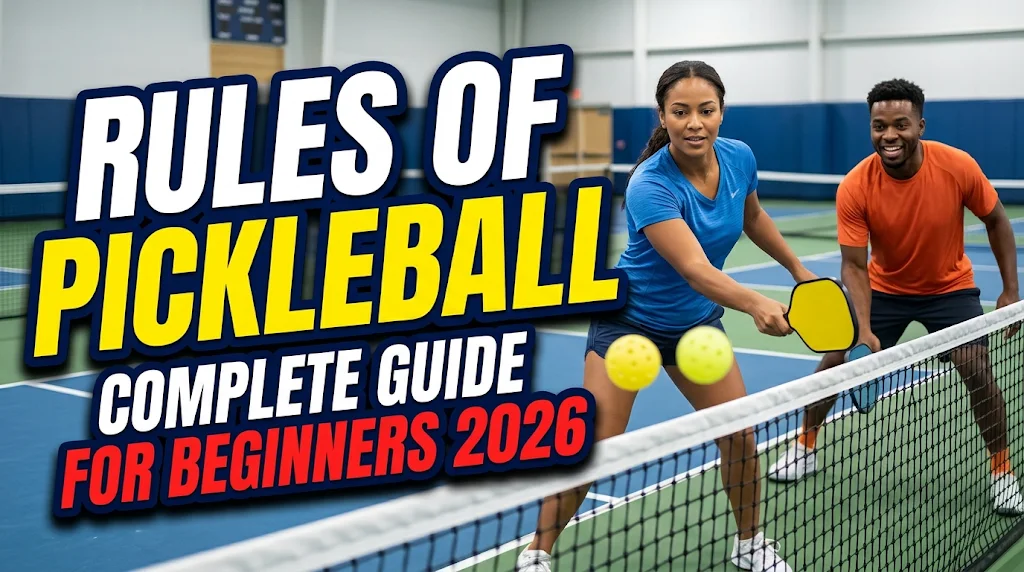
Pickleball looks simple when you watch it for the first time. Two players stand on opposite sides of a net, swing their paddles, and try to keep a small plastic ball in play. But once you step onto the court, questions start popping up. Can you hit the ball before it bounces? Why is there a kitchen near the net? How does the unusual scoring system work? And what happens when the ball lands on a line?
Understanding the rules of pickleball makes the game much more enjoyable. Whether you’re a complete beginner, a recreational player, or someone preparing for a local tournament, knowing the basics helps you avoid unnecessary faults and play with confidence.
The good news? Pickleball is easy to learn. You don’t need years of experience to enjoy a competitive rally. Once you understand the serving rules, two-bounce rule, kitchen rules, and scoring system, you’re ready to play.
Let’s break everything down in simple language.
What Is Pickleball?
Pickleball is a paddle sport that combines elements of tennis, badminton, and table tennis. Players use solid paddles to hit a lightweight, perforated plastic ball over a net.
The game can be played in two formats:
- Singles: One player competes against one opponent.
- Doubles: Two players compete against two opponents.
Doubles is especially popular because it encourages teamwork, communication, and strategic positioning.
A standard pickleball court measures 20 feet wide and 44 feet long. These dimensions remain the same for singles and doubles. The net measures 36 inches high at the sidelines and 34 inches in the middle.
Basic Rules of Pickleball
Before learning advanced techniques, you should understand the basic rules that apply to almost every game.
Here are the most important ones:
- The ball must be served diagonally into the opponent’s service court.
- The serve must clear the non-volley zone (kitchen).
- Both teams must allow the ball to bounce once after the serve and return.
- After those two bounces, players can volley or hit the ball after it bounces.
- Players cannot volley while standing in the kitchen or touching its boundary line.
- The ball must land inside the court boundaries to be considered in.
- A rally ends when a player commits a fault.
- Under traditional side-out scoring, only the serving team can score points.
- Most recreational games are played to 11 points, with a two-point winning margin.
These rules form the foundation of pickleball. Learn them first, and the rest of the game becomes much easier.
Pickleball Court Rules and Dimensions
Knowing the court layout is essential because different areas have different rules.
A standard court is divided into several sections:
- Baseline: The boundary line at the back of each side.
- Sidelines: The lines marking the left and right edges.
- Centerline: Divides each service area into two sections.
- Right service court: The service area on the right side.
- Left service court: The service area on the left side.
- Non-volley zone: The seven-foot area on each side of the net, commonly called the kitchen.
The kitchen is one of the most important parts of the court. It prevents players from standing directly beside the net and smashing every ball.
Remember that court lines are generally considered part of the area they define. A ball landing on a baseline or sideline is in, while a serve landing on the kitchen line is a fault.
Pickleball Serving Rules
Every rally starts with a serve, so understanding the serving rules is extremely important.
Unlike tennis, pickleball uses an underhand-style volley serve or a drop serve.
Volley Serve Rules
For a legal volley serve:
- The server must hit the ball with an upward motion.
- The paddle must contact the ball below the waist.
- The highest point of the paddle head must be below the wrist joint at contact.
- The server must keep at least one foot behind the baseline when striking the ball.
- Neither foot may touch the baseline or the court before the ball is struck.
- The serve must travel diagonally into the opposite service court.
The server gets only one serve attempt under standard rules.
Drop Serve Rules
The drop serve is another legal option and is particularly useful for beginners.
The server releases the ball naturally and lets it bounce before hitting it. The ball cannot be thrown or propelled downward or sideways to create an artificial bounce.
Unlike the volley serve, the drop serve does not require the same below-the-waist contact or upward swing restrictions.
Where Must the Serve Land?
The serve must land in the diagonally opposite service court. It can land on the centerline, sideline, or baseline, but it cannot land in the kitchen or on the kitchen line.
Beginner tip: Focus on serving consistently rather than hitting the ball as hard as possible. A controlled serve that lands legally is much more valuable than a powerful serve that goes out.
The Two-Bounce Rule in Pickleball
The two-bounce rule is one of the most unique rules in pickleball.
It means:
- The receiving team must let the serve bounce before returning it.
- The serving team must let the return bounce before hitting it.
- After these two bounces, either team can volley the ball or play it after a bounce.
For example, imagine you serve the ball to your opponent. Your opponent must allow it to bounce before returning it. You must then let that return bounce on your side before hitting it.
After that, normal rally play begins.
Why Does the Two-Bounce Rule Matter?
This rule prevents the serving team from immediately rushing toward the net and smashing the return. It gives both teams a fair opportunity to establish their positions and creates longer, more strategic rallies.
One common beginner mistake is trying to hit the return of serve out of the air. Don’t do it. Wait for the ball to bounce first!
The Kitchen Rule (Non-Volley Zone)
If there’s one pickleball rule that confuses beginners, it’s the kitchen rule.
The kitchen, officially known as the non-volley zone (NVZ), is the seven-foot area on both sides of the net.
The main rule is simple: You cannot volley the ball while standing in the kitchen or touching its boundary line.
A volley means hitting the ball before it touches the ground.
What Is Allowed in the Kitchen?
You can legally:
- Stand inside the kitchen.
- Walk into the kitchen.
- Hit a ball after it bounces inside the kitchen.
- Move out of the kitchen and continue playing.
What Is Not Allowed?
You cannot:
- Volley the ball while standing inside the kitchen.
- Step on the kitchen line while volleying.
- Let your momentum carry you into the kitchen after hitting a volley.
- Allow something you’re wearing or carrying to touch the kitchen during a volley-related momentum violation.
For example, imagine you’re standing just outside the kitchen and hit a powerful volley. Your shot lands successfully, but your momentum carries your foot into the kitchen. That’s still a fault.
The ball’s landing does not cancel the violation.
Important: You are allowed to enter the kitchen at any time when you are not volleying. The kitchen is not a forbidden area. It simply restricts volleys.
Pickleball Scoring Rules
Pickleball scoring can seem confusing at first, especially when you hear players calling three numbers before serving.
Under traditional side-out scoring, only the serving team can earn points.
Most recreational games are played to 11 points, and a team must win by at least two points.
For example:
- 11–9: The game is over.
- 11–10: Play continues.
- 12–10: The game is over.
Some tournaments use games to 15 or 21 points, depending on their format.
How Does Scoring Work?
If the serving team wins a rally, it earns one point and continues serving.
If the serving team loses a rally, it loses its serve. In doubles, the serve usually passes to the partner before going to the opposing team.
When both serving players lose their opportunities, a side-out occurs, and the opposing team begins serving.
Understanding the Three-Number Score
In traditional doubles scoring, players announce three numbers:
- Serving team’s score.
- Receiving team’s score.
- Server number (1 or 2).
For example, 6-4-2 means:
- Serving team has 6 points.
- Receiving team has 4 points.
- The second server is serving.
At the beginning of a game, the first serving team has only one serving turn before a side-out. This is why the opening score is commonly called 0-0-2.
Singles Scoring
Singles scoring is easier because players announce only two numbers: their score and their opponent’s score.
The server serves from the right side when their score is even and from the left side when their score is odd.
Pickleball Doubles Rules
Doubles is one of the most popular ways to play pickleball. Each team has two players, and teamwork plays a major role.
Here are the essential doubles rules:
- Each player on the serving team gets an opportunity to serve before a side-out, except at the beginning of the game.
- The first serve of a side-out starts from the right-hand service court.
- When the serving team scores, its players switch serving positions.
- The same server continues serving until the team commits a fault.
- Partners should communicate to avoid confusion over shots and line calls.
How Does the Doubles Serving Rotation Work?
Imagine Team A starts serving.
The first server serves until the team commits a fault. Then the second player becomes the server. If that player also commits a fault, the serve moves to Team B.
When Team B gets the serve, its first server starts from the right side.
This rotation continues throughout the match.
Pro tip: Communicate with your partner before and during every rally. Calling shots such as “mine,” “yours,” and “out” can prevent unnecessary mistakes.
Pickleball Singles Rules
Singles pickleball follows almost the same rules as doubles, but there are a few important differences.
In singles:
- Each player serves individually.
- There is no partner serving rotation.
- The server’s court position depends on the score.
- Even scores mean serving from the right.
- Odd scores mean serving from the left.
- Players must cover the entire court on their own.
Singles generally requires more movement and stamina because there is no partner to help cover open spaces.
Common Pickleball Faults
A fault is a rule violation that ends a rally.
Understanding common faults helps you avoid giving away easy points.
Here are some of the most common examples:
| Fault | What Happens |
|---|---|
| Ball goes out | The ball lands outside the court. |
| Ball hits the net | A legal return does not cross the net. |
| Kitchen violation | A player volleys while touching the kitchen. |
| Double bounce | The ball bounces twice before being returned. |
| Illegal serve | The server breaks the serving rules. |
| Foot fault | A server touches the baseline or court before striking the serve. |
| Net contact | A player touches the net or its support system while the ball is in play. |
| Double hit | A player makes an illegal multiple-contact stroke. |
A fault by the receiving team awards a point to the serving team under traditional scoring. A fault by the serving team results in a loss of serve.
Pickleball Line Rules: Is the Ball In or Out?
Line calls can decide close matches, so players should understand how they work.
The basic rule is straightforward:
If any part of the ball touches a boundary line, the ball is considered in.
For example, if the ball touches the sideline by even a small amount, it is in.
However, the kitchen line has a special serving restriction. If a serve touches the kitchen line, it is a fault because the serve must land beyond the non-volley zone.
Players should make line calls honestly and promptly. If you aren’t certain that a ball landed out, the benefit of the doubt generally goes to your opponent.
What Happens When the Ball Hits the Net?
The ball can touch the net during a rally and still remain in play if it crosses over and lands legally.
For example, your opponent hits a shot that touches the top of the net, falls onto your side, and lands inside the court. You must continue playing.
However, if the ball hits the net and falls back onto the hitter’s side, that player loses the rally.
A serve that touches the net and lands legally in the correct service court is also playable under current standard rules. There is no automatic replay simply because the serve touched the net.
Important Pickleball Etiquette Rules
Pickleball is not just about winning. Sportsmanship and respect are important parts of the game.
Follow these simple etiquette tips:
- Call your own faults honestly.
- Avoid arguing over every close line call.
- Wait until a rally finishes before walking across another court.
- Don’t distract opponents while they are preparing to hit.
- Return stray balls safely.
- Communicate with your partner.
- Respect players of different skill levels.
- Shake hands or tap paddles after the match.
Good etiquette makes the game more enjoyable for everyone, whether you’re playing casually or competitively.
Beginner Mistakes to Avoid
Even experienced players occasionally make mistakes, but beginners can avoid many common problems by learning the rules early.
Here are five mistakes worth watching:
Volleying the return of serve: Always allow the serve to bounce before returning it.
Forgetting the kitchen rule: You can enter the kitchen, but you cannot volley while touching it.
Serving into the kitchen: A serve must land beyond the kitchen line in the correct diagonal service court.
Calling the wrong score: Announce the score before every serve.
Hitting every ball too hard: Pickleball rewards control, patience, and placement. Power is not always the best strategy.
Frequently Asked Questions
What are the basic rules of pickleball?
The basic rules include serving diagonally, following the two-bounce rule, avoiding kitchen volleys, keeping the ball inside the court, and using the correct scoring system.
Can you step into the kitchen in pickleball?
Yes. You can enter the kitchen whenever you want, provided you don’t volley the ball while standing in it or touching its line.
Can the ball hit the kitchen line on a serve?
No. A serve that touches the kitchen line is a fault. The serve must land beyond the non-volley zone.
Can you hit the ball before it bounces?
Yes, after the serve and return have each bounced once. Before those two bounces occur, the ball must be allowed to bounce.
How many points do you need to win pickleball?
Most recreational games are played to 11 points, and you must win by two points. Tournament formats may use 15 or 21 points.
Can you score points when you’re not serving?
Under traditional side-out scoring, no. Only the serving team can score. Some formats use rally scoring, where points are awarded after every rally.
Is pickleball played with one or two serves?
Each server gets one serve attempt under standard rules. In doubles, both teammates generally get a turn to serve before a side-out.
What is the most important rule for beginners?
The two-bounce rule and kitchen rule are two of the most important rules to learn first. Understanding them prevents many common faults.
Final Thoughts
Pickleball is popular for a reason. It’s easy to start, fun to play, and challenging enough to keep you improving. But knowing the rules makes the difference between simply hitting a ball and actually understanding the game.
Start by mastering the serve, two-bounce rule, kitchen restrictions, and scoring system. Once these basics become second nature, you can focus on positioning, shot selection, teamwork, and strategy.
Remember, you don’t need to play perfectly to enjoy pickleball. Learn the rules, respect your opponents, practice regularly, and have fun. Your next great rally could be just one game away!

Leo Carter is a passionate sports writer and storyteller at SportNestify.com covering cricket, football, hockey, tennis, basketball and more. With a focus on clear insights, engaging analysis, player stories, and the latest sporting trends, Leo turns every game into a story worth following. His goal is simple