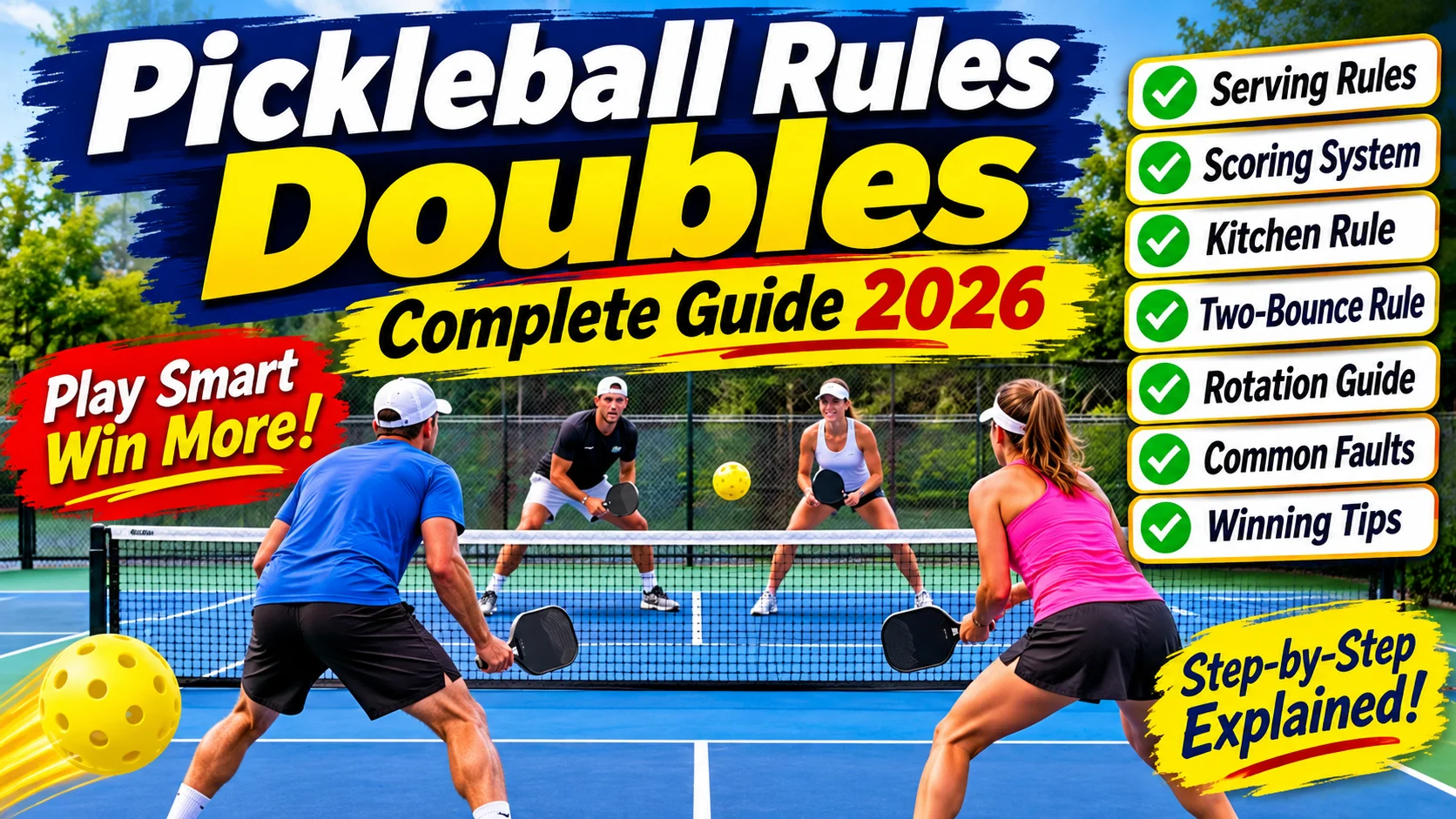
Pickleball doubles is one of the most exciting ways to enjoy the sport. Four players, two teams, fast rallies, clever shots, and plenty of teamwork make every game entertaining. But before you step onto the court, there’s one thing you need to understand: the rules of doubles pickleball.
Whether you’re a complete beginner, a recreational player, or someone preparing for a competitive match, knowing the rules can make a huge difference. From serving rotations and confusing score calls to the famous kitchen rule, understanding the basics helps you avoid unnecessary faults and play with confidence.
The good news? Doubles pickleball is easier to learn than it looks.
This guide explains the official pickleball doubles rules for 2026, including scoring, serving, court positioning, faults, and winning strategies. Let’s break everything down so you can spend less time wondering about the rules and more time enjoying the game.
What Are the Basic Rules of Pickleball Doubles?
Pickleball doubles is played between two teams of two players on a standard 20-by-44-foot court. Both teams work together to score points by serving, returning shots, and forcing their opponents to make mistakes.
Here are the essential rules every doubles player should know:
- Each team has two players.
- The game usually starts with a score of 0-0-2.
- Serves must travel diagonally into the opposite service court.
- The serve and the return of serve must bounce before being hit.
- Players cannot volley while standing in the kitchen or touching its line.
- Only the serving team scores points under standard scoring.
- Both players on a team get an opportunity to serve before a side out.
- Games are generally played to 11 points, and a team must win by at least two points.
These rules form the foundation of doubles pickleball. Once you understand them, the rest of the game becomes much easier.
Understanding the Doubles Pickleball Court
Before learning how to serve or score, you need to understand the court.
A standard pickleball court measures:
- Width: 20 feet
- Length: 44 feet
- Non-Volley Zone (Kitchen): 7 feet from the net on each side
- Net: Approximately 36 inches high at the sidelines and 34 inches in the center.
The court is divided into two service areas on each side: the right service court and the left service court.
Each team has two players who generally start on opposite sides of the court. The positions change according to the serving team’s score and the service rotation.
Understanding court positions is especially important because serving from the wrong position or receiving with the wrong player can result in a fault.
Pickleball Doubles Scoring Rules
Scoring is probably the most confusing part of doubles pickleball for new players. Unlike traditional tennis, standard pickleball uses side-out scoring.
This means only the serving team can earn points.
If the serving team wins a rally, it receives one point. If it loses the rally, the serve moves to its partner or eventually to the opposing team.
How Does Doubles Scoring Work?
A doubles score contains three numbers:
- Serving team’s score.
- Receiving team’s score.
- Server number (1 or 2).
For example, a score of 5-3-2 means:
- The serving team has 5 points.
- The receiving team has 3 points.
- The second server is currently serving.
The third number is important because it tells players which member of the serving team has the right to serve.
Why Does a Pickleball Game Start at 0-0-2?
You might wonder why the first score of a doubles game is called 0-0-2 instead of 0-0-1.
Here’s why.
At the beginning of a game, the starting team gets only one server before a side out occurs. This prevents the team that serves first from having an extra advantage.
Therefore, the first server is treated as the second server for scoring purposes.
After the first side out, both players on each team receive their normal serving opportunities.
How Many Points Do You Need to Win?
Most standard doubles pickleball games are played to 11 points.
However, reaching 11 isn’t always enough.
You must win by at least two points.
For example:
- 11-8: The game is over.
- 11-10: The game continues.
- 12-10: The game is over.
- 13-11: The game is over.
Some tournaments use different formats, including games to 15 or 21 points, depending on their competition rules.
Pickleball Doubles Serving Rules
Serving is one of the most important parts of doubles pickleball. A legal serve starts every rally, and understanding the serving rules helps prevent unnecessary mistakes.
Here are the key serving requirements.
Serve Diagonally
The server must hit the ball diagonally across the net into the opponent’s opposite service court.
The serve must clear the kitchen and land within the correct service area.
A serve landing in the kitchen or on the kitchen line is a fault.
However, a serve landing on the baseline, sideline, or centerline of the correct service court is considered in.
Volley Serve Rules
A volley serve means hitting the ball before it bounces.
Under the 2026 USA Pickleball rules:
- The paddle must move in an upward arc when contacting the ball.
- The highest point of the paddle head must not be above the highest part of the server’s wrist joint.
- The ball must be no higher than the server’s waist when struck.
Both forehand and backhand serving motions are permitted.
Drop Serve Rules
Players can also use a drop serve.
With this serving method, the ball is released naturally and allowed to bounce before being hit.
The player must not throw or propel the ball downward or upward to create an advantage.
Unlike a volley serve, the drop serve does not have the same paddle-angle or waist-height restrictions.
Can You Switch Serving Sides?
Yes, but serving positions follow the score.
When the serving team wins a point, the same server continues serving but switches sides with their partner.
The receiver positions do not change simply because the serving team scores.
The Two-Bounce Rule in Doubles Pickleball
The two-bounce rule is one of the most important rules in pickleball.
It prevents players from rushing directly to the net and attacking every serve.
Here’s how it works:
Bounce 1: The Serve
The receiving team must let the serve bounce before returning it.
Bounce 2: The Return
After the receiver hits the ball, the serving team must also let the return bounce before hitting it.
After these two required bounces, both teams can volley the ball or play it after a bounce.
Example of the Two-Bounce Rule
Imagine Team A serves to Team B.
- Team A serves the ball.
- Team B lets the ball bounce and returns it.
- Team A lets the return bounce.
- Team A hits the ball back across the net.
- From this point, either team can volley or play groundstrokes.
If a player volleys before the required bounce, their team commits a fault.
The Kitchen Rule in Doubles Pickleball
<PRIVATE_PERSON>Often called the kitchen, the non-volley zone is a seven-foot area on both sides of the net.
It is one of the most recognizable features of pickleball.
The main rule is simple:
You cannot hit the ball out of the air while standing in the kitchen or touching its boundary line.
But there’s more to understand.
What Can You Do in the Kitchen?
Players are allowed to:
- Step into the kitchen.
- Stand inside the kitchen.
- Hit a ball after it bounces in the kitchen.
- Move out of the kitchen and continue playing.
The restriction applies to volleying, not entering the area.
What Is a Kitchen Fault?
A kitchen fault occurs when a player volleys the ball while touching the kitchen or its line.
A fault can also happen when a player’s momentum carries them into the kitchen after hitting a volley.
For example, imagine you hit a powerful volley near the net. Your shot lands successfully, but your momentum carries you forward and your foot touches the kitchen line.
That’s a fault.
Even if the ball lands perfectly, the point is lost because of the violation.
Can Your Partner Stand in the Kitchen?
Absolutely!
Your partner can stand inside the kitchen while you volley, provided they don’t interfere with play or commit another fault.
The kitchen rule applies to the player who hits the volley and their own momentum.
Doubles Pickleball Serving Rotation Rules
Serving rotation is where many beginners get confused.
In doubles, both teammates usually get an opportunity to serve before the team loses its service.
Let’s understand the rotation.
Step-by-Step Serving Rotation
Imagine Team A consists of Player A1 and Player A2.
- Player A1 starts serving.
- Player A1 wins a rally and earns a point.
- Player A1 continues serving from the opposite side.
- Player A1 loses a rally.
- Player A2 gets the second serving opportunity.
- Player A2 continues serving until losing a rally.
- The serve moves to Team B.
This process repeats throughout the game.
Remember, at the beginning of the game, the starting team has only one serving opportunity before the first side out.
When Does a Side Out Happen?
A side out happens when both serving players have lost their serving opportunities.
After a side out, the opposing team receives the serve.
A side out does not award a point to the receiving team under standard scoring.
Common Pickleball Doubles Faults
A fault is a violation that ends the rally.
If your team commits a fault while serving, it can lose its serving opportunity. If you’re receiving, a fault generally awards the rally to the serving team.
Here are some common faults to avoid:
| Fault | What Happens |
|---|---|
| Ball lands out | The rally is lost |
| Ball hits the net and does not cross | The rally is lost |
| Serve lands in the kitchen | The serve is a fault |
| Volleying in the kitchen | The rally is lost |
| Missing the required bounce | The rally is lost |
| Hitting the ball before it crosses the net | The rally is lost |
| Hitting the ball twice with a non-continuous stroke | The rally is lost |
| Serving from the wrong position | The rally is lost |
Players should also avoid touching the net or its supporting system while the ball is in play.
Understanding these faults helps you play more confidently and avoid giving away easy rallies.
Where Should Doubles Players Stand?
Good positioning can make a huge difference in doubles pickleball.
Both teammates need to work together rather than covering only their individual sides.
Before the Serve
The serving team generally starts behind the baseline, with each player positioned according to the score and serving rotation.
The receiving team positions itself to receive the serve and prepare for the return.
After the Return
Once the two-bounce rule has been satisfied, both teams often try to move toward the kitchen line.
This position helps players control the rally and respond to short shots, volleys, and dinks.
Should Both Partners Stay Together?
Not necessarily.
Players should communicate and cover their assigned areas.
A common strategy is to move together toward the kitchen line and avoid leaving large gaps between partners.
Good communication prevents confusion over who should hit the ball.
Important Doubles Pickleball Rules Beginners Often Miss
Even experienced recreational players sometimes misunderstand these situations.
Here are a few important points:
Both partners can make line calls.
Either player on a doubles team can make line calls, including calls on the opponents’ shots.
The kitchen line is part of the kitchen.
Stepping on the line while volleying is a fault.
You can hit a ball inside the kitchen after it bounces.
The restriction is against volleying, not entering the kitchen.
The serving team does not automatically earn a point when the receiving team faults.
The serving team earns a point when it wins the rally.
A serve can touch the net and still be legal.
If the serve clears the net and lands in the correct service court, it remains in play.
You must call the score before serving.
The complete score must be announced before the serve is hit.
Your partner can return the ball after it bounces on your side.
However, only one player may strike the ball during a normal return attempt. If both partners hit it, that’s a fault.
Best Tips for Winning Doubles Pickleball Games
Knowing the rules is important, but applying them strategically is what makes you a better player.
Try these practical tips:
Communicate With Your Partner
Use simple calls like mine, yours, and out. Clear communication prevents unnecessary mistakes.
Master the Third Shot Drop
The third shot drop is a soft shot played after the serve and return. It helps the serving team move toward the kitchen line without giving opponents an easy attacking opportunity.
Control the Kitchen Line
The kitchen line is an important position in doubles. Players who control this area often have better opportunities to attack and defend.
Avoid Unnecessary Power
You don’t need to smash every ball. Controlled shots, accurate placement, and patience can be more effective than hitting everything hard.
Learn to Dink
A dink is a soft shot that lands in your opponent’s kitchen. It forces opponents to move, control their paddle, and wait for the right attacking opportunity.
Practice Your Serving Consistency
A powerful serve is useful, but a legal and accurate serve is even more important. Focus on getting the ball into the correct service court consistently.
Frequently Asked Questions
How many players are needed for doubles pickleball?
Four players are needed. Each team has two players competing against another pair.
What is the starting score in doubles pickleball?
The traditional starting score is 0-0-2. The second server designation is used because the starting team gets only one serving opportunity before the first side out.
Can both players serve in doubles pickleball?
Yes. Both players normally get an opportunity to serve before a side out occurs. The exception is the first serving team at the beginning of the game.
Can you enter the kitchen in pickleball doubles?
Yes. You can enter and stand in the kitchen. However, you cannot volley the ball while touching the kitchen or its boundary line.
What happens if the ball lands on the kitchen line during a serve?
It’s a fault. A serve must land beyond the kitchen line in the correct diagonal service court.
Can you switch positions with your partner in doubles?
Yes, players can change their court positions during a rally. However, the correct server and receiver must follow the official positioning and rotation rules.
Do you have to win by two points in doubles pickleball?
Yes. In standard games played to 11, a team must lead by at least two points to win.
Who scores points in doubles pickleball?
Under standard scoring, only the serving team scores points. Rally scoring is also available as a separate approved scoring option.
What is a side out in doubles pickleball?
A side out happens when the serving team loses both players’ serving opportunities, transferring the serve to the opposing team.
Can you hit the ball twice in pickleball doubles?
A continuous stroke in one direction may result in more than one paddle contact. However, an illegal double hit or having both partners strike the ball is a fault.
Final Thoughts
Pickleball doubles is all about teamwork, smart positioning, and understanding the rules. Once you learn how scoring works, when to serve, how the two-bounce rule applies, and what you can and cannot do in the kitchen, the game becomes much more enjoyable.
You don’t have to master every advanced technique on your first day. Start with the fundamentals, practice with your partner, communicate during rallies, and focus on consistency.
Most importantly, remember that pickleball is meant to be fun. Play fair, respect your opponents, and enjoy every rally.

Leo Carter is a passionate sports writer and storyteller at SportNestify.com covering cricket, football, hockey, tennis, basketball and more. With a focus on clear insights, engaging analysis, player stories, and the latest sporting trends, Leo turns every game into a story worth following. His goal is simple