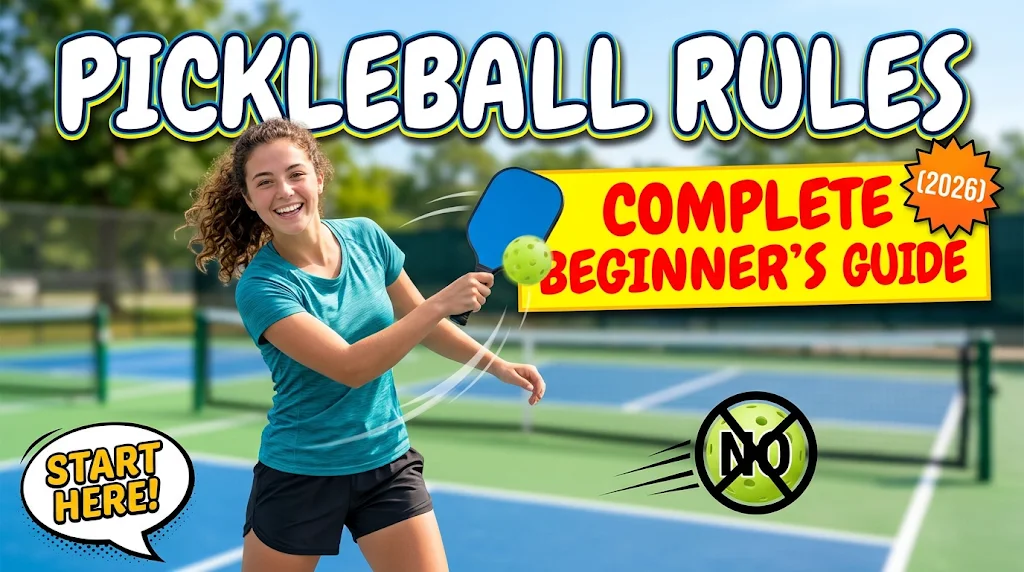
Have you ever watched a pickleball game and wondered why players keep talking about the kitchen, calling out three numbers before serving, or letting the ball bounce twice? You’re not alone! Pickleball is easy to pick up, but a few unique rules can make your first game confusing.
The good news? You don’t need to be a professional athlete or memorize a complicated rulebook to enjoy this exciting sport. Once you understand the serving rules, scoring system, two-bounce rule, and kitchen rule, you’ll be ready to step onto the court with confidence.
So, what are the rules of pickleball?
In simple terms, pickleball is played by hitting a perforated plastic ball over a net using solid paddles. Players must serve diagonally, follow the two-bounce rule, keep volleys out of the kitchen, and avoid hitting the ball out of bounds. Most traditional games are played to 11 points, and you must win by at least two.
Let’s break down everything you need to know about pickleball rules, including serving, scoring, faults, court boundaries, and common beginner mistakes.
What Are the Basic Rules of Pickleball?
Before getting into the details, here are the fundamental rules every beginner should understand:
- Pickleball can be played as singles (one player against one) or doubles (two players against two).
- The game starts with an underhand volley serve or a legal drop serve.
- Every serve must travel diagonally into the opponent’s service court.
- Both teams must allow the ball to bounce once at the beginning of a rally.
- Players cannot volley the ball while standing in the kitchen.
- The ball must land inside the court boundaries to remain in play.
- In traditional scoring, only the serving team can earn points.
- Most games go to 11 points, with a two-point winning margin.
These rules apply to recreational play and form the foundation of competitive pickleball.
Understanding the Pickleball Court
Knowing the court layout makes the rest of the rules much easier to understand.
A standard pickleball court measures:
- Length: 44 feet
- Width: 20 feet
- Net height: 36 inches at the sidelines and 34 inches at the center.
The court is the same size for singles and doubles.
There are several important areas:
Baseline: The line at the back of each side of the court. Servers must stay behind it when serving.
Sidelines: The lines running along the left and right edges of the court.
Centerline: The line dividing each side’s service area into two sections.
Non-Volley Zone (Kitchen): The seven-foot area on each side of the net where players cannot hit the ball out of the air.
Understanding these areas helps you avoid serving faults and incorrect line calls.
Pickleball Serving Rules
The serve is how every pickleball rally begins. Unlike tennis, pickleball has specific serving requirements that players must follow.
Here are the main serving rules:
- The server must hit the ball diagonally across the net into the opposite service court.
- The serve must clear the kitchen and its line.
- During a traditional volley serve, the paddle must contact the ball below the server’s waist.
- The server’s arm must move in an upward arc during a volley serve.
- The paddle head must not be above the highest part of the wrist at contact.
- At least one foot must be behind the baseline when the ball is struck.
- Neither foot may touch the baseline or the court inside it during contact.
- Only one serve attempt is allowed.
What Is an Underhand Serve?
An underhand serve is a serving technique in which the player hits the ball using an upward paddle motion rather than an overhead or tennis-style motion.
For a traditional volley serve, the ball must be struck below waist level, with the arm moving upward.
What Is a Drop Serve?
A drop serve is another legal way to start a pickleball rally.
Instead of hitting the ball directly out of the air, the server drops it and allows it to bounce before hitting it.
The ball must be dropped naturally. The player cannot throw it down or add force to the release.
Unlike the traditional volley serve, the drop serve does not have the same restrictions on paddle position, contact height, or upward arm motion.
Beginner tip: If you’re struggling with the traditional serve, try the drop serve. It can make learning the game much easier.
The Two-Bounce Rule in Pickleball
The two-bounce rule is one of the most important rules in pickleball. It’s also one of the easiest for beginners to forget.
Here’s how it works:
- The server hits the ball diagonally into the opponent’s service court.
- The receiving team must let the ball bounce once before returning it.
- The serving team must also let the returned ball bounce once before hitting it.
- After these two required bounces, either team can volley the ball or play it after a bounce.
For example, imagine you’re serving to your opponent. They cannot smash your serve directly out of the air. They must let it bounce first. When they return it, you must also let it bounce before hitting it.
After that, normal rallies begin.
Why does this rule exist?
The two-bounce rule prevents players from rushing straight to the net and dominating every rally. It creates longer exchanges, encourages better positioning, and makes pickleball more enjoyable for players of different skill levels.
What Is the Kitchen Rule in Pickleball?
If you’ve heard pickleball players shouting about the kitchen, they’re talking about the non-volley zone.
The kitchen is a seven-foot area extending from the net on both sides of the court.
It’s probably the most talked-about rule in pickleball, and for good reason!
The main rule is simple: You cannot volley the ball while standing in the kitchen.
A volley means hitting the ball before it touches the ground.
However, there’s more to understand.
What You Can Do in the Kitchen
- You can step into the kitchen at any time.
- You can hit the ball after it bounces while standing inside the kitchen.
- You can move through the kitchen to retrieve a short shot.
- You can stand inside the kitchen as long as you aren’t committing a volley fault.
What You Cannot Do in the Kitchen
- You cannot hit a volley while standing inside the kitchen.
- You cannot touch the kitchen line while volleying.
- You cannot hit a volley outside the kitchen and then have your momentum carry you into the kitchen.
Even if you hit the ball outside the kitchen, your momentum can still cause a fault if you step into the kitchen afterward.
Example: Imagine your opponent hits a high ball toward you. You jump from outside the kitchen and smash it. However, after landing, your momentum carries you into the kitchen. That’s a fault!
Remember: The kitchen doesn’t mean you can never enter that area. It simply means you cannot volley while touching it or be carried into it by your momentum.
Pickleball Scoring Rules Explained
Scoring is another area that confuses new pickleball players.
In traditional pickleball scoring, only the serving team can score points. If the receiving team wins a rally, it doesn’t earn a point; instead, it gains the opportunity to serve.
How Many Points Do You Need to Win?
Most pickleball games are played to 11 points.
However, there’s one important condition: You must win by at least two points.
For example:
- 11–9: The game is over.
- 11–10: The game continues.
- 12–10: The game is over.
- 15–13: The game is over.
Some tournaments use games to 15 or 21 points, also requiring a two-point lead.
How Does Doubles Scoring Work?
In doubles, each team has two players, and both players generally get an opportunity to serve before the team loses its serve.
The exception happens at the beginning of a new game. The first serving team starts with only one server.
When a team wins a rally while serving, it earns a point, and the same server switches sides to serve again.
When the first server commits a fault, the partner gets the next serving opportunity. When the second server commits a fault, the serve passes to the opposing team. This is called a side-out.
How Does Singles Scoring Work?
Singles is slightly simpler because there’s only one server on each side.
The server’s court position depends on their score:
- Even score: Serve from the right side.
- Odd score: Serve from the left side.
For example, if your score is 4, you serve from the right. If your score is 5, you serve from the left.
How to Call the Score in Pickleball
One unique feature of pickleball is its three-number scoring system in doubles.
The server announces three numbers before serving:
- Serving team’s score.
- Receiving team’s score.
- Server number (1 or 2).
For example, 6-4-2 means:
- The serving team has 6 points.
- The receiving team has 4 points.
- The second server is serving.
At the beginning of a game, the score is traditionally called 0-0-2 because the starting team gets only one serving opportunity before a side-out.
In singles, players generally call only two numbers: their score first, followed by the opponent’s score.
Calling the score before serving helps both teams stay organized and avoid confusion.
What Counts as a Fault in Pickleball?
A fault is a rule violation that ends a rally.
Depending on which team commits the fault, the result can be a lost serve or a point for the serving team.
Here are some common pickleball faults:
| Fault | What Happens |
|---|---|
| Serving into the net | The serve is lost |
| Serving into the kitchen | The serve is lost |
| Hitting the ball out of bounds | The rally ends |
| Volleying inside the kitchen | A fault occurs |
| Breaking the two-bounce rule | A fault occurs |
| Allowing the ball to bounce twice | A fault occurs |
| Touching the net while the ball is in play | A fault occurs |
| Making an illegal serve | A fault occurs |
| Hitting the ball before it crosses the net | A fault occurs |
| Ball hitting a player or their clothing | A fault occurs |
Important: If the receiving team commits a fault, the serving team earns a point under traditional scoring. If the serving team commits a fault, it loses its serving opportunity.
Pickleball Line Rules: Is the Ball In or Out?
Knowing how to make correct line calls is essential for fair play.
The general rule is simple:
If the ball touches any court boundary line, it is considered IN.
There is one important exception: A serve that touches the kitchen line is considered short and results in a fault.
Here are a few examples:
- Ball touching the baseline: IN.
- Ball touching the sideline: IN.
- Ball touching the centerline: IN.
- Serve touching the kitchen line: OUT.
Players should make line calls honestly and give their opponents the benefit of the doubt when they cannot clearly determine whether a ball landed in or out.
Pickleball Rules for Singles vs. Doubles
Pickleball can be played in two main formats: singles and doubles.
Although most rules are the same, there are a few differences.
| Rule | Singles | Doubles |
|---|---|---|
| Players | 1 vs. 1 | 2 vs. 2 |
| Court size | 20 × 44 feet | 20 × 44 feet |
| Serving rotation | One server per side | Two servers per team, except at the start |
| Score calling | Two numbers | Three numbers |
| Serving position | Based on server’s score | Based on team rotation and score |
Doubles is generally more popular among recreational players because it involves teamwork, communication, and less individual court coverage.
Singles requires more movement and places greater emphasis on fitness, positioning, and shot placement.
Pickleball Etiquette: Rules for Good Sportsmanship
Pickleball isn’t just about winning points. It’s also about having fun and respecting other players.
Following good court etiquette makes the experience better for everyone.
Here are some important habits:
- Call the score clearly before every serve.
- Avoid distracting opponents while they’re serving.
- Make honest line calls.
- Respect your opponents and teammates.
- Don’t argue aggressively over close calls.
- Return stray balls safely.
- Wait until the previous game finishes before entering the court.
- Congratulate opponents after the match.
A little sportsmanship goes a long way, especially when you’re playing recreational games with new people.
Common Pickleball Mistakes Beginners Should Avoid
Even experienced players occasionally make mistakes. However, beginners can avoid many unnecessary faults by remembering a few simple things.
Forgetting the two-bounce rule
Never hit the serve or the return of serve before it bounces.
Stepping into the kitchen while volleying
Always keep your feet outside the kitchen when hitting a volley. Remember that momentum counts, too.
Serving into the wrong court
Your serve must travel diagonally into the opposite service court.
Forgetting to call the score
Announce the complete score before serving, especially in doubles.
Assuming every kitchen entry is illegal
You can enter the kitchen to play a ball after it bounces. Just don’t volley while touching the kitchen or its line.
Forgetting the two-point winning margin
Scoring 11 points doesn’t automatically win the game. You must also lead by two.
Avoiding these mistakes will help you enjoy smoother rallies and build confidence much faster.
Pickleball Rules Cheat Sheet for Beginners
Need a quick reminder before your next game? Here’s a simple summary of the most important rules:
| Rule | Quick Answer |
|---|---|
| Court size | 20 × 44 feet |
| Net height | 36 inches at sides, 34 inches at center |
| Game length | Usually 11 points |
| Winning margin | 2 points |
| Serving direction | Diagonally across the court |
| Serve types | Volley serve or drop serve |
| Two-bounce rule | Both teams must let the first ball bounce |
| Kitchen size | 7 feet from the net on each side |
| Kitchen rule | No volleying inside the kitchen |
| Traditional scoring | Only serving team scores |
| Singles serving position | Right on even scores, left on odd scores |
| Doubles score | Three-number announcement |
Frequently Asked Questions
What are the 5 basic rules of pickleball?
The five basic rules are:
- Serve diagonally into the opposite service court.
- Follow the two-bounce rule.
- Never volley while touching the kitchen.
- Keep the ball inside the court boundaries.
- In traditional scoring, only the serving team earns points.
Can you step into the kitchen in pickleball?
Yes! You can enter the kitchen whenever you want. You can even hit a ball from inside it after the ball bounces. However, you cannot volley while standing in the kitchen or touching its boundary line.
Can the ball hit the net during a pickleball serve?
Yes. A serve that touches the net but still lands in the correct service court beyond the kitchen line remains in play. There is no traditional let-serve replay.
Can you score a point when you’re not serving?
Under traditional side-out scoring, no. Only the serving team can score points. However, an approved rally-scoring format awards points to the team that wins each rally, regardless of who serves.
How many times can the ball bounce in pickleball?
The ball can bounce once before a player returns it. If it bounces twice on your side, you lose the rally.
Is pickleball easier than tennis?
Many beginners find pickleball easier to learn because it uses a smaller court, a lighter ball, and simpler basic techniques. However, becoming a skilled player still requires practice, strategy, and good movement.
Do you have to win by two points in pickleball?
Yes. Standard games typically go to 11 points, but a player or team must lead by at least two points to win.
Can you hit the ball out of the air in pickleball?
Yes. Hitting the ball before it bounces is called a volley. You can volley from anywhere outside the kitchen, provided you haven’t violated the kitchen momentum rule or another rule.
What happens if you touch the kitchen line?
Touching the kitchen line is a fault if you’re volleying. However, touching the line while entering the kitchen to play a ball after it bounces is legal.
What is the starting score in pickleball doubles?
The traditional starting score is 0-0-2. It indicates that the first serving team has only one server before the serve passes to the opposing team.
Final Thoughts?
Pickleball may look complicated when you first watch it, but its rules are surprisingly easy to learn. Once you understand serving, scoring, the two-bounce rule, and the kitchen, you’ll have everything you need to enjoy your first match.
Remember these four important things: serve diagonally, let the ball bounce twice at the beginning of each rally, avoid volleying in the kitchen, and win by two points.
Most importantly, don’t worry about making mistakes when you’re starting out. Grab a paddle, find a partner, practice a few serves, and enjoy the game.
Now that you know the rules of pickleball, are you ready to hit the court?

Theo Bennett is a passionate sports writer and storyteller at SportNestify.com covering cricket, football, hockey, tennis, basketball and more. With a focus on clear insights, engaging analysis, player stories, and the latest sporting trends, Leo turns every game into a story worth following. His goal is simple