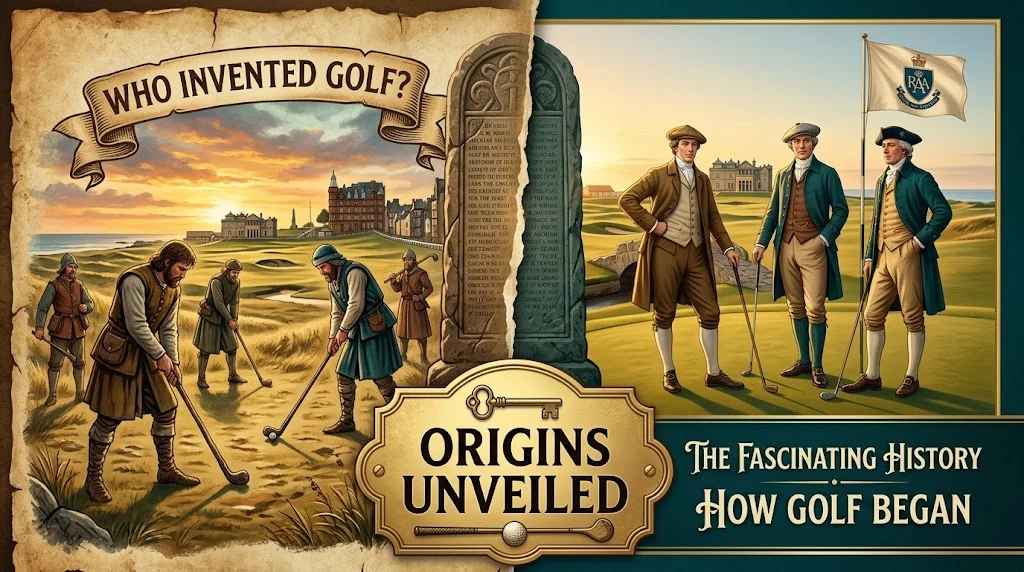
The short answer is: no single person is known to have invented golf. Modern golf developed gradually in Scotland, particularly during the 15th and 16th centuries, from earlier stick-and-ball games. Over time, Scottish golfers developed the rules, equipment, courses, and traditions that transformed those early games into the sport we recognize today.
Golf’s story is therefore less about one inventor and more about centuries of evolution.
From players hitting balls across coastal links to the famous Old Course at St Andrews, golf has traveled an extraordinary path to become a global sport.
Who Invented Golf?
Golf was not invented by one known individual. Historians generally trace the development of modern golf to Scotland, where a recognizable form of the game was being played by the 15th century.
The earliest Scottish version involved hitting a ball with a club toward a target. As the game developed, players increasingly played across natural landscapes called links, using holes as targets.
The United States Golf Association notes that golf evolved from its origins in the 15th century, with early clubs made from wood and balls made from materials such as feathers.
That means the question “Who invented golf?” has a more complicated answer than simply naming one person.
Scotland developed golf into the game we know today, but the basic idea of hitting an object with a stick is much older.
Where Did Golf Originate?
The strongest historical connection is Scotland.
Scottish records from the 15th century show that games involving hitting a ball with a club were already being played. Golf became particularly associated with coastal links and towns such as St Andrews.
The University of St Andrews notes that there is evidence of sporting activity around the area before the university’s formal foundation in 1413, although it is not certain that golf was part of those earliest activities. By the 16th century, however, golf was clearly established in St Andrews.
A particularly important document is the 1552 Golf Charter, an agreement that explicitly refers to playing golf on the links at St Andrews.
This makes St Andrews one of the most important places in golf’s early history.
Was Golf Invented in Scotland?
Modern golf is generally considered to have developed in Scotland.
However, saying that Scotland invented every element of the game would be too simplistic.
Games involving sticks and balls existed in different cultures long before modern golf. Similar games appeared in parts of Europe and Asia, and historians have debated whether some of these games influenced later forms of golf.
What makes Scotland especially important is that the Scots transformed the basic concept into something recognizable as golf.
They developed:
- Clubs designed specifically for striking golf balls
- Golf balls designed for distance
- Courses with designated holes
- Rules governing play
- Competitive golf
- Golf clubs and organized societies
- The tradition of playing across links land
In other words, Scotland did not necessarily invent the idea of hitting a ball with a stick, but it played the central role in developing the modern sport of golf.
When Was Golf Invented?
There is no exact year when golf was invented.
The modern game began taking recognizable shape during the 1400s and 1500s in Scotland.
One important historical clue comes from Scottish legislation.
During the 15th century, Scottish kings attempted to restrict golf because they believed it distracted young men from practicing archery.
According to the University of St Andrews, golf was banned by Scottish kings including James II, James III, and James IV during the second half of the 15th century because archery was considered important for national defense.
That is an intriguing fact because it proves that golf was already popular enough to attract official attention hundreds of years ago.
Imagine that: golf was once considered such a distraction that Scottish authorities wanted people to stop playing it.
The First Written Reference to Golf
One of the earliest known references to golf appears in Scotland in the 15th century.
In 1457, an Act of the Scottish Parliament attempted to restrict games including golf and football because young men were being encouraged to practice archery instead.
This doesn’t mean golf suddenly appeared in 1457.
Rather, the law indicates that the game was already established enough to be recognized by the government.
That makes the 15th century a crucial period in golf’s development.
Did the Dutch Invent Golf?
This is where golf history becomes particularly interesting.
Some historians have suggested connections between golf and older Dutch games such as kolf, in which players used clubs to hit a ball toward a target.
Dutch paintings and historical records demonstrate that stick-and-ball games were played in the Netherlands centuries ago.
However, that does not prove that the Dutch invented modern golf.
The Scottish game developed its own distinctive characteristics, particularly the practice of playing over open links land toward a series of holes.
So, while earlier European games may have influenced the broader tradition of club-and-ball sports, Scotland remains the key location in the development of modern golf.
What Did Early Golf Look Like?
Early golf looked very different from today’s professional game.
Forget perfectly manicured fairways, GPS watches, carbon-fiber drivers, launch monitors, and automated irrigation.
Early golfers played across natural landscapes.
The courses were often coastal areas containing:
- Sand dunes
- Long grass
- Natural hazards
- Uneven ground
- Bushes
- Natural depressions
These landscapes became known as links.
Players had to deal with whatever nature put in front of them.
The clubs were also relatively simple. Early clubs were generally made from wood, while golf balls went through several stages of development.
Early feather-filled balls, known as featheries, were expensive and difficult to manufacture.
Golf equipment would eventually become dramatically more sophisticated.
How Did the First Golf Balls Work?
The earliest golf balls were not anything like the modern dimpled balls used today.
One famous early design was the feathery.
A feathery was made from leather and stuffed with compressed feathers. The leather was stitched around the feathers and then painted.
Making these balls was difficult and expensive.
Later, gutta-percha balls became popular during the 19th century. They were cheaper to produce and helped make golf more accessible.
Eventually, the development of rubber-core balls and modern dimple patterns dramatically improved distance and consistency.
The golf ball’s evolution is one of the clearest examples of how technology transformed the sport.
Why Is St Andrews So Important to Golf History?
If Scotland is the birthplace of modern golf, St Andrews is often described as the “home of golf.”
Golf has been played at St Andrews for centuries.
The famous Old Course evolved gradually rather than being created as a modern 18-hole course from the beginning.
In fact, the Old Course was originally played with more than 18 holes.
The University of St Andrews states that the Old Course was a 22-hole course until 1764. Over time, the layout evolved into the 18-hole format that became standard.
That evolution is incredibly important because the modern 18-hole golf course is now one of the sport’s defining features.
Who Created the 18-Hole Golf Course?
There wasn’t one inventor who suddenly decided that every golf course should have 18 holes.
The 18-hole standard developed gradually.
St Andrews played an important role in this process. In 1764, the Old Course was reduced from 22 holes to 18.
Because St Andrews became enormously influential in golf, the 18-hole format eventually became the standard for most full-length golf courses.
So when you play an 18-hole round today, you’re following a tradition that developed through centuries of experimentation.
Who Invented the Rules of Golf?
The rules of golf also evolved over time.
One of the most important milestones occurred in 1744, when the Honourable Company of Edinburgh Golfers created what is widely recognized as the first known written Rules of Golf.
The original rules were developed for a competition at Leith. They established a framework for how the game should be played.
The Royal and Ancient Golf Club of St Andrews later adopted these rules for its own competitions in 1754.
This was a major turning point.
Golf was moving from a loosely organized pastime toward a standardized sport.
Why Were Written Golf Rules Important?
Imagine playing golf with no shared rules.
One golfer might count a stroke differently from another. Another might interpret hazards differently. Players could disagree about where a ball should be played from.
Written rules solved many of these problems.
They helped establish consistent standards for:
- Counting strokes
- Playing the ball
- Handling hazards
- Match play
- Competition
- Equipment
- Course conditions
As golf spread beyond Scotland, standardized rules became increasingly important.
How Did Golf Spread Around the World?
Golf eventually traveled beyond Scotland and Great Britain.
It reached other parts of Europe and eventually North America.
The game was being played in the American colonies long before the modern U.S. golf boom of the late 19th century. The USGA notes records of golf clubs in Massachusetts dating to 1729, while shipping records from the 1740s document golf clubs and balls being exported from Scotland to American colonies.
By the late 1800s, golf was rapidly becoming organized in the United States.
Golf clubs appeared across the country, competitions became more formal, and national organizations were established.
When Did Golf Become Popular in America?
Golf became significantly more popular in the United States during the late 19th century.
By 1894, more than 50 golf clubs existed in the country, according to the USGA.
That same year marked another major moment.
Representatives from five prominent clubs came together and established what became the United States Golf Association (USGA).
The organization was created to help establish common rules and organize national championships.
The first U.S. Open was played in 1895.
From there, American golf expanded rapidly.
Who Invented Modern Golf Equipment?
No single person invented modern golf equipment.
Instead, hundreds of inventors, clubmakers, players, engineers, and manufacturers contributed to its development.
The transformation has been remarkable.
Early Golf
- Wooden clubs
- Feather-filled balls
- Natural turf
- Basic equipment
19th-Century Golf
- Gutta-percha balls
- Improved club designs
- Better manufacturing
- More organized courses
20th-Century Golf
- Rubber-core balls
- Steel shafts
- Improved clubheads
- Mass-produced equipment
Modern Golf
- Titanium drivers
- Graphite shafts
- Multi-layer golf balls
- Launch monitors
- GPS technology
- Advanced club fitting
- Data-driven swing analysis
Golf may have started with a wooden stick and ball, but modern equipment is the result of centuries of technological development.
Who Invented the Golf Tee?
Interestingly, although nobody can claim to have invented golf itself, we do know who patented one of the earliest modern wooden golf tees.
Dr. George Grant, a Boston dentist and golfer, patented a wooden golf tee in 1899.
Before wooden tees became common, golfers typically used small piles of sand to elevate their balls.
The USGA records Grant’s 1899 patent as the first U.S. patent for a golf tee.
However, Grant did not widely market his invention.
The wooden tee became much more popular later, particularly with the development of William Lowell’s Reddy Tee in the early 1920s.
This is another fascinating example of how golf evolved through many separate innovations.
Was Golf Always an 18-Hole Game?
No.
This is one of the most common misconceptions about golf.
The 18-hole format became standard over time. St Andrews played a major role in that development.
The Old Course had 22 holes until 1764, when its layout was reduced to 18.
As the influence of St Andrews grew, the 18-hole round became the accepted standard.
Today, saying “I’m playing a round of golf” generally means playing 18 holes, although nine-hole rounds are also extremely common.
How Did Golf Become a Professional Sport?
For centuries, golf was largely a recreational and competitive pastime.
As the sport spread, tournaments became more organized.
Professional golfers emerged, golf clubs became more established, and major championships developed.
The creation of events such as The Open Championship, U.S. Open, U.S. Amateur, and later professional tours transformed golf into an international spectator sport.
Television then changed the game again.
Golfers such as Arnold Palmer, Jack Nicklaus, Tiger Woods, and many others helped introduce the sport to enormous global audiences.
Today, professional golf is played across continents and attracts millions of fans.
What Is the Biggest Myth About Who Invented Golf?
The biggest misconception is that one person invented golf.
There is no historical evidence supporting the idea that a single named individual suddenly created the complete game.
Golf is better understood as an evolutionary invention.
People played ancient stick-and-ball games.
European cultures developed different versions.
Scottish players developed a distinctive form involving clubs, balls, courses, and holes.
Golf organizations then created standardized rules.
Later generations improved the equipment, courses, competitions, and technology.
The sport we know today is the result of all those stages.
Golf’s Journey: A Quick Timeline
| Period | Important Development |
|---|---|
| Ancient period | Various stick-and-ball games existed |
| 1400s | Golf-like games were established in Scotland |
| 1457 | Scottish legislation references golf |
| 1500s | Golf becomes firmly established in Scotland |
| 1552 | Golf is directly referenced in the St Andrews Golf Charter |
| 1744 | First known written Rules of Golf |
| 1754 | St Andrews adopts rules for its competitions |
| 1764 | St Andrews Old Course moves from 22 holes toward 18 |
| 1800s | Equipment and golf balls improve |
| 1894 | USGA is founded |
| 1895 | First U.S. Open is played |
| 1899 | Dr. George Grant patents a wooden golf tee |
| 20th century | Golf becomes a global professional sport |
| Today | Technology and worldwide competition continue to reshape golf |
So, Who Really Invented Golf?
The most accurate answer is:
Nobody invented golf by themselves. Modern golf developed gradually, with Scotland playing the central role in turning older stick-and-ball traditions into the organized sport we know today.
The earliest recognizable forms of Scottish golf emerged centuries ago, while St Andrews became one of the sport’s most influential centers.
Written rules appeared in the 18th century. The 18-hole format developed over time. Equipment evolved through countless innovations. And eventually, golf spread from Scotland to Britain, North America, and virtually every corner of the world.
That’s what makes golf’s origin so fascinating.
There isn’t a single inventor standing at the beginning of the story.
Instead, there are centuries of players, craftsmen, clubs, courses, rules, inventions, and traditions.
From a golfer swinging a wooden club across a Scottish links centuries ago to today’s professional using advanced equipment and analyzing every shot with technology, the basic challenge remains remarkably familiar:
Hit the ball, find it, and somehow get it into the hole.
And perhaps that simplicity is exactly why golf has survived and thrived for so many centuries.
Frequently Asked Questions?
Who invented golf?
No single person invented golf. Modern golf developed gradually in Scotland, particularly from the 15th century onward.
Where was golf invented?
Modern golf is generally traced to Scotland. St Andrews became one of the most important centers in the sport’s development.
When was golf invented?
There is no exact invention date. Golf-like games were being played in Scotland by the 15th century, and the sport continued evolving over subsequent centuries.
Why is St Andrews called the home of golf?
Golf has been played at St Andrews for centuries, and the town’s Old Course played a major role in shaping golf’s traditions, including the development of the 18-hole format.
Who wrote the first golf rules?
The Honourable Company of Edinburgh Golfers created the first known written Rules of Golf in 1744. The Royal and Ancient Golf Club of St Andrews later adopted rules for its competitions.
Was golf invented in England?
The historical development of modern golf is most strongly associated with Scotland, rather than England.
Did the Dutch invent golf?
Dutch games such as kolf are sometimes discussed in connection with golf’s broader history, but there is no simple evidence that the Dutch invented modern golf. Scotland played the central role in developing the recognizable game.
Who invented the golf tee?
Dr. George Grant patented a wooden golf tee in 1899. Wooden tees became widely popular later, particularly after the development of the Reddy Tee in the 1920s.
Why does golf have 18 holes?
The 18-hole standard developed gradually. St Andrews’ Old Course was reduced from 22 holes to 18 in 1764, helping establish the format that eventually became standard worldwide.
Final Thoughts
Golf has no single inventor. Its modern form developed in Scotland over several centuries, with evidence of golf being played there by the 15th century. St Andrews became a major center of the sport, while written rules, standardized courses, improved equipment, and organized competitions gradually transformed golf into the international game played today.
So, if someone asks, “Who invented golf?”, the most historically accurate response is:
Golf wasn’t invented by one person it evolved in Scotland, with generations of golfers shaping it into the sport we know today.

Leo Carter is a passionate sports writer and storyteller at SportNestify.com covering cricket, football, hockey, tennis, basketball and more. With a focus on clear insights, engaging analysis, player stories, and the latest sporting trends, Leo turns every game into a story worth following. His goal is simple